This post is just for sake of my mental sanity because I’m always forgetting the keystroke combination to perform a CTRL-ALT-DEL thru Remote Desktop on an Azure Virtual Machine because if you press a CTRL-ALT-DEL key combination it will perform that command in your local machine – maybe now next time I will remember it, otherwise I know were to look.
To bring up the Windows Security dialog box for the Remote Desktop Session Host (RD Session Host) (provides the same functionality as pressing CTRL+ALT+DEL on the local computer) you need to use the following keystroke combination: CTRL + ALT + END.
While researching, once again, I found out another very useful shortcut:
ALT+PRINT SCREEN will place a snapshot of the active window, within the client, on the clipboard
Sandro Pereira lives in Portugal and works as a consultant at DevScope. In the past years, he has been working on implementing Integration scenarios both on-premises and cloud for various clients, each with different scenarios from a technical point of view, size, and criticality, using Microsoft Azure, Microsoft BizTalk Server and different technologies like AS2, EDI, RosettaNet, SAP, TIBCO etc. He is a regular blogger, international speaker, and technical reviewer of several BizTalk books all focused on Integration. He is also the author of the book “BizTalk Mapping Patterns & Best Practices”. He has been awarded MVP since 2011 for his contributions to the integration community. View all posts by Sandro Pereira
Recently I have been looking at some opportunities to utilise the new Model-Driven capabilities in Power Apps. I spent some time at Integrate 2018 chatting to Kent Weare about some of its capabilities and realised it was a great fit for some of the architecture challenges we have. Before I go into some of the opportunities in a sample architecture lets consider an existing setup.
Existing Architecture
In the existing architecture we have a cloud hosted integration platform which the company uses to integrate partners into Dynamics CRM Online and some existing on premise line of business applications. The cloud integration platform is able to support partners submitting data via multiple channels. In this case we have a traditional SFTP and batch based mechanism which old school partners still use. With this pattern we use BizTalk where it excels on the IaaS part of the platform to manage multiple partners submitting different file formats all being converted to a canonical format and then messages are loaded into systems via helper functions on Azure which implement the service façade pattern.
You can see this in the diagram below represented by Partner B.
We also have partners who use more modern approaches to integration where we expose an API via Azure APIM which allows them to submit data which is saved to a queue. BizTalk will process the queue and reuse the existing functionality to load data into our core systems.
The Challenge
While we support 2 example channels in this architecture, we have a massive partner network with different capabilities and some partners even use a person to person and email based interactions. If you imagine a person in a call centre is sent an email with some data or a form in the post and they will type the data into systems manually.
As the application architecture expanded there were more systems these users would need to work with and we needed to find efficiencies to optimise the user entering data. The more records a user can enter in 1 day the bigger the potential cost savings.
The challenge with this was to provide a new form to enter data that was simple and quick. We initially looked at options like Microsoft Forms and Cognitio Forms which could allow us to create forms to capture data but they missed ticking boxes on some of the key non functional requirements such as security and authentication. We needed something which had more features than these options which were good but too simple.
Above we do have Dynamics CRM but the key problem with that like our other applications is that it is tied to a product backlog which means our changes and optimisations would need to fit within an agile release process which was delivering change in a complex system. What we really needed was a sandbox type application where we could build a simple App without many dependencies which would then integrate with our processes.
Proposed Architecture
Coming back to the discussion with Kent, I could see that model driven Power Apps is really like a cut down version of Dynamics and looking at some of the apps in the samples and that people are building you could see straightaway this could be a great opportunity. The Power Apps environment allowed us to build some forms and a data model very quickly to model the data we need users to capture.
We then implemented a logic app which would fire on the update of a record which would check for a field being set to indicate that the record was ready to be published. The logic app would extract the data from the Power App. The really cool bit was that I can use the Dynamics connectors in Logic Apps because the Power App is really just a Dynamics instance. The Logic App puts a message on a queue which is then used to reuse our existing integration.
The below picture represents the architecture from the perspective of the new Power App. Please note that to keep the diagram simple I have omitted the existing B2B SFTP and API integrations so that we can focus on the Power Apps bit.
From this point I now have a pretty simple Power App which can allow these users to input data manually into our process which we think can save a few minutes per record based on manually keying the record in the old ways.
The benefits of Power Apps though are way beyond just this, first off the key to empowering rapid change is that its in an isolated app focusing on just this use case. I don’t have to worry about all of the many features within a bigger CRM implementation. When it comes to implementing changes and regression testing things are much simpler.
At the same time the licensing is slightly different with Power Apps our users are using P1 licenses which aren’t that expensive and good for users who just run the Power App. we use P2 Power Apps licenses for those users who need to admin and develop the Power App.
We also get for free the integration with Azure AD so that our users have a good authentication story. This was one of the challenges with our previous considered options. The products we looked at which provided out of the box forms capability seemed to lack the ability to authenticate then restrict the users to just certain users and to then know who filled in which form. This is a key requirement.
When it comes to many of the other security scenarios as existing Dynamics users we have already gone through the governance around what Dynamics is, how it works, its security, etc. The model driven Power App seems to be just the same in terms of capabilities.
At one time we were considering building an ASP.net app for our users and when you consider everything PaaS on Azure offers for very little cost it would seem an attractive option, but compared to these new more powerful Power Apps I think removing the considerations about hosting, security, custom coding, design experience, etc you get so much out of the box that it’s a compelling argument to try the Power App.
At this point Power Apps seems to be offering a great opportunity for us to build those utility applications and system of engagement applications on an enterprise ready platform but without lots of custom development. Really focusing on delivering business value there seems to be loads of places we could use this.
Hopefully we can provide more info about Power Apps as our journey progresses.
Do you feel difficult to keep up to date on all the frequent updates and announcements in the Microsoft Integration platform?
Integration weekly update can be your solution. It’s a weekly update on the topics related to Integration – enterprise integration, robust & scalable messaging capabilities and Citizen Integration capabilities empowered by Microsoft platform to deliver value to the business.
If you want to receive these updates weekly, then don’t forget to Subscribe!
Feedback
Hope this would be helpful. Please feel free to reach out to me with your feedback and questions.
At the recent Integrate 2018 summit the Q&A drew some contentious questions from the audience about the next version of BizTalk and when it is going to be. What was clear is that the product teams new approach of having a customer feedback driven back log means they have been busy and successful in delivering changes to Logic Apps and also the BizTalk feature pack and having just completed those they have not planned the next major release of BizTalk.
Now that being said, the team should have expected these questions because they always come up and I think an answer of “we aren’t ready to talk about that yet and we will get back to you” would have been fine, but there was a bit of fluff around the answers given which resulted in the audience drawing their own conclusions in a negative way. After such a great conference I found myself wishing the Q&A had never taken place as this miscommunication at the end sent a lot of people away with a degree of confusion.
With that said in the pub later we were talking about the idea of product support lifecycles and I have always felt the problem around Microsoft tech was that there is too much info out there on the subject and that is actually detrimental to the intention. I decided to test this idea by looking at the support lifecycle for some other vendors. First off lets recap Microsoft’s position.
Microsoft BizTalk Server
Lets start by using the link below where community members have a nice easy to follow interpretation of the Microsoft Support Lifecycle for BizTalk.
You can see from the above table there is still some kind of support available for 5 versions of BizTalk covering up to 9 years from now. Even a 9 year old version of BizTalk is still available under extended support for over 1 more year.
Now we have a picture of the Microsoft position, lets take a look at some of the other vendors out there.
MuleSoft provides Standard Support for the latest released minor version of the Mule runtime.
Once a new minor version for a major version is released, the previous minor version will receive Standard Support for an additional 18 months. All minor versions for a major version will receive Standard Support for a minimum of 2 years.
Starting with Mule 3.7 and later, after Standard Support ends, MuleSoft will offer Extended Support for an additional 2 years. Mule 3.5 and 3.8 will receive Extended Support for a total of 3 years.
Extended Support versions are only available on CloudHub for applications already deployed on it
Once a new major version is released, MuleSoft will continue to offer Standard Support for at least one minor version of the previous major version for a minimum of 3 years.
Once a minor version is outside the Standard Support and Extended Support windows, MuleSoft will provide End of Life Support.
My interpretation of the Mulesoft position compared to BizTalk is that the current version of Mulesoft has committed support for 2 years less than the current version of BizTalk and extended support for 5 years less than the current version of BizTalk.
Jitterbit
If we take a look at Jitterbit, their documentation states, “Jitterbit is committed to supporting a version for 12 months from the release date”. So effectively each release is under support for a committed 12 months only. It may be longer in reality but if we look at the example of their last version to end of life you can see below it was only supported for 1 year which seems fairly consistent.
My interpretation of the comparison of BizTalk vs Jitterbit is that Jitterbit are only committing to year on year support versus long term commitments from Microsoft.
Oracle Fusion Middleware
From the below link I was able to findout some basic info about Oracle Fusion.
I could not find any information online about support life cycle commitments or versions released. I did find some information on the release notes for each release which is available below to give an idea of how often change occurs.
Interestingly I can not find any public information about the public position on the support life cycle for Logic Apps.
Conclusion
The simple fact is that Microsoft have a publicly stated duration of support for the current version of BizTalk which is 5 years longer than any other vendor I am able to find information on! That means if “BizTalk is dead”, based on info in the public domain all of the other vendors are going to be dead well before it.
With that said it is important to consider that iPaaS products may mean we need to think about the lifecycle in a different way because the idea of upgrading is not really the same thing, but with that in mind we do need to consider that the example of MABS from Microsoft was an iPaaS product which some customers bet on and was then deprecated. With the volatility in the iPaaS market and the expected consolidation of vendors with things such as the recent acquisition of Mulesoft by SalesForce it may be worth considering if the absence of a communicated lifecycle on iPaaS is a good thing for customers.
I would draw the conclusion that at this stage the recent discussions around BizTalk product lifecycle are really just a case of under par communications and marketing on the Microsoft side which allow the myth to be created that BizTalk product lifecycle is a problem. If you look at the hard facts actually it has by far the strongest story I can find.
If we compare the 2 biggest competitors, with BizTalk we are 4 years from the end of support of the current version, that’s 2 year more than a brand new release of Mule gets so maybe things aren’t so bad after all.
0815 — Once again, it was an early start but a good number of attendees were ready to listen to Richard Seroter’s session.
Architecting Highly available cloud integrations
Richard Sereter started his talk about building a highly available cloud integrations. He clearly conveyed the message that if there is any problem with the solution with multiple cloud services, it is not the responsibility of the services itself but a responsibility of solution architecture. He suggested to follow the practices such as chaos testing in which one randomly turn off few services and see how the solution behaves.
Core patterns
Richard started off with some of the core patterns for a highly available solution.
Handling Transient failures — It is quite common that services will have temporary hiccups such as network issues, database issues etc. Our solution need to be designed to handle such scenarios.
Load balancing — scale out Via more instances. Redundancy applies to compute, messaging , event streaming, data and networking, and auto scale.
Replicate your Data — Both transactional and metadata. Consider read and write. Cross regional replication and Disaster recovery
Throttle some of your users — one user’s load can impact all other integration tenants. Reject or return low quality results, and do it in a transparent way.
Introduce load leveling
Secure with least privilege, encryption, and anti-DDOS
access should be as restrictive as possible
turn on encryption with every possible ways
Configure for availability
What Azure storage serviceProvides
Get file , disk , blob storage
Four replication options
Encryption at rest
What we have to do
Set replication option
Create strategy for secondary storage
Consider server or client side encryption
What SQL TableProvides
Highly available storage
Ability to scale up or out
Easily create read replicas
Built in backup and restore
Includes threat detection
What we have to do
Create replicas
Decide when to scale horizontally or vertically
Restore database from back up
Turn on threat detection
What Azure Cosmos DBProvides
99.999% availablity for reads
Automatically partitions data and replicates it
Supports for multiple consistency levels
Automatic and manual failover
WHAT WE HAVE TO DO
Define partition key , through put, replication policies
Configure regions for read , write
Choose consistancy for DB
Decide to trigger a manual failover
What Azure service busProvides
Resilience within a region
Initiates throttling to prevent overload
Automatic partitioning
Offers geo-disaster recovery
WHAT WE HAVE TO DO
Select message retention time
Choose to use partitioning
Configure geo-disaster recovery
What Azure EVENT HUBSProvides
Handles massive ingest load
Auto-inflate adds throughput units to meet need
Supports geo-disaster recovery
What Azure logic appsProvides
In region HA is built in
Impose limits on timeout , message size
Supports synchronizing B2B resources to another region
WHAT WE HAVE TO DO
Configure B2B resource synchronization
Configure integration to highly available endpoints
Duplicate logic app in other regions
What Azure FUNCTIONsProvides
Scale underlying resources with consumption plan
Scales VM’s automatically
Basic uptime SLA at this time
WHAT WE HAVE TO DO
Choose plan type
Set scaling policies while using app service plan
Replicate functions to other regions
What VPN GATEWAYProvides
Deploys active-standby instances by default
Run as a managed service and your never access underlying virtual machines
WHAT WE HAVE TO DO
Resize as needed
Configure redundant on prem VPNdevices
Create active-active VPNgateway configuration
To sum it all
Richard finished his talk with few points —
Only integrate with highly available endpoints
Clearly understand what services failover together
Regularly perform chaos testing
0900 — DevOps empowered by Microsoft Flow
During the second session of the day Michael Stephenson explained how Microsoft flow can be used to simplify tasks that can be tedious in execution and bring very little business value e.g. User Onboarding.
The presentation was based on a big multi-business multi-geo CRM Implementation where multiple parties were involved to create a new B2B User. The process consisted of sending a CSV file through PowerShell to create the user in Azure AD and then in Dynamics CRM.
The problem was cross team friction:
Support user does not have enough skills to execute this process and on top of that this kind of scripts require elevated permissions
Admin – does not have enough time to perform this task due to basic daily admin tasks and does not want the support user to accidently delete the system.
Michael then explained how Microsoft flow can be used to create a black box on top of the entire on boarding process and allow the support user to easily execute it without any permissions to the system.
Then Michael together with Steef-Jan, demonstrated the Microsoft flow in action within Minecraft. It looks like the audience really liked the other demo he did from few years back and everyone wanted more.
Next, he showed a diagram on how easily this process can be extended to eliminate the support user from the execution and fully automate it, by extracting relevant information from the request email of the end user.
Lastly, Michael emphasised the importance of automating repetitive tasks within the organisation to improve efficiency and reduce the costs of performing tasks that do not bring business value.
0940 — Using VSTS to deploy to a BizTalk Server, what you need to know
In this session, Johan Hedberg showed us how easy it is to setup the CI and CD for your BizTalk projects using VSTS using the BizTalk Server 2016 Feature pack 1. He showed us how to configure the BizTalk build project and how to create a build definition in VSTS to run the build whenever a developer tries to check in the code.
He stressed the importance of having automated unit tests and how to run it as part of your build pipeline. He also mentioned the advantages of using a custom agent instead of hosted agent. Overall the session was well received by the audience.
1050 — Exposing BizTalk Server to the World
During this session Wagner explained and demonstrated how you can unlock your BizTalk endpoints to the outside world using Azure Services. Wagner emphasised that there are options such as email, queues and file exchange, but his session focused more on the HTTP endpoints.
The options which were demoed during the session included:
Azure Relays
Logic Apps
Azure Function Proxies
Azure API Management
Each of the available options were clearly explained and Wagner provided detailed information on various aspects such as security, message format and ease of implementation.
“Identify your needs” – was the key to the session. Wagner clearly explained that not every option will suite your requirements, as it all depends on what you want to achieve. For example, Logic Apps is a perfect option to extend your workflows, on the other hand, relays are perfect to securely expose on premise services without the need to punch through your firewall.
1130 — Anatomy of an Enterprise Integration Architecture
In this session, Dan Toomey talked about complexity of the integration process especially when it comes to integration large number applications together. He talked about how are we doing the integration currently and what problems are we trying to solve using integration and where are all the areas in the integration space where we can do it better.
He further went on to explain how we can use Gartner’s pace layers which includes Systems of records, System of differentiation and System of innovation to create a technology characteristics for the integration scenarios.
For this work we need a solid system of record layer which includes things like Security, API’s, service fabric etc. We should limit the customization in this layer. On top that in the differentiation layer we need systems like Logic Apps which are loosely coupled inter-layer communication systems to take care of the integration needs.
On top of the differentiation layer we need to allow room for innovation for examples things like cognitive services, power apps, Microsoft Flow etc.
1210 — Unlock the power of hybrid integration with BizTalk Server and webhooks!
Toon started out his session by showing the difference between polling and using Webhooks. He pointed out that while polling, you are actually hammering an endpoint, which might not (yet) have the data you requested for. In many scenarios it might be that using Webhooks is more efficient, than using polling. Toon gave an overview of both the advantages and the disadvantages of using Webhooks.
Advantages
more efficient
faster
no client side state
provides extensibility
Disadvantages
not standardized
extra responsibilities for both client and server
considered as a black box
After giving few examples of solutions which are using Webhook (GitHub, TeamLeader, Azure Monitoring), Toon continued by giving a number of design considerations for Webhooks, which contained that it’s best to give your Webhooks a clear and descriptive name and use a consistent name convention for easy of use. Also make sure that consumers are able to register and unregister your Webhook via a user interface or via an API.
From a Publisher perspective, you should take care of the following:
reliability (asynchronously, not synchronously)
security (use HTTPS)
validity (check accessibility at registration)
Also Consumers of Webhooks should be aware of reliability and security, but they should also keep high availability, scalability and sequencing of Webhooks.
Toon also showed some demos on how to manage Webhooks with BizTalk and Event Grid and how to synchronize contacts and documents.
1340 — Refining BizTalk implementations
The last session of the event was done by Mattias Logdberg. By taking a user case he explained how you could start with a basic BizTalk scenario in which a web shop was integrated with an ERP by using BizTalk, but based on business needs all kind of Azure technologies were introduced to end up with an innovative solution which enabled for much more possibilities.
He mentioned that Business needs often conflict with IT needs; where the business often needs more and more capabilities, it can be hard for IT departments to keep up with the pace.
Mattias started drawing that basic scenario, which involved that web shop, BizTalk and that ERP system and showed how this scenario could greatly be improved by using Azure technologies like Service Bus topics, API Management, DocumentDb, etc. That monolithic application was turned in a loosely coupled solution with many more capabilities. Bottom line was that by going through this process, Mattias pointed out that unnecessary complexity was removed and the earlier existing complex framework was replaced by a set of micro functions, thereby giving the business more flexibility to further develop their needs.
After the last session, it was time for an open Q&A session with the Microsoft Product Group. The discussion spanned across different areas such as BizTalk Server, Logic Apps, Microsoft Flow and was an engaging one.
With that, it was time to wrap up what was a great 3 days at INTEGRATE 2018.
Check out the pictures captured by our event photographer Tariq Sheikh here —
Thanks to the following people for helping me to collate this blog post—
Umamaheswaran Manivannan
Lex Hegt
Srinivasa Mahendrakar
Daniel Szweda
Author: Sriram Hariharan
Sriram Hariharan is the Senior Technical and Content Writer at BizTalk360. He has over 9 years of experience working as documentation specialist for different products and domains. Writing is his passion and he believes in the following quote – “As wings are for an aircraft, a technical document is for a product — be it a product document, user guide, or release notes”. View all posts by Sriram Hariharan
Many customers use their BizTalk platform to exchange EDI (Electronic Data Interchange) messages with their partners. BizTalk Server contains a number of features for EDI like Interchange processing, Batch processing and Trading Partner Management.
From an operational viewpoint, all kind of features exist in BizTalk Server and many have found their way to BizTalk360 as well. However, besides querying for running processes, there is no feature which shows the EDI processes from a statistical viewpoint.
What are the current challenges?
Often, BizTalk Server is considered as a black box and organizations with little knowledge of the product, sometimes prefer not to touch it. This behaviour can be quite dangerous as the (EDI) processes in BizTalk Server might not run as expected. So, insight into these processes is required to be able to guarantee everything is okay. Information like the number of AS2 messages or the transaction count by transaction type or by partner id over a certain period is very useful to determine the well-being of the processes, but cannot be revealed from BizTalk Server.
How BizTalk360 solves this problem?
BizTalk360 tries to breach this black box behaviour by bringing a platform which makes BizTalk Server environments easier to understand and safe to operate on.
Related to EDI, we bring a couple of features:
EDI Dashboards
EDI Status Reports
Reporting Manager
Parties and Agreements
EDI Dashboards
The EDI Dashboard is one of the features which enables the BizTalk user to get insight in what’s going in BizTalk. As the other dashboards in BizTalk360, also the EDI Dashboard is customizable and consists of widgets from different categories. In case of the EDI Dashboard, the following categories exist:
EDI Interchanges – widgets exist for
Interchange count by Partner Id/Name
Agreement
Encoding (X12/EDIFACT)
EDI Transaction Sets – widgets exist for
Transaction count by Partner Id/Name
Transaction type (filtered by Partner Id)
ACK Status (filtered by Partner Id)
EDI AS – widgets exist for
Number of messages by Partner Id
Number of messages by Partner Id and MDN status
Number of messages by MDN status
Below you can view some examples of EDI Dashboards you can create in BizTalk360.
EDI Reports
Comparable to the EDI query features in the BizTalk Administration Console, BizTalk360 brings a Reporting feature. On top of the set of queries you might know from the Admin console, BizTalk360 also provides a Functional ACK Status report.
EDI Reporting Manager
For easy configuration of your EDI reports, BizTalk360 brings the EDI Reporting Manager. See below for a screen print of that feature.
Parties and Agreements
Also the parties and agreements can be viewed in BizTalk360. See below for a screen print of that feature.
By bringing all these features, BizTalk360 gives good visibility of the EDI processes.
Author: Lex Hegt
Lex Hegt works in the IT sector for more than 25 years, mainly in roles as developer and administrator. He works with BizTalk since BizTalk Server 2004. Currently he is a Technical Lead at BizTalk360. View all posts by Lex Hegt
Many customers use their BizTalk platform to exchange EDI (Electronic Data Interchange) messages with their partners. BizTalk Server contains a number of features for EDI like Interchange processing, Batch processing and Trading Partner Management.
From an operational viewpoint, all kind of features exist in BizTalk Server and many have found their way to BizTalk360 as well. However, besides querying for running processes, there is no feature which shows the EDI processes from a statistical viewpoint.
What are the current challenges?
Often, BizTalk Server is considered as a black box and organizations with little knowledge of the product, sometimes prefer not to touch it. This behaviour can be quite dangerous as the (EDI) processes in BizTalk Server might not run as expected. So, insight into these processes is required to be able to guarantee everything is okay. Information like the number of AS2 messages or the transaction count by transaction type or by partner id over a certain period is very useful to determine the well-being of the processes, but cannot be revealed from BizTalk Server.
How BizTalk360 solves this problem?
BizTalk360 tries to breach this black box behaviour by bringing a platform which makes BizTalk Server environments easier to understand and safe to operate on.
Related to EDI, we bring a couple of features:
EDI Dashboards
EDI Status Reports
Reporting Manager
Parties and Agreements
EDI Dashboards
The EDI Dashboard is one of the features which enables the BizTalk user to get insight in what’s going in BizTalk. As the other dashboards in BizTalk360, also the EDI Dashboard is customizable and consists of widgets from different categories. In case of the EDI Dashboard, the following categories exist:
EDI Interchanges – widgets exist for
Interchange count by Partner Id/Name
Agreement
Encoding (X12/EDIFACT)
EDI Transaction Sets – widgets exist for
Transaction count by Partner Id/Name
Transaction type (filtered by Partner Id)
ACK Status (filtered by Partner Id)
EDI AS – widgets exist for
Number of messages by Partner Id
Number of messages by Partner Id and MDN status
Number of messages by MDN status
Below you can view some examples of EDI Dashboards you can create in BizTalk360.
EDI Reports
Comparable to the EDI query features in the BizTalk Administration Console, BizTalk360 brings a Reporting feature. On top of the set of queries you might know from the Admin console, BizTalk360 also provides a Functional ACK Status report.
EDI Reporting Manager
For easy configuration of your EDI reports, BizTalk360 brings the EDI Reporting Manager. See below for a screen print of that feature.
Parties and Agreements
Also the parties and agreements can be viewed in BizTalk360. See below for a screen print of that feature.
By bringing all these features, BizTalk360 gives good visibility of the EDI processes.
Author: Lex Hegt
Lex Hegt works in the IT sector for more than 25 years, mainly in roles as developer and administrator. He works with BizTalk since BizTalk Server 2004. Currently he is a Technical Lead at BizTalk360. View all posts by Lex Hegt
0830 — An early start on Day 2. The session started with consideration of using Logic Apps for System to System, Application to Application integration.
Logic Apps finds it applications in multi-billion-dollar transactions that happen through Enterprise Application Integration platform.
Most of these business cases are in BizTalk Server. Using Logic Apps and other Azure Services can modernise these platforms.
Microsoft Vision
We do integration at the speed of the business. We want to simplify the process
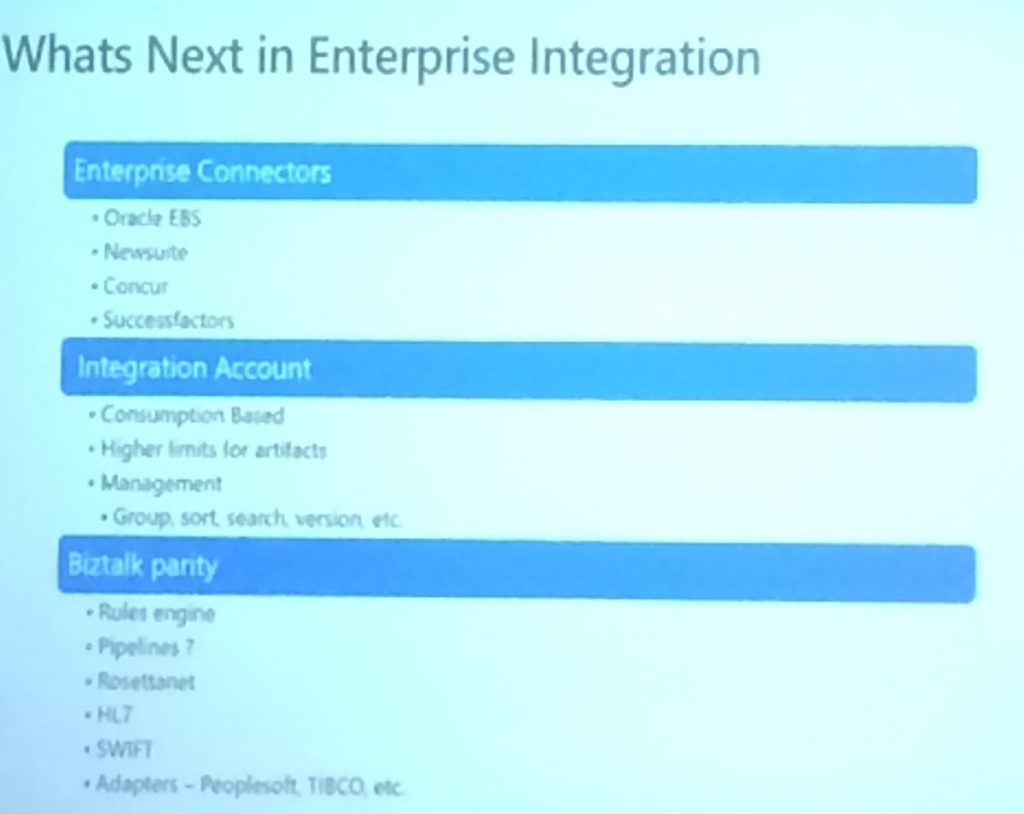
Microsoft is building tooling to automatically onboard partners and enable migration from BizTalk Server to Logic Apps. Embracing the change from taking the lead.
They are looking at reducing the DevOps time from Code -> Development -> Production
Microsoft is willing to share what they build to partners and community. Lot of integration patterns being built.
Microsoft is working on strategy to migrate from BizTalk Server to Logic Apps. How they plan to do?
Use On-Premise Gateway
Publish / Subscribe Model (work-in-progress)
The idea is to use integration workflows, publish to queues and there will be a subscriber reading from Queues to SAP / SFTP depending on the location.
They also mentioned about the categorization of Logic Apps under the following verticals:
Policy / Route
Processing
LoB (Line of Business) Adapters
Suggestion is Have Logic Apps simple and self contained.
As more protocols are being added, they will update the policies. Also help decouple platform from onboarding.
APIM Policies make it simple to drive itinerary
Policies allow for dynamic routing of messages
What properties need to be promoted can be derived from meta data
This means same logic app can be used for different partners and purposes by using routing and metadata
Exception Handling
Enumerate over failures in run scope, extract properties relevant to business
Forward to another logic app
They are suitable in Warm Path and Hot Path Monitoring.
Future Considerations
Integration Account to be used for
BizTalk Server Partner configurations
Logic Apps for Partners
Microsoft is ready with Migration strategy for the same
Logic Apps are being built suitable for isolated businesses provide offering to meet strongest SLAs
Amit demonstrated the following
TPM Management tool
Help self-service onboarding
Accelerate EDI integration
AB Testing tool
Basically, Microsoft is aimed at Simplification and Acceleration of Migration and on boarding process
Finally, they concluded the session with the learning to migrate to Logic Apps
0915 — API Management deep dive
After the first session of day 2 Vladimir Vinogradsky took the stage to talk about API Management which is one of first Azure service that developers gets introduced too.
Vladimir has started of with list of features that Azure API Management offers and how it helps developers to consume, mediate and publish their web API’s. In this he has explained how you can open the azure portal and look at the documentation of your APIs which is powered by Swagger without writing single line of code.
He also went in to detail on authentication and authorization and explained how Azure API management will help you with various authentication mechanisms from simple username password combo to Azure AD authentication etc. He also mentioned how easy it is to use third party providers such as Google, Facebook with Azure API management.
Vladimir then went into detail on what are all the frequent questions from API developers and how Azure API management can solve that. He explained this using some live demos which was well received from the audience.
1000 — Logic Apps Deep Dive
Kevin started with explaining Task Resiliency in Logic Apps
The highlight of the session was the demonstration of Integrated Service Environments (ISE) and its Architecture – but this is in the pre- private preview, means we need to wait for quite sometime.
Private Static IPs for Logic Apps are released with ISE
The deployment model of Logic Apps was also discussed with
Logic Apps now has more than 200 Custom Connectors built. The Component Architecture of Logic Apps goes was also discussed.
1115 — Logic Apps Patterns & Best Practices
Kevin started this session with introducing the following patterns:
Work Flow patterns –
Patterns are derived to implement Error Handling at work flows
Define Retry policy – turn on/off retries, custom retries at custom and fixed rate as required for business.
Run After patterns help in running logic apps after failure or time out. Limit can also be set for eg. You can stop Logic App execution after 30 seconds
Patterns for Termination of execution of Logic Apps and associated Run Actions
Scopes will have final status of all actions in that scope
Implementation of Try-Catch-Finally in Logic Apps
Concurrency Control for
Runs
Instances are created concurrently
Singleton trigger executions include level parallelism
Degrees of parallel execution can be defined
Parallel Actions
Explicit Parallelizations
Join with Run After patterns
For Each Loops
Do Until Loops
Patterns are discussed for Scheduling Executions. Example workloads can be clean up jobs
Logic Apps can execute Run Once jobs. Example workloads can be time based jobs i.e. when you want to fire the action
Logic Apps support Messaging Protocols like:
REST/SOAP
Workflow Invocation
Queues
Pub/Sub
Event Streams
Eventing
These provide workflow invocation and componentization of Logic Apps
Messaging Patterns
Kevin then discussed the patterns for messaging that are categorized as
Messaging Communication Patterns
Messaging Handling Patterns
Derek Li provided some Best Practices
Working with Variables
Variables in Logic Apps are global in scope
Array is heterogenous
Care needs to be taken when using variables in parallel for-each loop
Sequential for-each comes handy for having order
Derek Li made an impressive demo on how to efficiently use collections and parallel executions to process messages working with Arrays.
He also made a comparison of executing an array in Logic Apps in different possibilities that provided interesting inference.
He also made a comparison of executing an array in Logic Apps in different possibilities that provided interesting inference.
1200 — Microsoft Integration Roadmap
The last session before the lunch break was presented by Jon Fancey and Matt Farmer. The presentation was short and to the point. The audience got a view of the past and Microsoft plans towards future of integration.
Initially, we got a quick glimpse of all things that have been released as part of pro-integration in the past year. To emphasise that Microsoft is doing hard work in the integration space Jon and Matt announced that Microsoft has been recognised as a leader of enterprise integration in 2018 by Gartner.
Next came the interesting stuff, what Microsoft has in plans for the Logic Apps?
Smart Designer – as seen in the other demos from Jeff and Derek they want to make the designer more user-friendly. They are looking into getting improved hints, suggestions and recommendations that actually apply to what you are using inside Azure.
Dedicated and connected – for all the companies that care about the security of their integrations, Logic Apps will be available in a vnet.
Obfuscation – another feature that will make the Logic Apps more secure within your organisation. Obfuscation will allow you to specify certain users that will be available to see the output of Logic App run.
On-Prem – Logic Apps are coming to Azure stack.
More: OAuth request trigger, China Cloud, Manage serviced identity, Testability, Manage serviced identity, Key Vault and Custom domain name for Logic Apps
Lastly, Jon and Matt revealed that they want to club every key azure integration such as Logic Apps, Event Grid, Azure Functions under one umbrella called Azure Integration Services.
The aim is to create a one-stop platform that will supply all the tools needed to fulfil your requirements in order to effortlessly bring your integrations to production in minimal time and maximum results. A platform that will allow you to run your integrations wherever you need it and however you need it, serverless or on-prem. We were told that Microsoft will provide guidance and templates across all the regions.
They finalised by acknowledging that there is still a lot to do and that many systems are not yet possible to connect with, but they strive to get everything into the platform including BizTalk, which they still see as part of the integration picture.
1330 — Post lunch, Duncan Barker, Business Development Manager at BizTalk360 thanked all the partners for their continued support. Then Saravana took stage to demonstrate the capabilities of BizTalk360 and ServiceBus360.
Highlight of this session — ServiceBus360 will be re-branded into Serverless360. For more updates, please read this blog post.
1415 – Serverless Messaging with Microsoft Azure
Steef started with introducing the concept of Severlesss with the evolution from VM -> Containers -> IaaS -> PaaS -> Serverless.
Serverless reduces Time to Market, billed at micro level unit, reduced DevOps.
Messaging in Serverless is like Down, Stay, Come i.e you retrieve message when you want and got good control over message processing
The categorization of Serverless in Azure looks like:
There are various applications for Messaging in Serverless
Financial Services
Order Processing
Logging / Telemetry
Connected Devices
Notifications / Event Driven Systems
Azure Serverless Components that support messaging are – ServiceBus, EventHub, EventGrid & Storage Queues
Steef provided lot of demo scenario for Messaging applications like
Serverless Home Automation (Used Queues & Logic Apps)
Connecting to Kafka Endpoint
Toll Booth License plate recognition, that included IoT, OCR and Serverless components. He also used functions to process images.
Pipes and Filters cloud patterns
Microservice Processing
Data and Event PipelineHe suggested some messaging considerations:
Protocol
Format
Size
Security
Frequency
Reliability
Monitoring
Networking
1450 — What’s there & what’s coming in Atomic Scope
After the session on Serverless Messaging with Microsoft Azure, Saravana took the stage to present on Atomic Scope, our brand new product from Kovai Limited. Even though there was an considerable amount of interest in Atomic Scope throughout the day 1 of integration event, most of the participants haven’t got the chance to fully experience the product due to various reasons like time constraints etc.
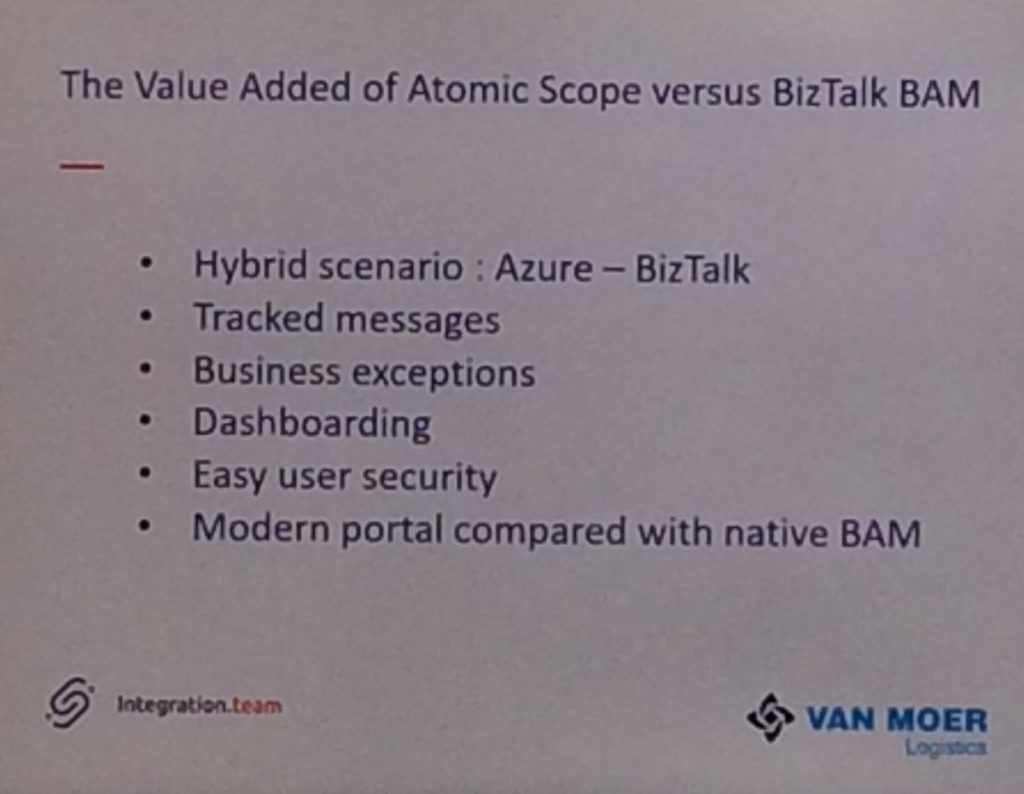
Saravana started explaining the challenges of the end to end monitoring when it comes to BizTalk and Hybrid integration scenarios and provided a couple example business process belonging to different domains. He also then proceeded to explain list of things that Atomic Scope tries to address like security end to end business visibility etc.
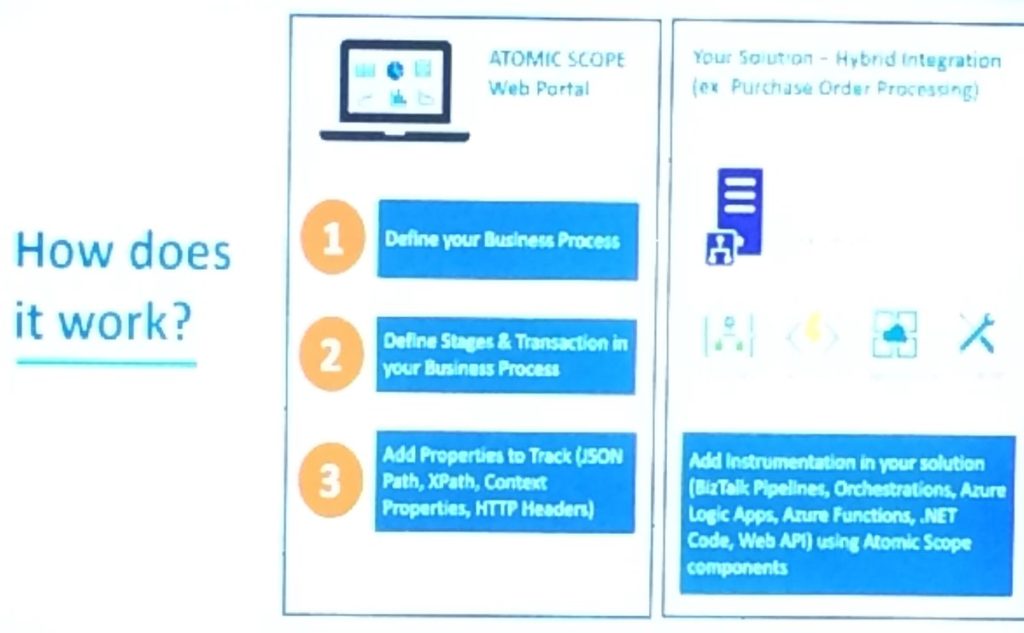
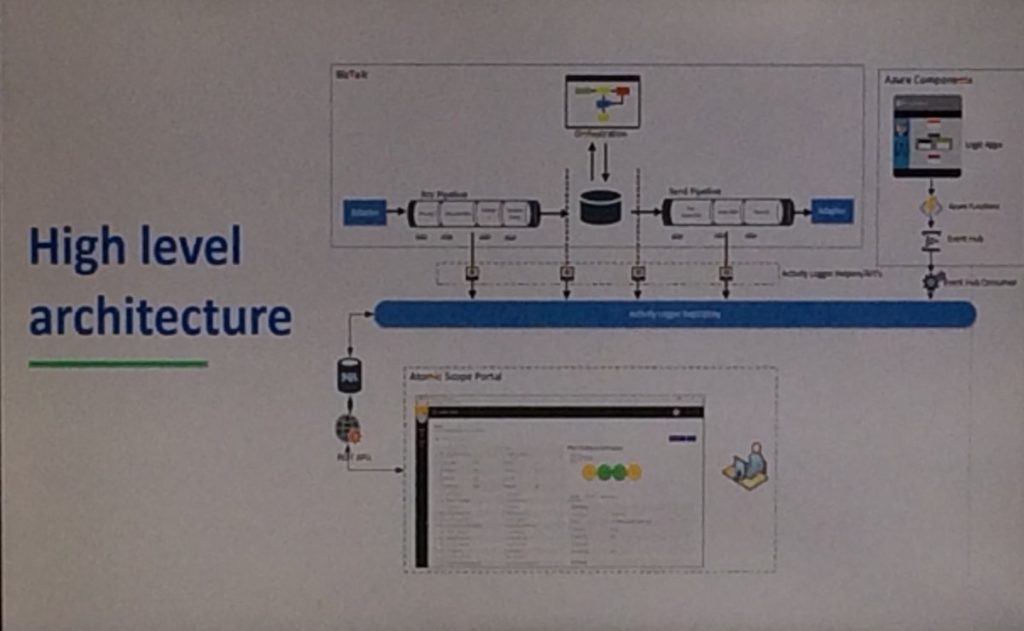
He then pointed out how much amount of effort that Atomic Scope can reduce when compared to the typical custom implementation solution for the end to end monitoring. Then Saravana went little bit deeper and explained how Atomic Scope actually works.
With that Saravana handed over the session to Bart from Integration Team and he showed how solution like BAM will not be sufficient for end to end monitoring and then he proceeded to explain a production ready atomic scope implementation which can add better value than BAM. Bart showed step by step process of how you can configure the business process and how tracking has happened once he dropped an EDI message to the APIM and On premise.
Bart’s presentation on Atomic Scope was very well received so much so that the AtomicScope booth was bombarded by participants after the presentation with people showing interest in the product and from people who was just curious to know more about the product.
1600 — BizTalk Server: Lessons from the Road
Sandro being a great lover of biz talk spoke about best practices such as making use of patterns , naming conventions , logging and tracing etc .
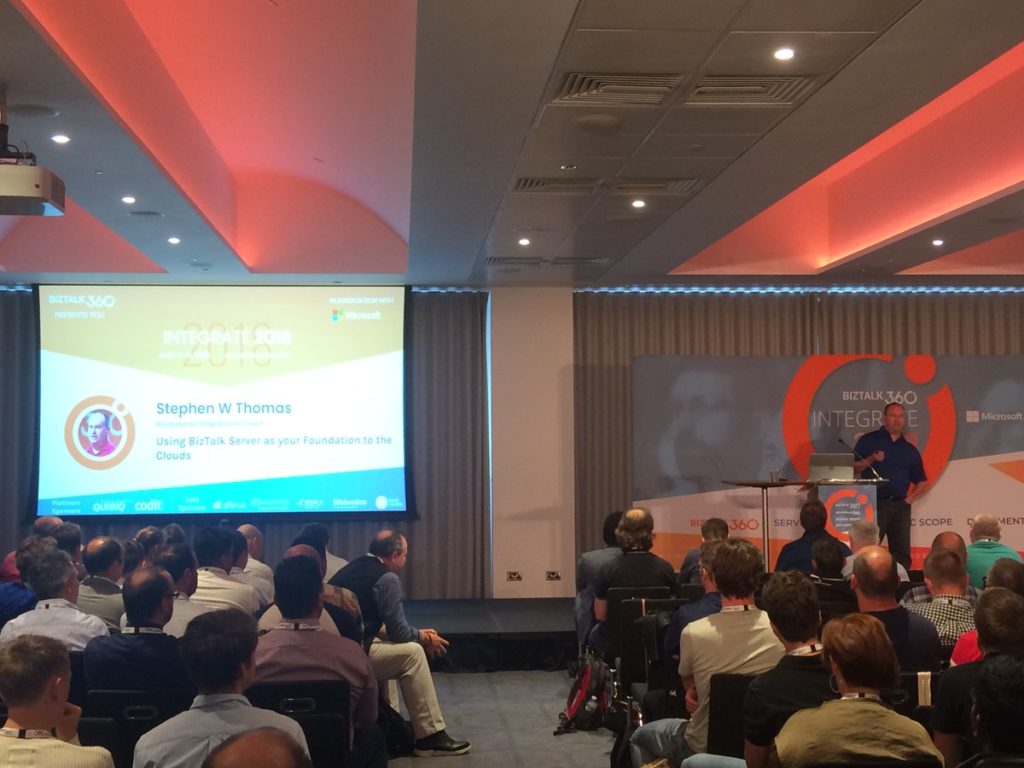
1640 — Using BizTalk Server as your Foundation to the Clouds
The last session of the day was done by Stephen M. Thomas, who gave his view on how BizTalk Server can be used as a foundation to using the cloud. Before he began his actual session, he introduced himself and mentioned a few resources he has been working on for learning purposes of Logic Apps. Amongst them are few Pluralsight trainings and hand-outs which can be found at his web site (http://www.stephenwthomas.com/labs).
The session consisted of two parts, being the Why you could use BizTalk Server combined with Logic Apps and Friction Factors which could prevent you from using them.
Why use BizTalk Server and Logic Apps
Stephen admits that Logic Apps don’t fit all scenarios. For example, in case your integrations are 100% on-premise or you have a low latency scenario at had, you could decide to stick with BizTalk Server. However, the following could be the reasons to start using Logic Apps:
use connectors which do not exist in BizTalk Server
load reduction on the BizTalk servers
plan for the future
save on hardware/software costs
want to become an integration demo
Stephen sketched a scenario in which the need of connector exist which are not available in BizTalk. Think of for example scenarios for:
social media monitoring, in which you need Twitter, Facebook or LinkedIn connectors
cross team communication, in which you need a Skype connector
incident management, in case you would need a ServiceNow adapter
Before Stephen showed few demos on batching and debatching with Logic Apps, he told that Logic Apps is quite good in batching, while BizTalk is not that good at it.
Friction factors
In the second part of his session, Stephen mentioned a number of factors which might prevent organisations to start using Logic Apps for your integration scenarios.
These factors included:
We already have BizTalk (so we don’t need another integration platform)
Our data is too sensitive to move it to the cloud
The infrastructure manager says No
Large learning curve for Logic Apps
Azure changes too frequently
CEO/CTO says NO to cloud
All these factors were addressed by Stephen, putting the door open to start using Logic Apps for your integrations, despite the given friction factors.w
With that, we wrapped up day 2 at INTEGRATE 2018 and it was time for the attendees to enjoy the INTEGRATE party over some drinks and music.
Read the Day 3 highlights here.
Thanks to the following people for helping me to collate this blog post—
Arunkumar Kumaresan
Umamaheswaran Manivannan
Lex Hegt
Srinivasa Mahendrakar
Daniel Szweda
Rochelle Saldanha
Author: Sriram Hariharan
Sriram Hariharan is the Senior Technical and Content Writer at BizTalk360. He has over 9 years of experience working as documentation specialist for different products and domains. Writing is his passion and he believes in the following quote – “As wings are for an aircraft, a technical document is for a product — be it a product document, user guide, or release notes”. View all posts by Sriram Hariharan
0430 — It all started early for the BizTalk360 team. Train ride, walk to the underground station, a tube ride and finally the team reached 155 Bishopsgate, etc.Venues — the event venue.
0610 — Activities sprung off in a flash to get the venue set up for the big day — pulling up banners, setting up the registration desks, and more.. But what happens when 15 people get together to do these, job done in less than an hour.
0715 — Attendees start to come in to the venue and the numbers started to increase as the clock passed 8 AM. Everything started to pick up pace as we were quite strict to maintain the event on time.
0830 — We clocked over 350+ attendees who had been given their badges and the welcome kit.
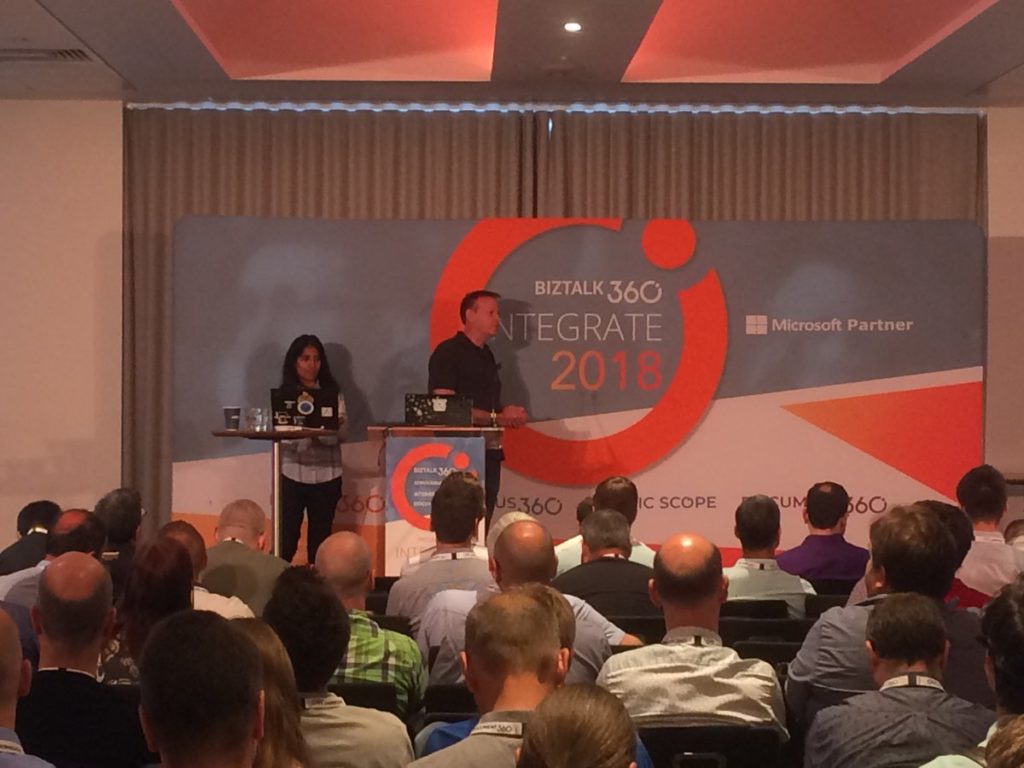
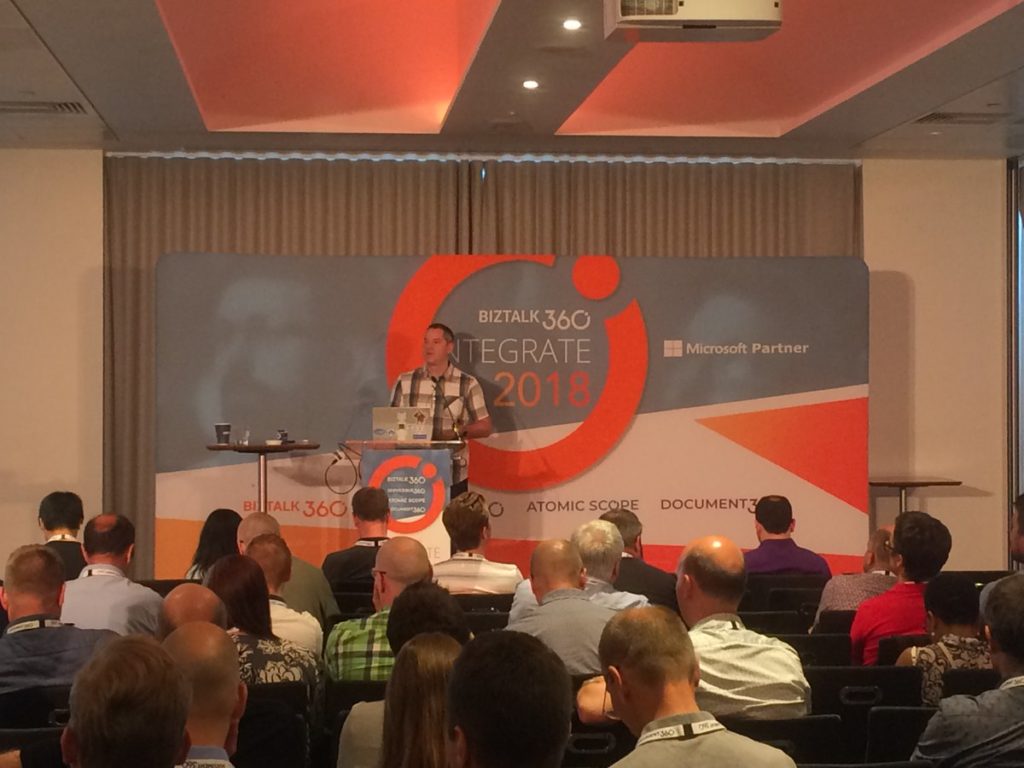
0845 — Time for Saravana Kumar, Founder/CTO of BizTalk360 to get the event going with his welcome speech. Saravana extended his thanks to all the attendees (420+), speakers, sponsors and his team for making #INTEGRATE2018 a grand success.
0855 — Saravana introduced Jon Fancey to deliver the keynote speech on “The Microsoft Integration Platform”.
0900 — Jon Fancey started his talk with the words “I wanna talk about change“. His talk was focused on history, change, inevitable disruptions in the technology and Microsoft’s approach to work with partners and ISVs to keep up and innovate.
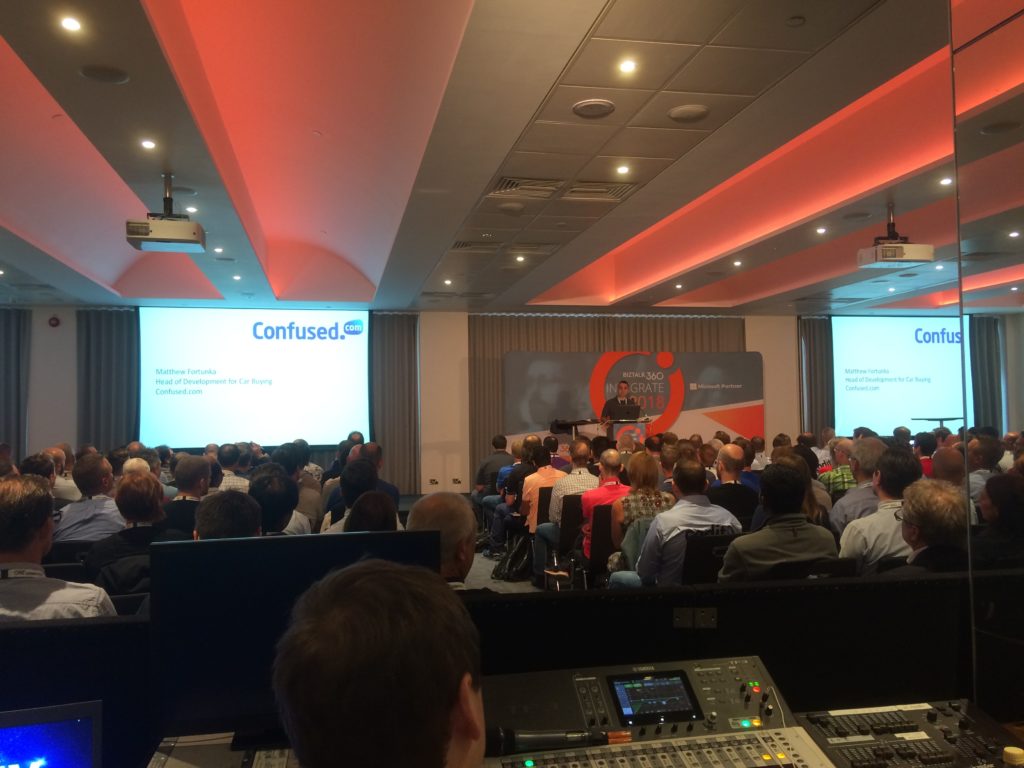
0920 — Jon Fancey presented a case study about Confused.com and introduced Mathew Fortunka, Head of development for car buying at Confused.com. Some of the very interesting insights from the talk of Mathew Fortunka were — Confused.com’s pricing flow is powered by Azure Service Bus and includes a consumption based model. He explained how Confused.com delivers the best price to customers.
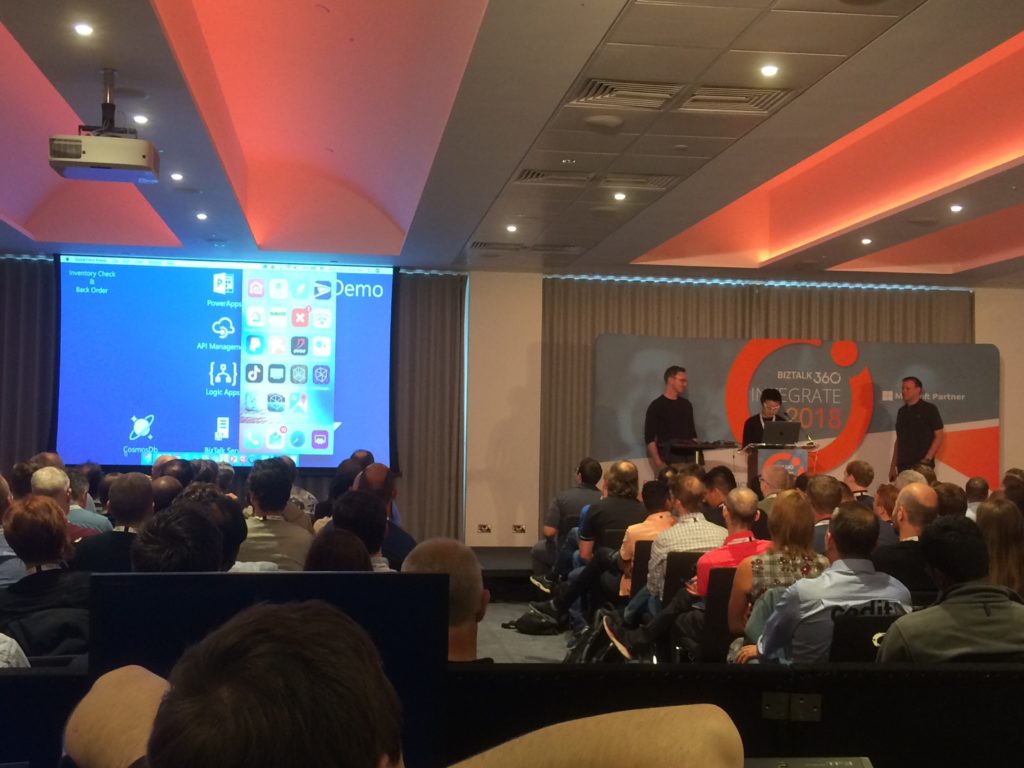
0935 — Jon Fancey sets up the context for #INTEGRATE2018 with the fictional “Contoso Retail” example (very similar to the Contoso Fitness example they showed during INTEGRATE 2017). He showed how the traditional Contoso example can change with the Integration concepts, and how Microsoft is using IPaaS offerings in their supply chain solutions. The Contoso Retail is divided into four pieces —
Inventory check and back order,
Order processing and send to supplier,
Register delivery and alerting the customer,
Pick up and charge the credit card
Key updates from this fictional example were —
VNET integration for Azure Logic Apps
Private preview of bi-directional SAP trigger for Azure Logic Apps
Demo using a Logic Apps trigger based on a SAP webhook trigger with the webhook registered in the gateway
Private hosting of Azure Logic Apps using Integration Service Environments (ISE)
1005 — Just one hour into #INTEGRATE2018 and already few key announcements from the Microsoft Pro Integration team. This got the audience definitely interested and to look forward for more in the day / over the next few days. Jon Fancey wrapped up his talk with the recap of the key announcements during the talk and a quote from Satya Nadella, Microsoft CEO.
1015 — Second session of the day by Kevin Lam and Derek Li on “Introduction to Logic Apps“. Kevin started off with the question of “How many in this room have known/worked on Logic Apps?”. 50-60% of the audience raised their hand and this shows how popular Logic Apps is in the Integration space. Then, Kevin Lam explained about the basics of Azure Logic Apps for people who were new to the concept. Logic Apps has over 200+ connectors. Kevin showed the triggers that are available with Logic Apps.
1027 — Derek Li showed how easy it is to move from “Hello World” to Integration Hero in just 5 minutes with an interesting demo. The power of having Azure and using Machine Learning, Artificial Intelligence to the integration process really propels you to become an Integration hero.
Post the demo, Derek continued his talk and showed how you can get the same experience as in the Logic App designer in Visual Studio (for developers). Kevin also showcased a weather forecast demo in just a few clicks.
The second demo scenario was even an interesting one with a little complexity added to it — receiving an invoice, using Optical Character Recognition (OCR) to read the image and Azure Function to process the text in the image, and send an email if the amount in the invoice accounted to more than $10.
New Logic App features —
Running Logic Apps in China Cloud
Smart(er) designer – with AI – better predictive management of connector operations make it even faster
Dedicated and connected – on the ISE
Testability
On-premise (Azure Stack)
Managed Service Identity (MSI) – LA can have its own identity and access your system
OAuth request trigger
Output property obfuscation
Key Vault Support
1045 – Networking break time over some coffee
1115 — Jeff Hollan started his talk by saying “INTEGRATE is one of his favourite conference to attend and he loves coming here every year”. Jeff kicked off with a one liner explanation of “What is Azure Functions?”
Then Jeff went deeper into the Azure Functions concepts such as Trigger, Bindings. Jeff showed a nice demo of how you can create an Azure Function using Visual Studio.
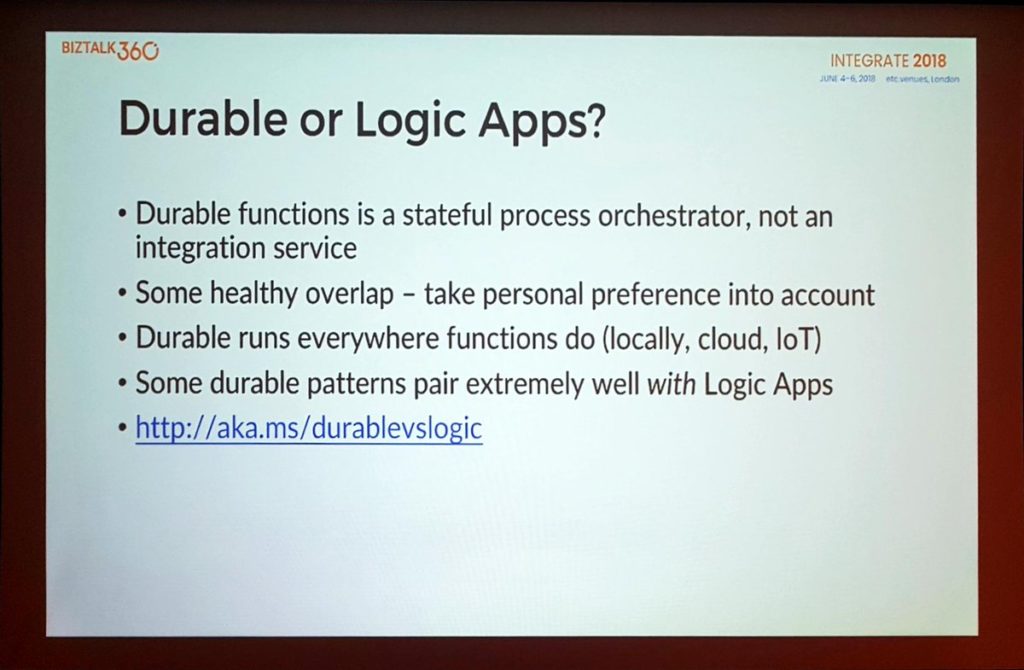
Jeff wrapped up his session by giving best practice tips for Azure Functions and the ways in which you can run Azure Functions. Jeff also spoke about Durable Functions and the limitations/tips to use Durable functions. Jeff gave a nice comparison of when you should use Durable and Logic Apps.
1200 — Paul Larsen and Valerie Robb took the stage to talk about “Hybrid integration with Legacy Systems”. They started off with whats coming in BizTalk Server 2016 and the most important update was the announcement of BizTalk Server 2016 Cumulative Update (CU) 5. They also showed the traditional BizTalk Server life cycle diagram that showed that just a month is left ahead for support to end for BizTalk Server 2013 and BizTalk Server 2013 R2.
Paul also pointed about the BizTalk Server Migration Tool, which will make migration from these versions to BizTalk Server 2016 easier.
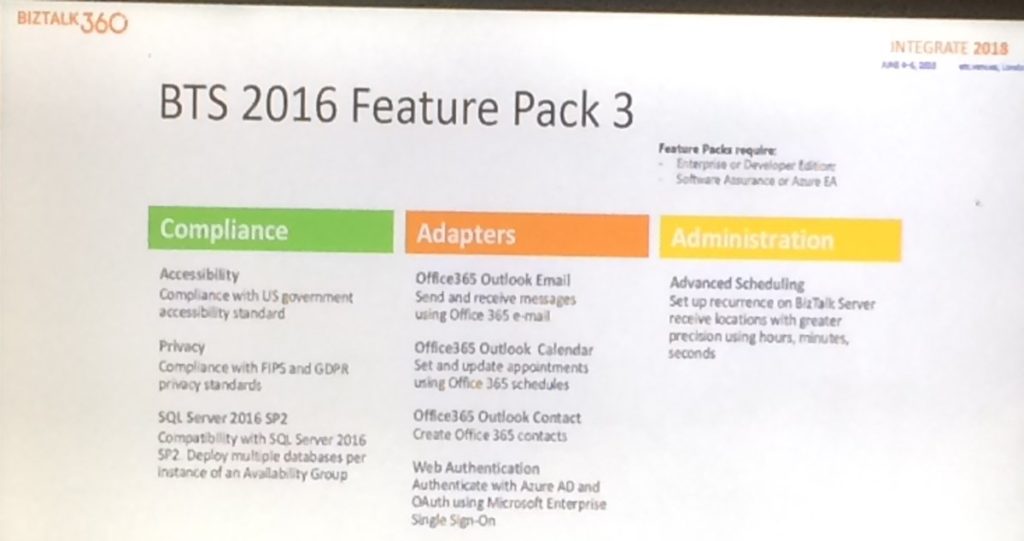
BizTalk Server 2016 Feature Pack 3
Paul announced the availability of BizTalk Server 2016 Feature Pack 3 by the end of June 2018. This Feature Pack will contain, amongst others, the following features:
Compliance:
Accessibility – compliance to US government accessibility standard
Privacy – compliance with GDPR and FIPS privacy standard
Support of SQL Server 2016 SP2
Adapters:
Office 365 Outlook Email
Office 365 Outlook Calendar
Office 365 Outlook Contacts
Web Authentication
Administration:
Advanced Scheduling
The good thing of SQL Server 2016 SP2 support is, that when you have an Always On setup with Availability Group, you can have multiple BizTalk databases in the same SQL Instance, thereby cutting down license and operation costs.
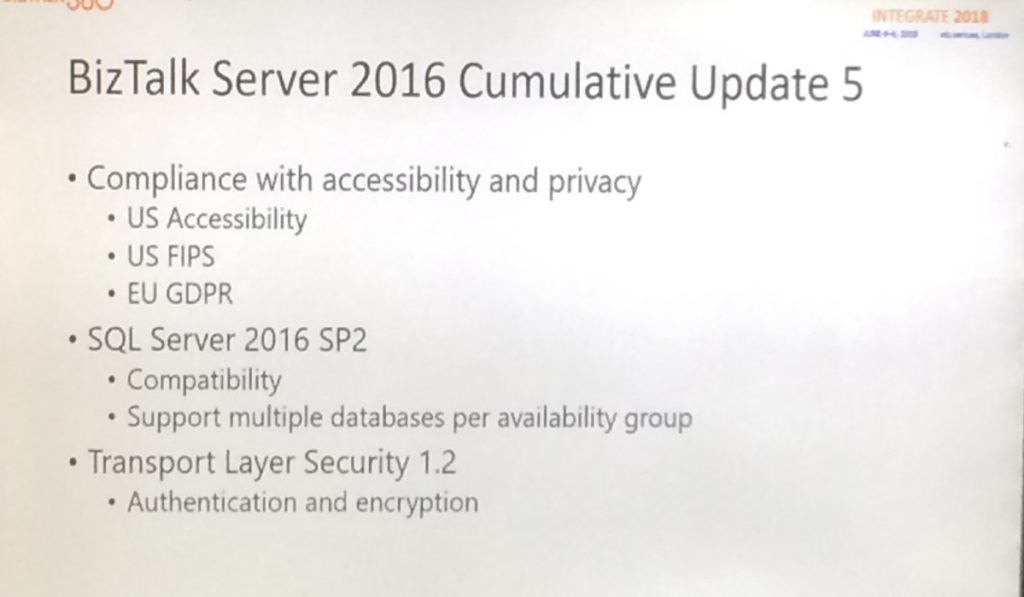
Besides FP3, the BizTalk team is also working on BizTalk Server CU 5, which is expected for coming July. Few months later, there will also be a CU5, which contains Feature Pack 3.
CU 5 will contain the following:
compliance with US Accessibility
US FIPS
EU GDPR
SQL Server 2016 SP 2 (multiple databases per Availability Group
TLS 1.2
1245 — Lunch time
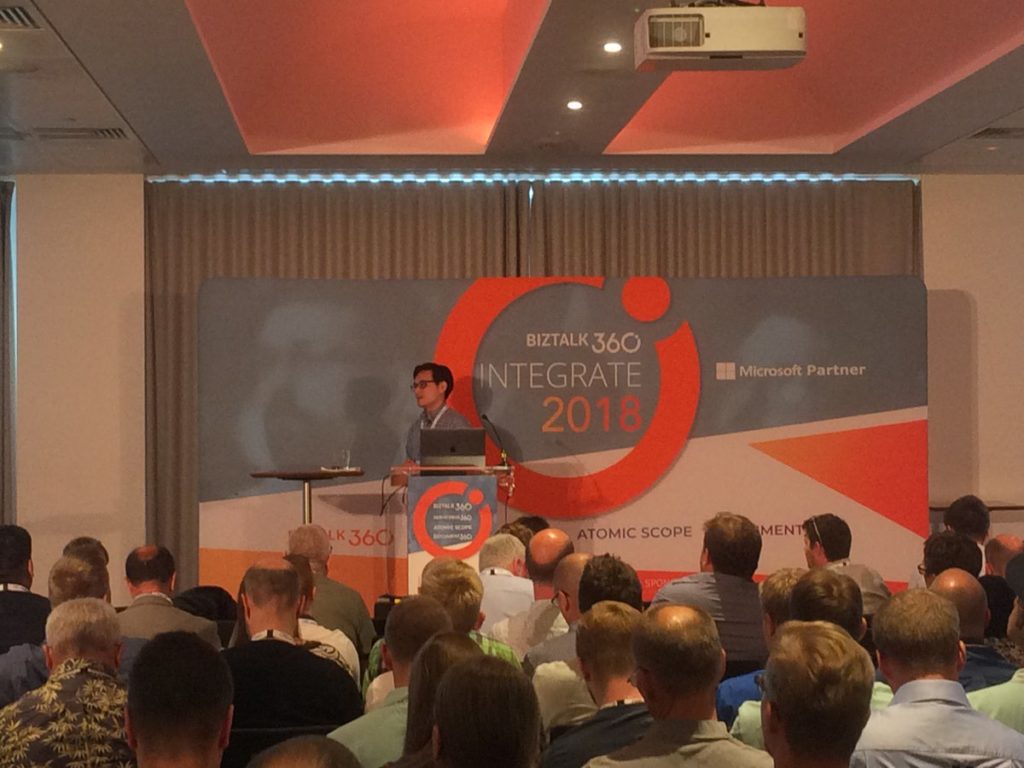
1345 — Post lunch, it was time for Miao Jiang from the Microsoft API Management team to talk about “Azure API Management Overview“.
During this session, Miao started with telling about the importance of API`s which started in the periphery but are now in the core of Enterprise IT. Nowadays, API’s can be considered the default way to do it.
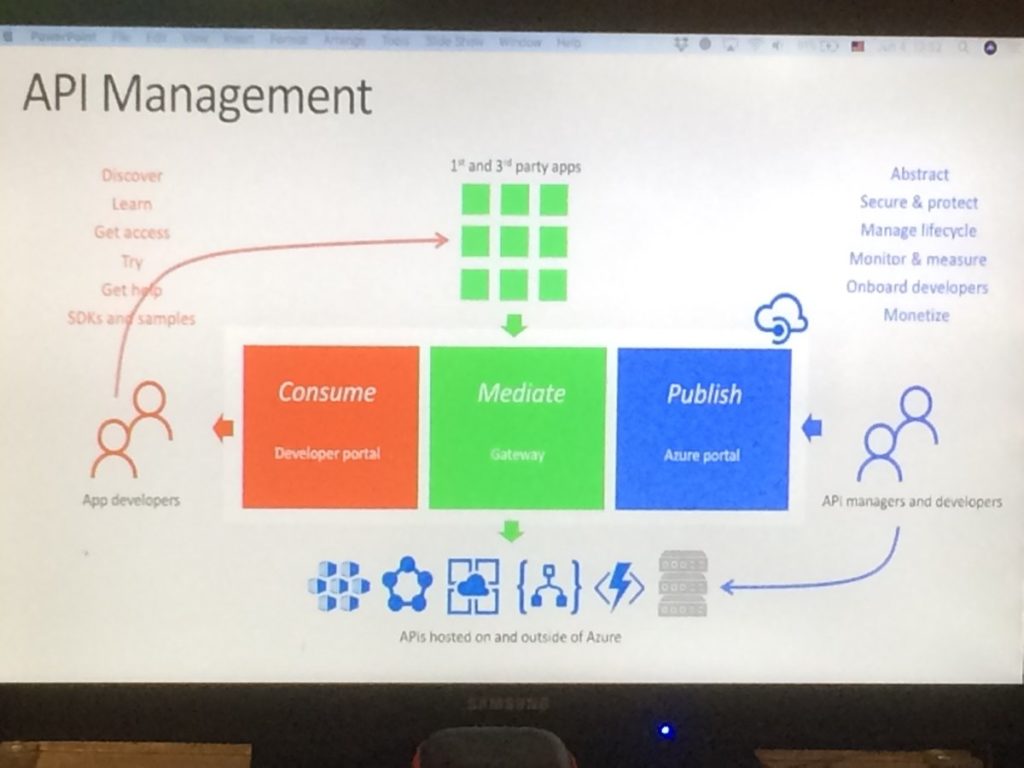
Miao explained both the Publish side and the Consumption side of API’s and told about the steps to take with API Management, being:
Consume – use the Developer portal
Mediate – that’s done in the Gateway
Publish – use the Azure portal
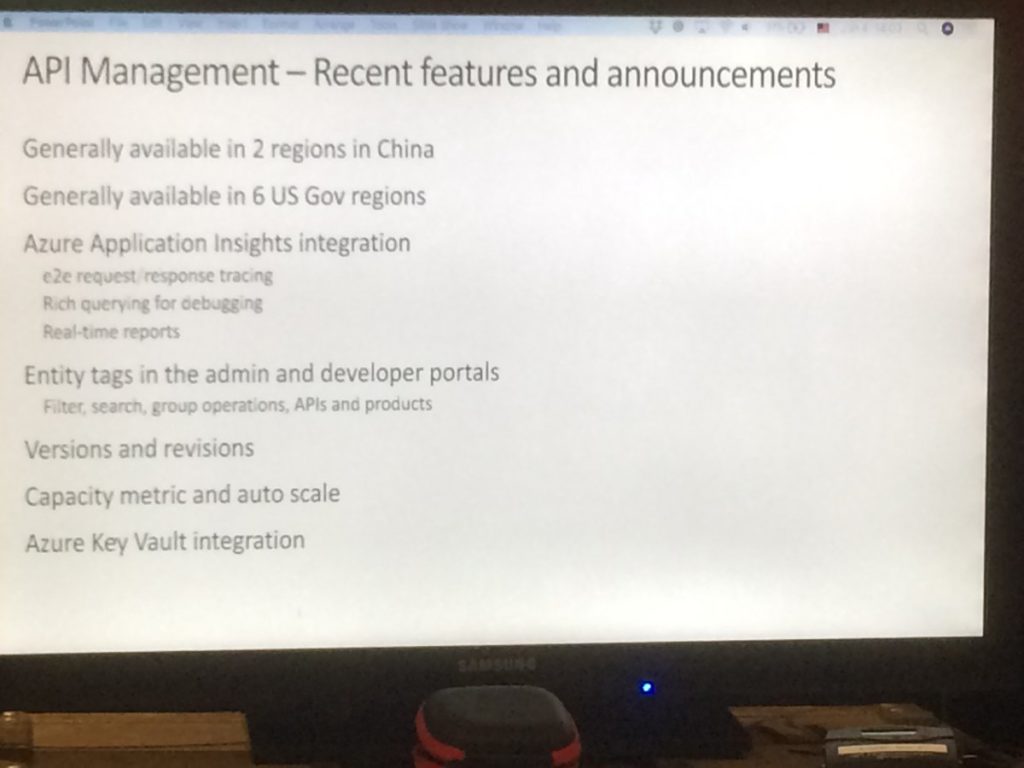
Next, he spoke about encapsulating common API functions like access control, protection, transformation and caching via API Policies. After also telling about Policy Expressions, he updated the audience on the recent features and announcements.
Recent features and announcements
Here’s the overview:
General Availability of 2 Chinese regions
General Availability of 6 US Governmental regions
Integration with Azure App Insights
Support of Entity Tags in the Admin and Dev portal
Support of Versions and Revisions
Integration with KeyVault
Miao ended his session with an extended demo, during which he showed, amongst others, how to use Policies to limit the number of requests, how non-breaking compatibility Revisions and breaking compatibility Versions work and also how to mock API’s, enabling Developers and Admins working in parallel on the same API.
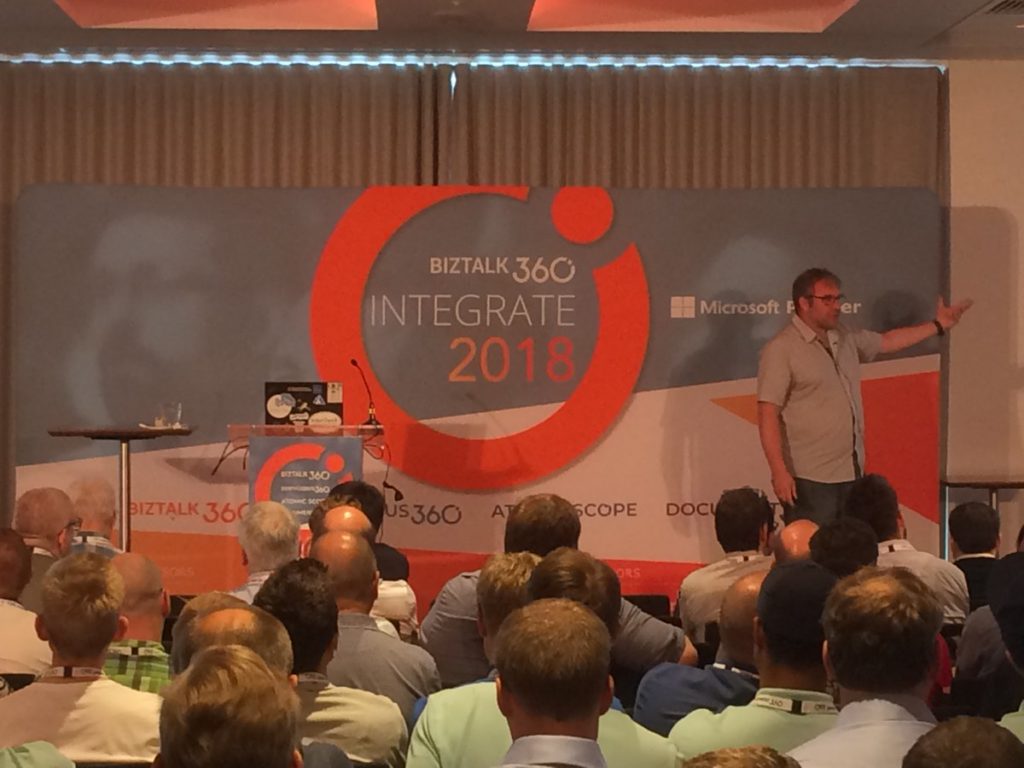
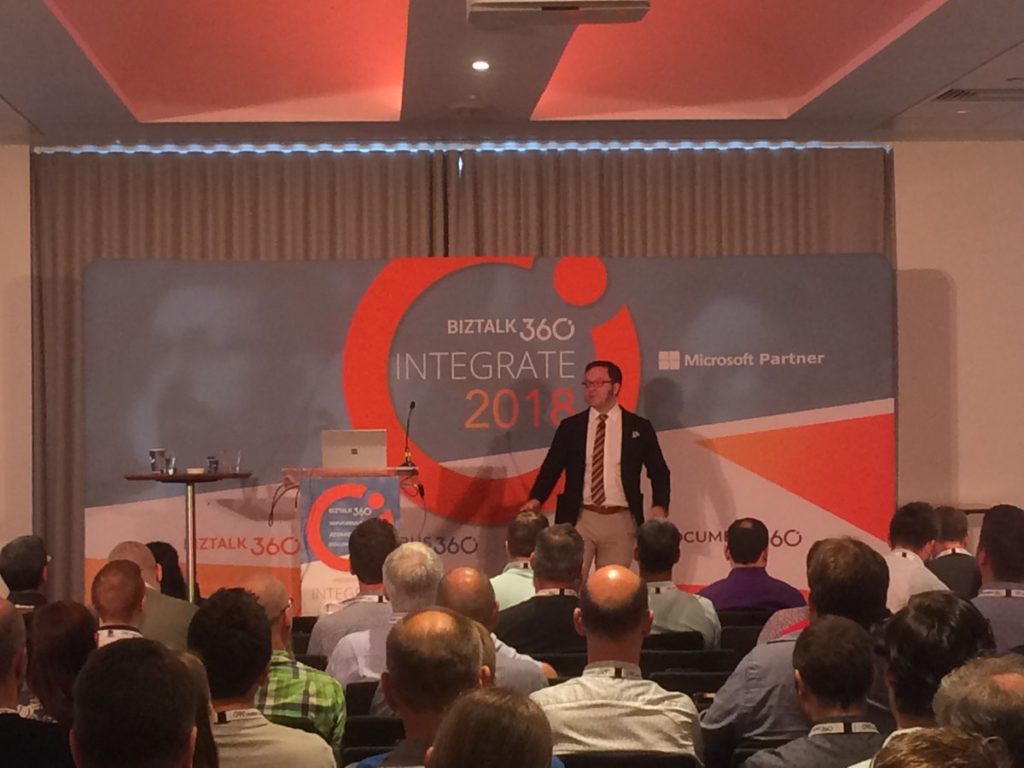
1430 – Next up was Clemens Vasters to talk on “Eventing, Serverless and the Extensible Enterprise“. Clemens set the scene by sketching few scenarios. The first scenario was around a photographer who was uploading photos to Service Bus, which triggered an Azure function to automatically resize photos to a particular size. The photos could next by ingested, via an Azure Function, to for example Lightroom, Photoshop or Newsroom app.
The second scenario was about sensor driven management, which can be used for, for example Building management. Buildings could contain sensors for, for example:
Occupance (motion sensors)
Fire/Smoke
Gaz/Bio hazard
Climate (temperature/humidity)
With that information available, it will become easy to ask all kind of questions, which can be necessary in case of, for example, an emergency.
The scenarios were just used to point out the incredible amount of possibilities with the current feature set. Clemens pointed out few of the characteristics of services, like they are autonomous and should not hold state.
Clemens concluded that the modern notion of a service is not about code artifact counts or sizes or technology choices; it is about ownership.
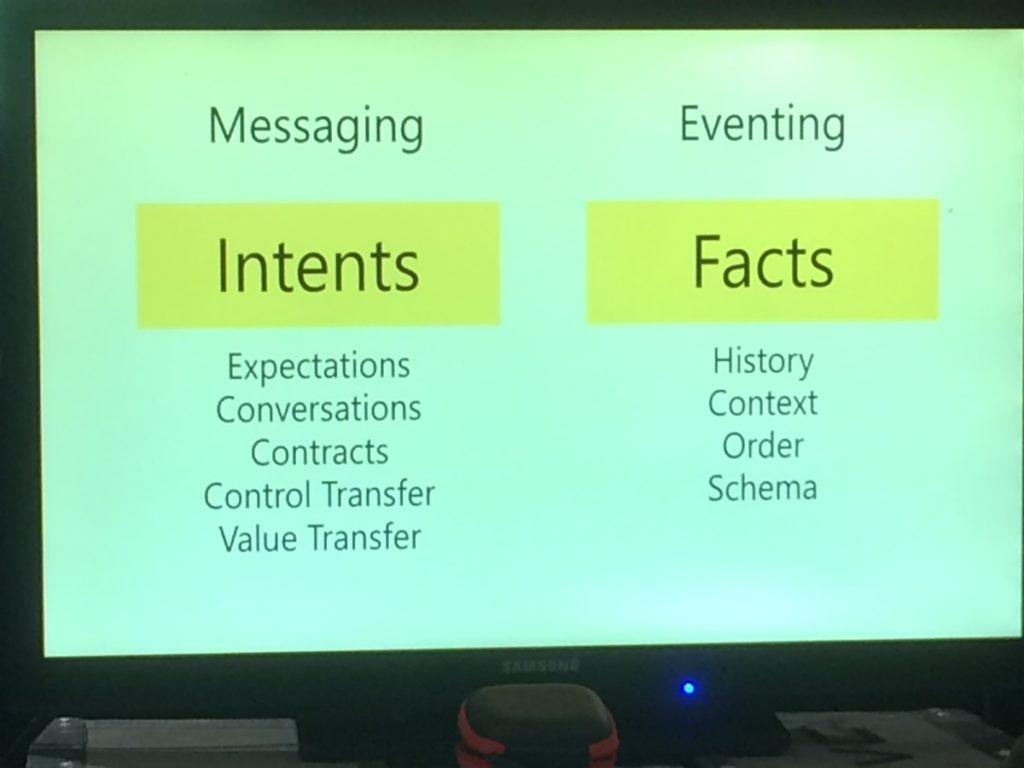
Continuing, Clemens told about Eventing and Messaging and about their characteristics and gave some examples on both.
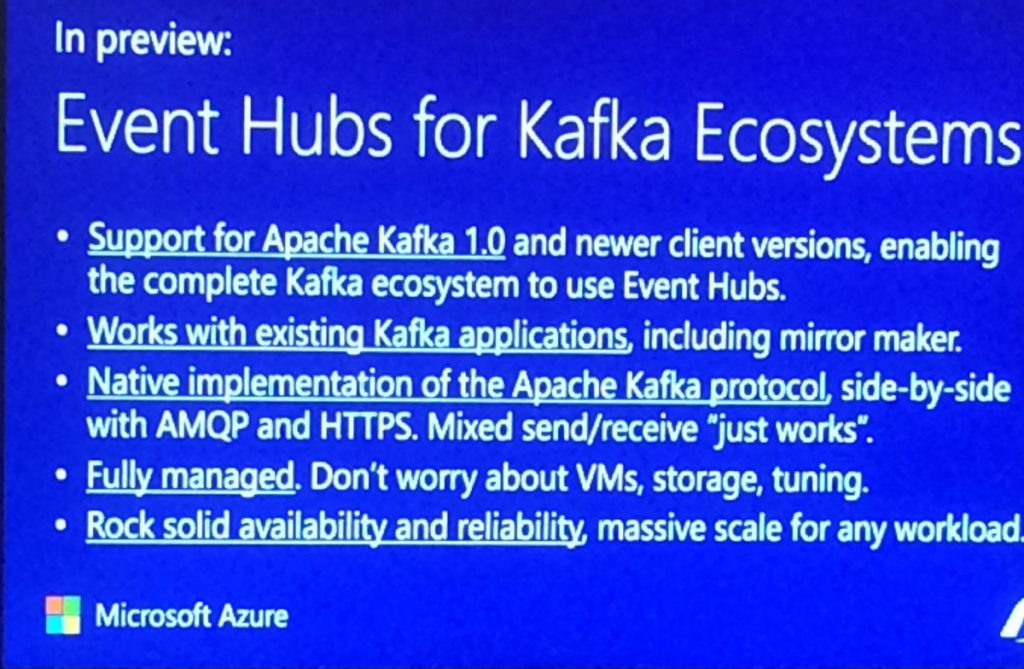
In preview: Event Hubs for the Kafka Eco system
Clemens announced that Event Hubs for Kafka Eco system is in preview. Features are:
– Supports for Apacha Kafka 1.0, enabling the complete Kafka Eco system to be used in Event Hubs
– Works with existing Kafka applications
– Native implementation of the Apache Kafka protocol
– Fully managed – don’t worry about VMs, storage and tuning
– Rock solid availability and reliability
1530 — After tea break, Dan Rosanova did a session on The Reactive Cloud: Azure Event Grid. He firstly explained the conceptual architecture of Event Hubs, with the flow from Event producers to Event Hub to Event consumers. In a simple demo, Dan showed how events could be generated, pushed to Event Hub and being received in a console application.
Dan pointed out that messaging services, like web hooks or queues, can both be publishers and subscribers to Event Grid. Dan also showed Stream Analytics, Time Series Insights and Java-based Open Source Eco system of Kafka.
1615 – Second last session of the day by Jon Fancey and Divya Swarnkar on “Enterprise Integration using Logic Apps“. Jon explained how the VETER pipeline can be used for enterprise messaging. He continued with telling about a number of characteristics of Message handling in Logic Apps. These characteristics contain:
flexibility in content types: JSON, XML
mapping: JSON-based and XML-based
data operations: compose, CSV/HTML tables
flat-file processing
message validation
EDI support
batching support
Jon continued with telling about Disaster Recovery with B2B scenarios. He told amongst others about the ability to have Primary and Secondary Integration Accounts, which can be deployed in different regions. If necessary, you can have multiple Secondary Integration Accounts. All these Secondary Integration Accounts can be replicated from the Primary one by using Logic Apps, in case changes occur in the Primary Integration Account.
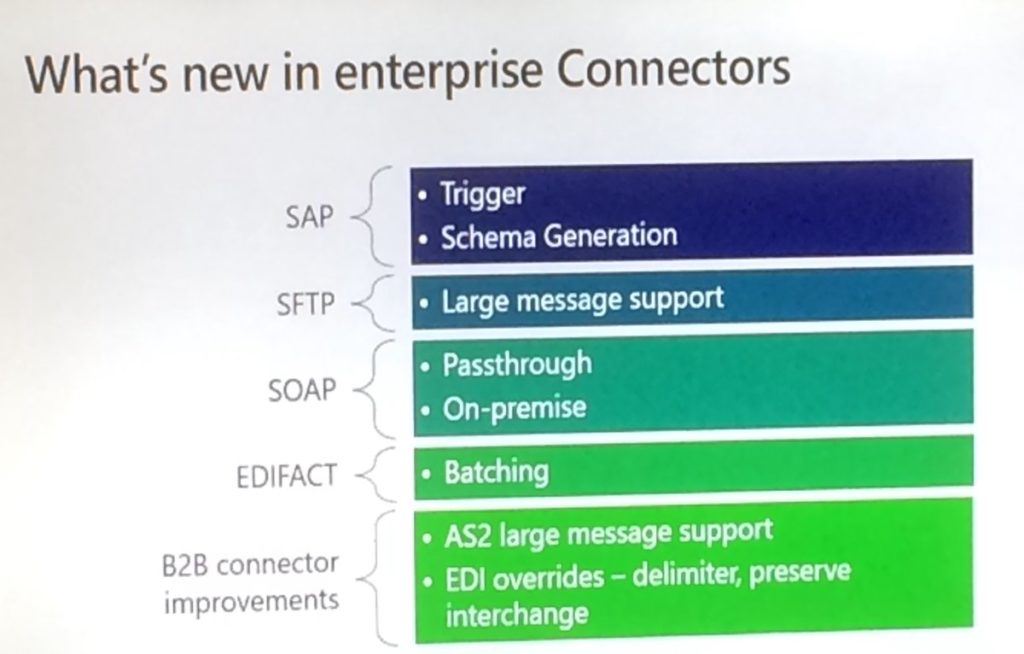
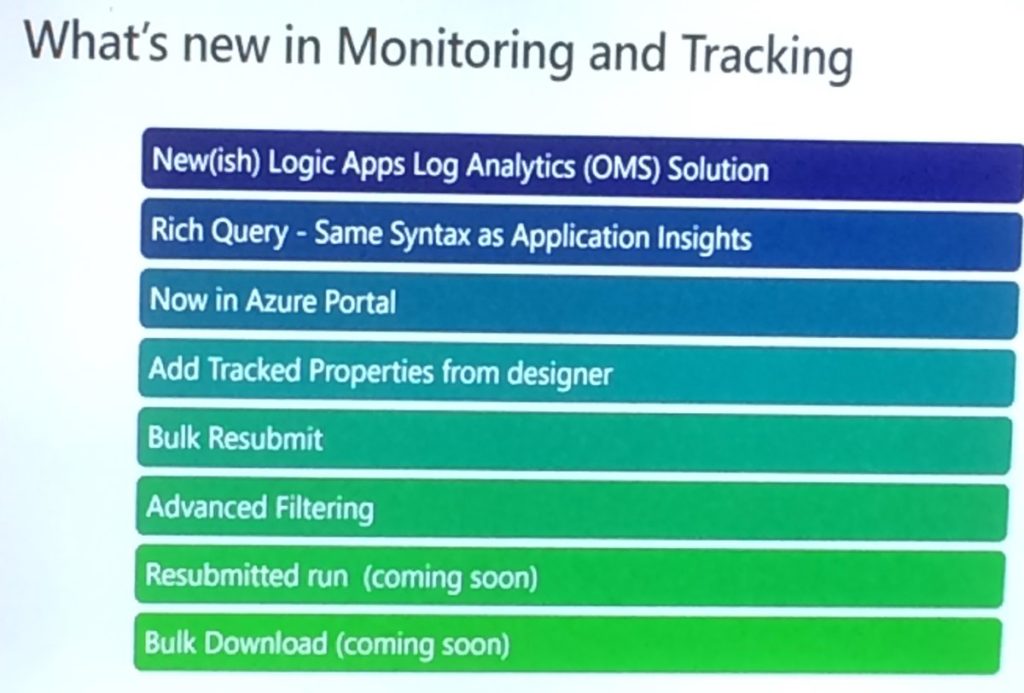
After discussing the tracking capabilities for Integration Accounts, Logic Apps, EDI, custom tracking and OMS, Jon explained what’s new to the Enterprise adapters. He mentioned the adapters for SAP, SFTP, SOAP, EDIFACT and also mentioned the B2B connector improvements like AS2 large message support and EDI overrides.
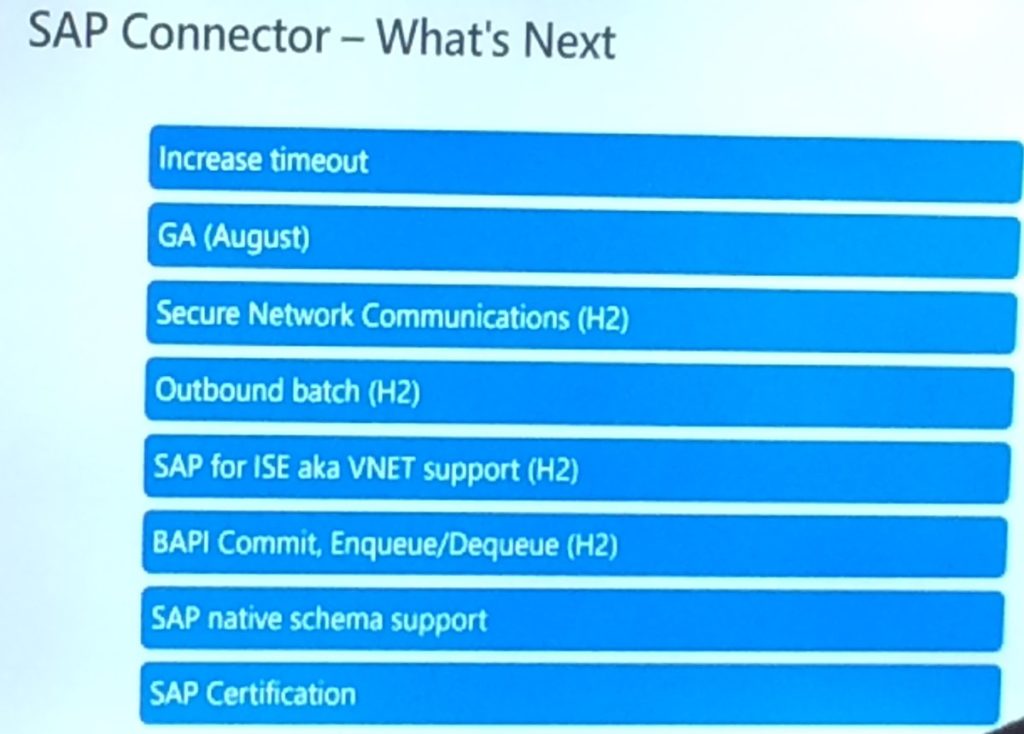
The SAP ECC connector was shown in a demo by Divya. She mentioned the pre-requirements of the adapter and in the demo she showed how to receive a message from that SAP adapter in Logic Apps and simply write the contents of that message to a file location.
The session was wrapped by mentioning what’s new in Mapping, Monitoring and Tracking and what we can expect for the SAP connector and other enterprise adapters.
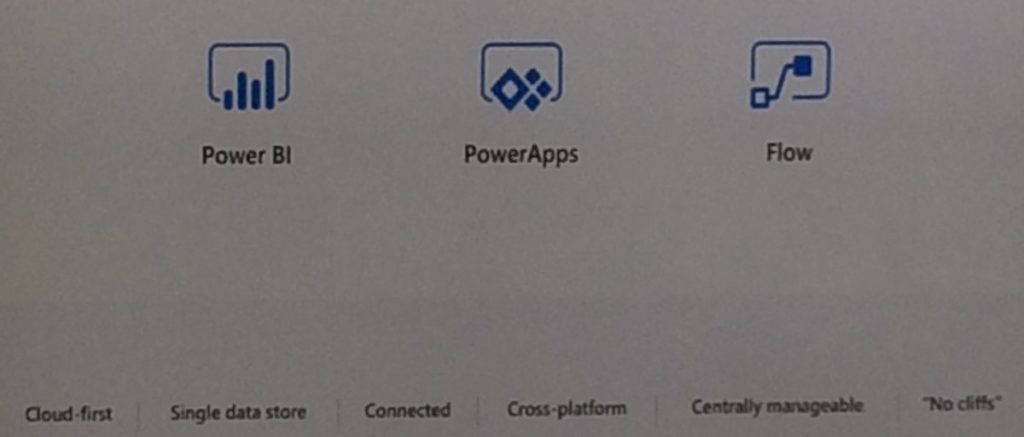
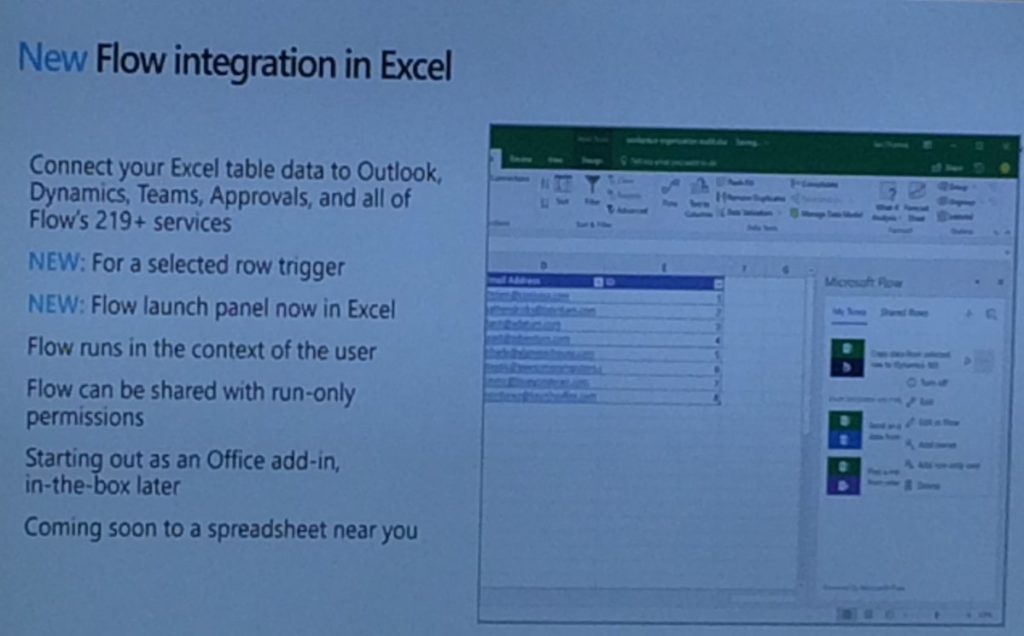
1700 — Kent’s session started with positioning Microsoft Flow, after which he explained how the product fits in the Business Application Platform. This platform consists of PowerApps (including Microsoft Flow) and Power BI.
Microsoft plans to unify these technologies to one powerful highly-productive application platform.
Momentarily, 1.2 million users, coming from over 213.000 companies, are using the platform on a monthly base.
Kent compared Microsoft Flow with MS Access, where MS Access has less to no visibility to the IT department, where (luckily) this is not the case with Microsoft Flow. Because of the better federation with Microsoft Flow, the risk of proliferation with Microsoft Flow is way less, than with Microsoft Access.
Next, Kent showed 4 demos to the audience, indicating the versatility of Microsoft Flow.
Kent concluded the session with the road map for the second and third quarter of the year. This exists of:
Improving the user experience
Office 365 integration
Compliance (GDPR, US Gov cloud deployments)
Sandbox environments for IT Pro’s, Admin, Developer
With that, it was a wrap on the session of Day 1 and time for some networking and drinks.
Stay tuned for the Day 2 blog updates.
Author: Sriram Hariharan
Sriram Hariharan is the Senior Technical and Content Writer at BizTalk360. He has over 9 years of experience working as documentation specialist for different products and domains. Writing is his passion and he believes in the following quote – “As wings are for an aircraft, a technical document is for a product — be it a product document, user guide, or release notes”. View all posts by Sriram Hariharan
This is the fifth and final post in my series around setting up CI/CD for Azure API Management using Azure Resource Manager templates. We already created our API Management instance, added products, users and groups to the instance, and created unversioned and versioned APIs. In this final post, we will see how we can use linked ARM templates in combination with VSTS to deploy our solution all at once, and how this allows us to re-use existing templates to build up our API Management.
The posts in this series are the following, this list will be updated as the posts are being published.
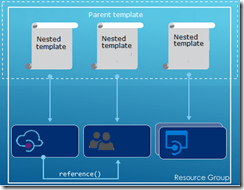
So far we did each of these steps from their own repositories, which is great when you want to have different developers only working on their own parts of the total solution. However if you don’t need this type of granular security on your repositories, it probably makes more sense to have you entire API Management solution in a single repository. When working with ARM templates, they can quickly become quite large and cumbersome to maintain. To avoid this, we can split up the template into smaller templates, which each does it’s own piece of work, and link these together from a master template. This allows for re-use of templates and breaking them down into smaller pieces of functionality. For this post we will be creating a API Management instance, create products, users and groups for Contoso, and deploy a versioned API. We will be re-using the templates we created in the previous blogposts from this series for our content.
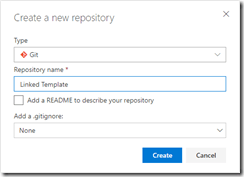
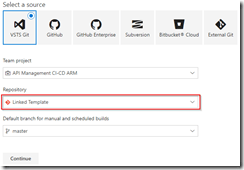
We will start by creating a new GIT repository in our VSTS project called Linked Template. This repository will hold the master and nested templates which will be used to roll out our API Management solution.
Create Linked Template repository
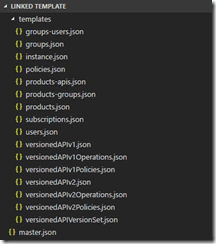
Once the repository has been created, we will clone it to our local machine, and add a folder called templates in the repository. In the templates folder, create a new file called instance.json, which will hold the following nested ARM template for the API Management instance. All the ARM templates in this post should be placed in the templates folder unless otherwise specified.
The next ARM template will hold the users of Contoso, add a users.json file to the same local repository and add the following template.
{"$schema":"https://schema.management.azure.com/schemas/2015-01-01/deploymentTemplate.json#",
"contentVersion":"1.0.0.0",
"parameters":{"APIManagementInstanceName":{"type":"string",
"defaultValue":"MyAPIManagementInstance"}},
"resources":[{"type":"Microsoft.ApiManagement/service/users",
"name":"[concat(parameters('APIManagementInstanceName'), '/john-smith-contoso-com')]",
"apiVersion":"2017-03-01",
"scale":null,
"properties":{"firstName":"John",
"lastName":"Smith",
"email":"[email protected]",
"state":"active",
"note":"Developer working for Contoso, one of the consumers of our APIs",
"confirmation":"invite"}}]}
Now add a groups.json file to the repository containing the following ARM template, this will add the groups for Contoso.
{"$schema":"https://schema.management.azure.com/schemas/2015-01-01/deploymentTemplate.json#",
"contentVersion":"1.0.0.0",
"parameters":{"APIManagementInstanceName":{"type":"string",
"defaultValue":"MyAPIManagementInstance"}},
"resources":[{"type":"Microsoft.ApiManagement/service/groups",
"name":"[concat(parameters('APIManagementInstanceName'), '/contosogroup')]",
"apiVersion":"2017-03-01",
"scale":null,
"properties":{"displayName":"ContosoGroup",
"description":"Group containing all developers and services from Contoso who will be consuming our APIs",
"type":"custom",
"externalId":null}}]}
The following ARM template will be used to add the product for Contoso, for this we are going to add products.json to the repository.
{"$schema":"https://schema.management.azure.com/schemas/2015-01-01/deploymentTemplate.json#",
"contentVersion":"1.0.0.0",
"parameters":{"APIManagementInstanceName":{"type":"string",
"defaultValue":"MyAPIManagementInstance"}},
"resources":[{"type":"Microsoft.ApiManagement/service/products",
"name":"[concat(parameters('APIManagementInstanceName'), '/contosoproduct')]",
"apiVersion":"2017-03-01",
"scale":null,
"properties":{"displayName":"ContosoProduct",
"description":"Product which will apply the high-over policies for developers and services of Contoso.",
"terms":null,
"subscriptionRequired":true,
"approvalRequired":true,
"subscriptionsLimit":null,
"state":"published"}}]}
We have created our templates for the products and groups, so the next template, which will be called products-groups.json, will link the Contoso group to the Contoso product.
Next we will create the version set which will hold the different versions of our versioned API. Add a file to the repository called versionedAPIVersionSet.json and add the following template to it.
{"$schema":"https://schema.management.azure.com/schemas/2015-01-01/deploymentTemplate.json#",
"contentVersion":"1.0.0.0",
"parameters":{"APIManagementInstanceName":{"type":"string",
"defaultValue":"MyAPIManagementInstance"}},
"resources":[{"name":"[concat(parameters('APIManagementInstanceName'), '/versionsetversionedapi')]",
"type":"Microsoft.ApiManagement/service/api-version-sets",
"apiVersion":"2017-03-01",
"properties":{"description":"Version set for versioned API blog post ",
"versionQueryName":"api-version",
"displayName":"Versioned API",
"versioningScheme":"query"}}]}
We will now add the template for the first version of the versioned API, by creating a file in the repository called versionedAPIv1.json.
{"$schema":"https://schema.management.azure.com/schemas/2015-01-01/deploymentTemplate.json#",
"contentVersion":"1.0.0.0",
"parameters":{"APIManagementInstanceName":{"type":"string",
"defaultValue":"MyAPIManagementInstance"}},
"resources":[{"type":"Microsoft.ApiManagement/service/apis",
"name":"[concat(parameters('APIManagementInstanceName'), '/versioned-api')]",
"apiVersion":"2017-03-01",
"scale":null,
"properties":{"displayName":"Versioned API",
"apiRevision":"1",
"description":"Wikipedia for Web APIs. Repository of API specs in OpenAPI(fka Swagger) 2.0 format.nn**Warning**: If you want to be notified about changes in advance please subscribe to our [Gitter channel](https://gitter.im/APIs-guru/api-models).nnClient sample: [[Demo]](https://apis.guru/simple-ui) [[Repo]](https://github.com/APIs-guru/simple-ui)n",
"serviceUrl":"https://api.apis.guru/v2/",
"path":"versioned-api",
"protocols":["https"],
"authenticationSettings":null,
"subscriptionKeyParameterNames":null,
"apiVersion":"v1",
"apiVersionSetId":"[concat(resourceId('Microsoft.ApiManagement/service', parameters('APIManagementInstanceName')), '/api-version-sets/versionsetversionedapi')]"}}]}
Operations
For the first version of the API we will now add a file called versionedAPIv1Operations.json which will hold the various operations of this API.
{"$schema":"https://schema.management.azure.com/schemas/2015-01-01/deploymentTemplate.json#",
"contentVersion":"1.0.0.0",
"parameters":{"APIManagementInstanceName":{"type":"string",
"defaultValue":"MyAPIManagementInstance"}},
"resources":[{"type":"Microsoft.ApiManagement/service/apis/operations",
"name":"[concat(parameters('APIManagementInstanceName'), '/versioned-api/getMetrics')]",
"apiVersion":"2017-03-01",
"scale":null,
"properties":{"displayName":"Get basic metrics",
"method":"GET",
"urlTemplate":"/metrics",
"templateParameters":[],
"description":"Some basic metrics for the entire directory.nJust stunning numbers to put on a front page and are intended purely for WoW effect :)n",
"responses":[{"statusCode":200,
"description":"OK",
"headers":[]}],
"policies":null}},
{"type":"Microsoft.ApiManagement/service/apis/operations",
"name":"[concat(parameters('APIManagementInstanceName'), '/versioned-api/listAPIs')]",
"apiVersion":"2017-03-01",
"scale":null,
"properties":{"displayName":"List all APIs",
"method":"GET",
"urlTemplate":"/list",
"templateParameters":[],
"description":"List all APIs in the directory.nReturns links to OpenAPI specification for each API in the directory.nIf API exist in multiple versions `preferred` one is explicitly marked.nnSome basic info from OpenAPI spec is cached inside each object.nThis allows to generate some simple views without need to fetch OpenAPI spec for each API.n",
"responses":[{"statusCode":200,
"description":"OK",
"headers":[]}],
"policies":null}}]}
Policies
The policies for the first version of our API are next, lets add the versionedAPIv1Policies.json file for this.
{"$schema":"https://schema.management.azure.com/schemas/2015-01-01/deploymentTemplate.json#",
"contentVersion":"1.0.0.0",
"parameters":{"APIManagementInstanceName":{"type":"string",
"defaultValue":"MyAPIManagementInstance"}},
"resources":[{"type":"Microsoft.ApiManagement/service/apis/operations/policies",
"name":"[concat(parameters('APIManagementInstanceName'), '/versioned-api/getMetrics/policy')]",
"apiVersion":"2017-03-01",
"scale":null,
"properties":{"policyContent":"[concat('<!--rn IMPORTANT:rn - Policy elements can appear only within the <inbound>, <outbound>, <backend> section elements.rn - Only the <forward-request> policy element can appear within the <backend> section element.rn - To apply a policy to the incoming request (before it is forwarded to the backend service), place a corresponding policy element within the <inbound> section element.rn - To apply a policy to the outgoing response (before it is sent back to the caller), place a corresponding policy element within the <outbound> section element.rn - To add a policy position the cursor at the desired insertion point and click on the round button associated with the policy.rn - To remove a policy, delete the corresponding policy statement from the policy document.rn - Position the <base> element within a section element to inherit all policies from the corresponding section element in the enclosing scope.rn - Remove the <base> element to prevent inheriting policies from the corresponding section element in the enclosing scope.rn - Policies are applied in the order of their appearance, from the top down.rn-->rn<policies>rn <inbound>rn <base />rn <set-backend-service base-url="https://api.apis.guru/v2/" />rn <rewrite-uri template="/metrics.json" />rn </inbound>rn <backend>rn <base />rn </backend>rn <outbound>rn <base />rn </outbound>rn <on-error>rn <base />rn </on-error>rn</policies>')]"}},
{"type":"Microsoft.ApiManagement/service/apis/operations/policies",
"name":"[concat(parameters('APIManagementInstanceName'), '/versioned-api/listAPIs/policy')]",
"apiVersion":"2017-03-01",
"scale":null,
"properties":{"policyContent":"[concat('<!--rn IMPORTANT:rn - Policy elements can appear only within the <inbound>, <outbound>, <backend> section elements.rn - Only the <forward-request> policy element can appear within the <backend> section element.rn - To apply a policy to the incoming request (before it is forwarded to the backend service), place a corresponding policy element within the <inbound> section element.rn - To apply a policy to the outgoing response (before it is sent back to the caller), place a corresponding policy element within the <outbound> section element.rn - To add a policy position the cursor at the desired insertion point and click on the round button associated with the policy.rn - To remove a policy, delete the corresponding policy statement from the policy document.rn - Position the <base> element within a section element to inherit all policies from the corresponding section element in the enclosing scope.rn - Remove the <base> element to prevent inheriting policies from the corresponding section element in the enclosing scope.rn - Policies are applied in the order of their appearance, from the top down.rn-->rn<policies>rn <inbound>rn <base />rn <set-backend-service base-url="https://api.apis.guru/v2" />rn <rewrite-uri template="/list.json" />rn </inbound>rn <backend>rn <base />rn </backend>rn <outbound>rn <base />rn </outbound>rn <on-error>rn <base />rn </on-error>rn</policies>')]"}}]}
And now we will add the second version of our versioned API as well, in a file called versionedAPIv2.json.
{"$schema":"https://schema.management.azure.com/schemas/2015-01-01/deploymentTemplate.json#",
"contentVersion":"1.0.0.0",
"parameters":{"APIManagementInstanceName":{"type":"string",
"defaultValue":"MyAPIManagementInstance"}},
"resources":[{"type":"Microsoft.ApiManagement/service/apis",
"name":"[concat(parameters('APIManagementInstanceName'), '/versioned-api-v2')]",
"apiVersion":"2017-03-01",
"scale":null,
"properties":{"displayName":"Versioned API",
"apiRevision":"1",
"description":"Wikipedia for Web APIs. Repository of API specs in OpenAPI(fka Swagger) 2.0 format.nn**Warning**: If you want to be notified about changes in advance please subscribe to our [Gitter channel](https://gitter.im/APIs-guru/api-models).nnClient sample: [[Demo]](https://apis.guru/simple-ui) [[Repo]](https://github.com/APIs-guru/simple-ui)n",
"serviceUrl":"https://api.apis.guru/v2/",
"path":"versioned-api",
"protocols":["https"],
"authenticationSettings":null,
"subscriptionKeyParameterNames":null,
"apiVersion":"v2",
"apiVersionSetId":"[concat(resourceId('Microsoft.ApiManagement/service', parameters('APIManagementInstanceName')), '/api-version-sets/versionsetversionedapi')]"}}]}
Operations
Add the operations for the second version of our API in a file called versionedAPIv2Operations.json.
{"$schema":"https://schema.management.azure.com/schemas/2015-01-01/deploymentTemplate.json#",
"contentVersion":"1.0.0.0",
"parameters":{"APIManagementInstanceName":{"type":"string",
"defaultValue":"MyAPIManagementInstance"}},
"resources":[{"type":"Microsoft.ApiManagement/service/apis/operations",
"name":"[concat(parameters('APIManagementInstanceName'), '/versioned-api-v2/listAPIs')]",
"apiVersion":"2017-03-01",
"scale":null,
"properties":{"displayName":"List all APIs",
"method":"GET",
"urlTemplate":"/list",
"templateParameters":[],
"description":"List all APIs in the directory.nReturns links to OpenAPI specification for each API in the directory.nIf API exist in multiple versions `preferred` one is explicitly marked.nnSome basic info from OpenAPI spec is cached inside each object.nThis allows to generate some simple views without need to fetch OpenAPI spec for each API.n",
"responses":[{"statusCode":200,
"description":"OK",
"headers":[]}],
"policies":null}}]}
Policies
And add a file called versionedAPIv2Policies.json which will hold the policies for the second version of our versioned API.
{"$schema":"https://schema.management.azure.com/schemas/2015-01-01/deploymentTemplate.json#",
"contentVersion":"1.0.0.0",
"parameters":{"APIManagementInstanceName":{"type":"string",
"defaultValue":"MyAPIManagementInstance"}},
"resources":[{"type":"Microsoft.ApiManagement/service/apis/operations/policies",
"name":"[concat(parameters('APIManagementInstanceName'), '/versioned-api-v2/listAPIs/policy')]",
"apiVersion":"2017-03-01",
"scale":null,
"properties":{"policyContent":"[concat('<!--rn IMPORTANT:rn - Policy elements can appear only within the <inbound>, <outbound>, <backend> section elements.rn - Only the <forward-request> policy element can appear within the <backend> section element.rn - To apply a policy to the incoming request (before it is forwarded to the backend service), place a corresponding policy element within the <inbound> section element.rn - To apply a policy to the outgoing response (before it is sent back to the caller), place a corresponding policy element within the <outbound> section element.rn - To add a policy position the cursor at the desired insertion point and click on the round button associated with the policy.rn - To remove a policy, delete the corresponding policy statement from the policy document.rn - Position the <base> element within a section element to inherit all policies from the corresponding section element in the enclosing scope.rn - Remove the <base> element to prevent inheriting policies from the corresponding section element in the enclosing scope.rn - Policies are applied in the order of their appearance, from the top down.rn-->rn<policies>rn <inbound>rn <base />rn <set-backend-service base-url="https://api.apis.guru/v2" />rn <rewrite-uri template="/list.json" />rn </inbound>rn <backend>rn <base />rn </backend>rn <outbound>rn <base />rn </outbound>rn <on-error>rn <base />rn </on-error>rn</policies>')]"}}]}
And finally we will add the products-apis.json file, which will link the versions of our versioned API to the Contoso product.
We have now created all of our linked templates, so lets create the master template in a file called master.json. Don’t place this file in the templates folder, but instead place it in the root directory of the repository. This template will call all our other templates, passing in parameters as required. This is also where we handle our dependOn dependencies.
As you will notice, the first parameter is a path to a container in a storage account, so be sure to create this container. You could even do this from the build pipeline, but for this blog post we will do it manually.
Create storage account
Create container
We should now have a repository filled with ARM templates, so commit and push these to the remote repository.
Overview of ARM template files
Switch to our project in VSTS, and create a build pipeline called API Management CI-CD ARM-CI – Linked Template to validate the ARM template. Remember to enable the continous integration trigger, so our build runs every time we do a push to our repository.
Create build template for Linked Template repository
In the build definition, we will add a Azure File Copy step, which will copy our linked templates to the blob container we just created, so update the settings of the step accordingly.
Set Azure File Copy steps properties
In the output of this step we will get back the URI and SAS token for our container which we will need in our ARM template, so make sure to update the variables here.
Set output names so we can use these in our ARM template
The other steps in the build pipeline are just as described in the first post in this series, except that we now use the variables from the Azure Copy File step in our Azure Resource Group Deployment step to update the location and SAS token of the storage account, and we include an extra Publish Built Artifacts step.
The complete build pipeline for validation
Note that in first the Publish Built Artifacts step we just publish the master.json files.
Only publish master template in first Publish Build Artifacts step
While in the second Publish Built Artifacts step we publish the linked templates.
Publish templates folder in second Publish Build Artifacts step
Once done, make sure to save and queue the build definition.
We will now create the deployment pipeline using a new release definition called API Management Linked Template, which again is almost the same as described in the first post of this series, except we will now include the Azure Copy File step just like in the build pipeline to copy our linked templates to the templates container.
Use output from build pipeline as artifact
Do not forget to enable the Continuous deployment trigger so this deployment is triggered each time the build runs successfully. In the Test environment, add a Azure File Copy step to copy the linked template files to our templates container, and set variables containing the URI and SAS token.
Set properties for Azure Copy Files step
In the Azure Resource Group Deployment step use the variables from the Azure File Copy step to set the location and SAS token of the container.
Use URI and SAS token from previous step
Clone the test environment and set the cloned environment up as production environment, do remember to include an approval step.
Approval should be given before deploying to production
We have now finished our complete CI/CD pipeline, if we make push any changes to our repository it will trigger the build which does validation of the ARM templates, and then uses them to deploy or update our complete API Management instance including all users, groups, products and APIs which we defined in our templates.
API Management instance created including users, groups, products and APIs

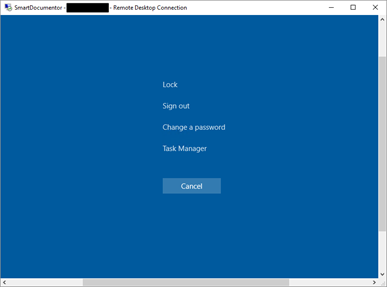
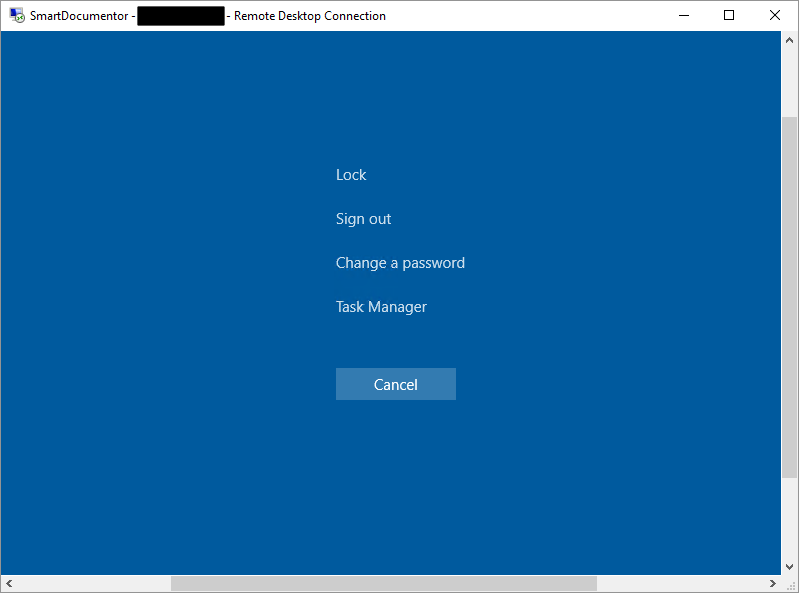


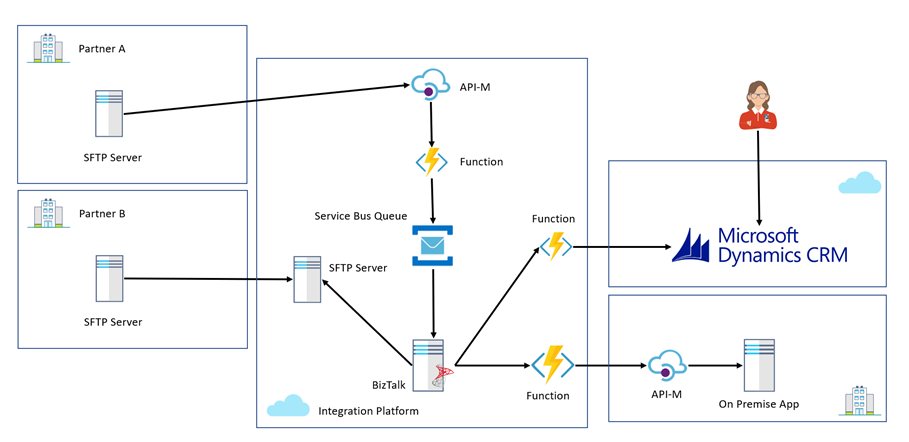
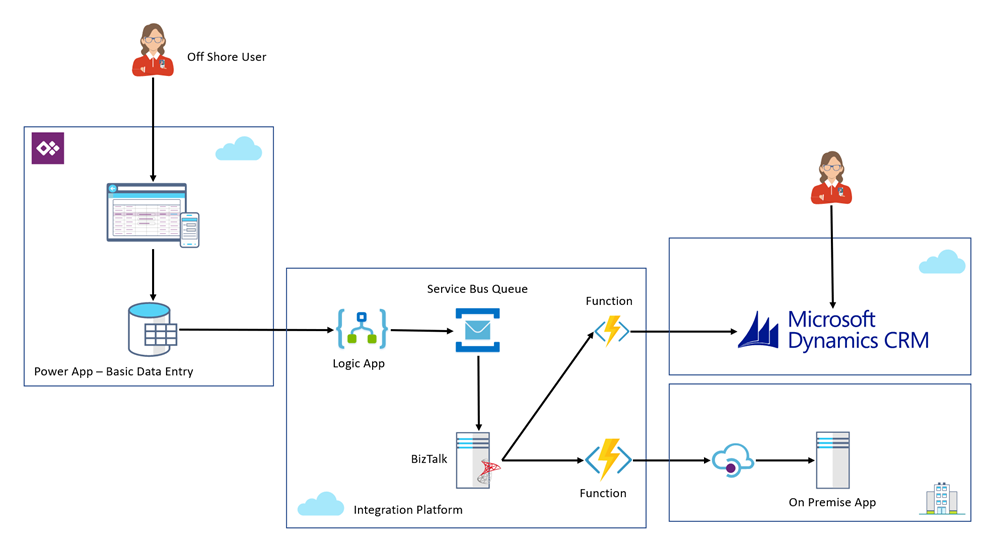


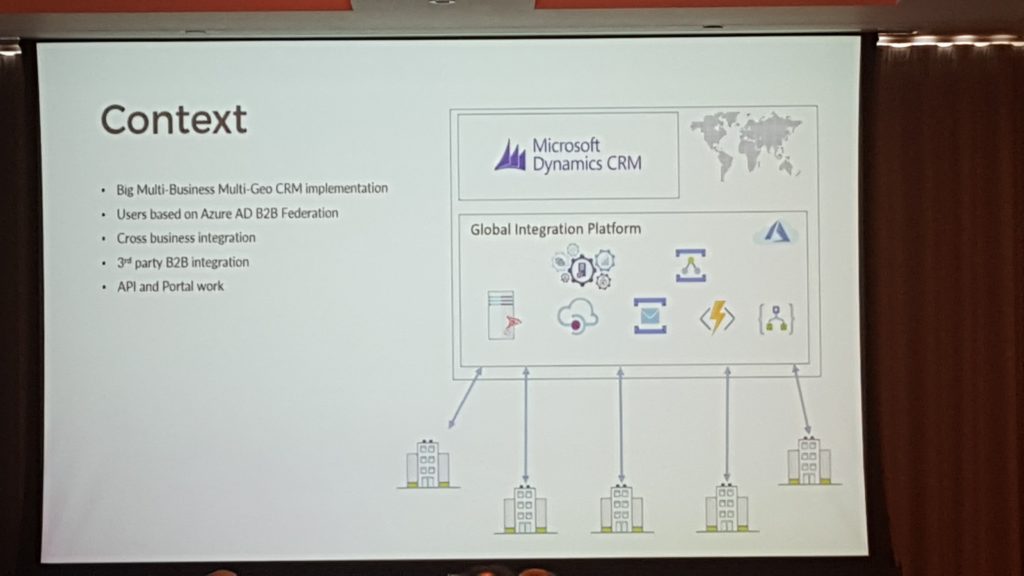
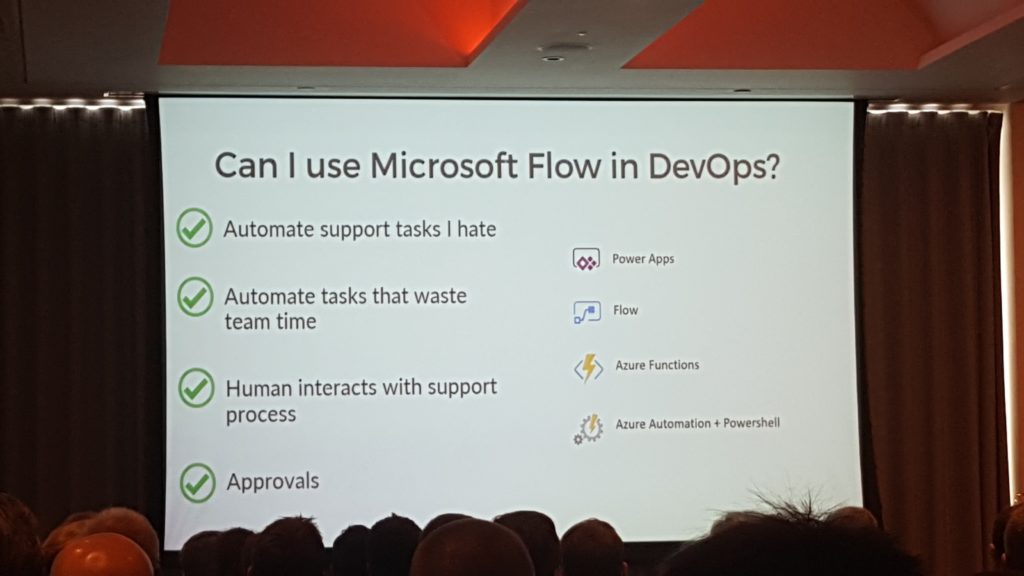
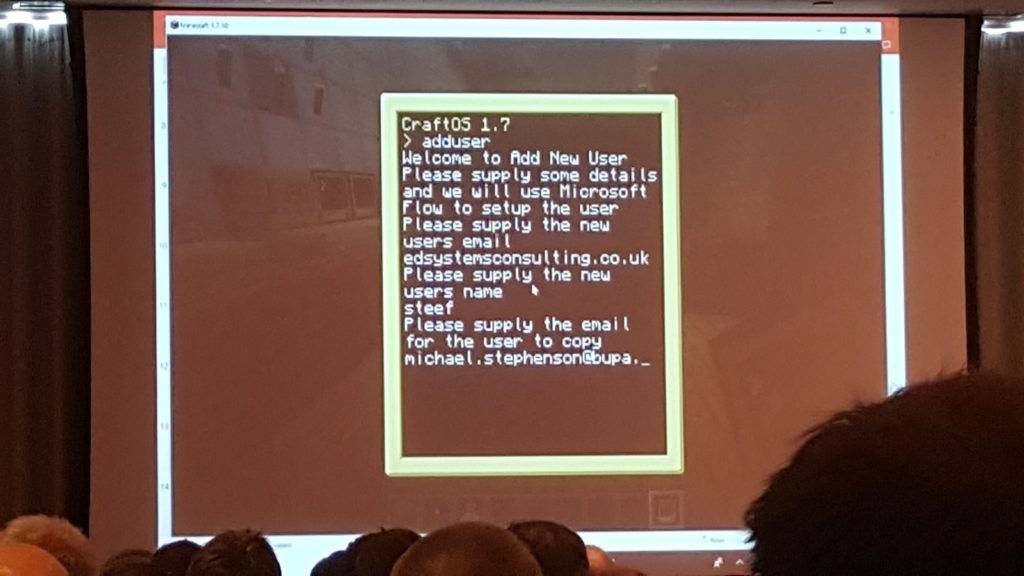
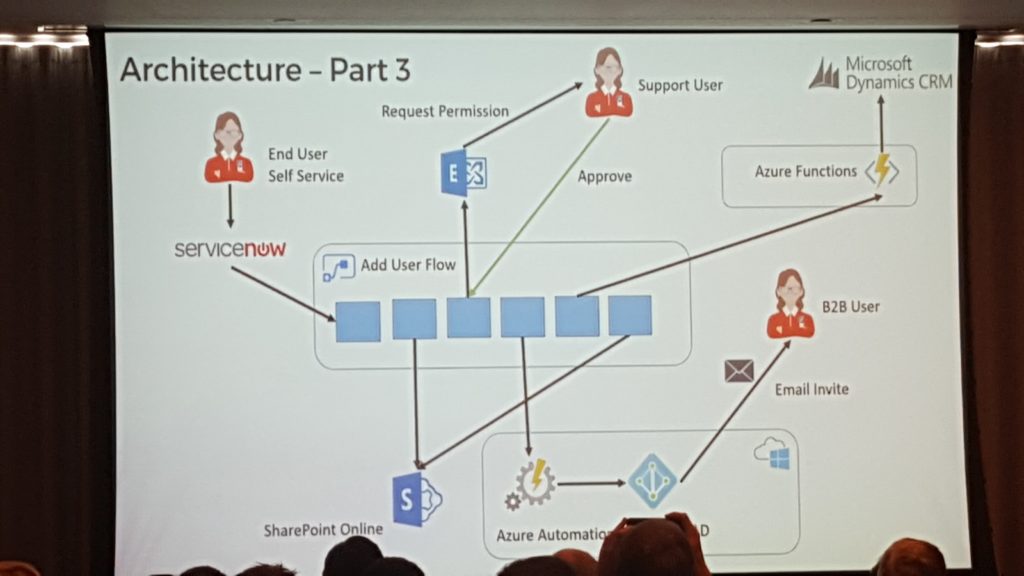
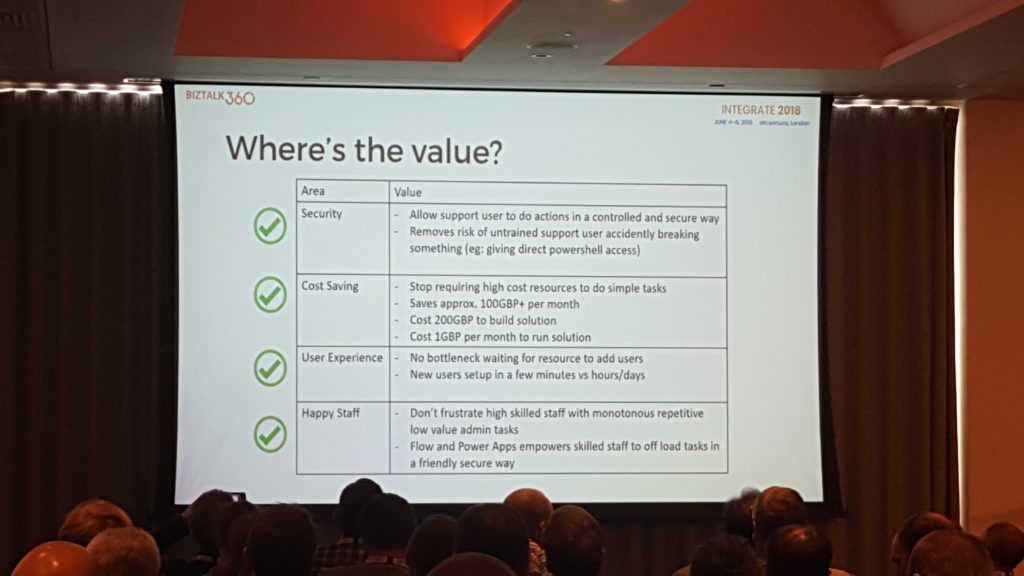


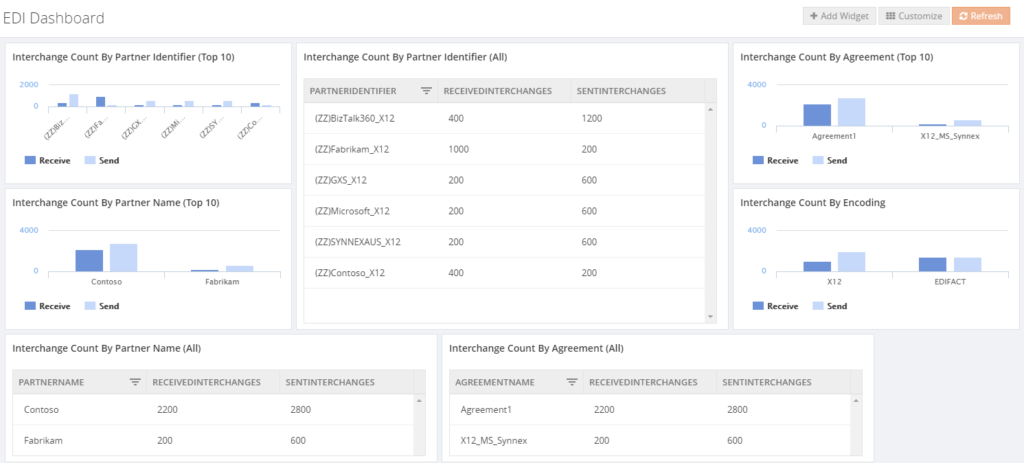
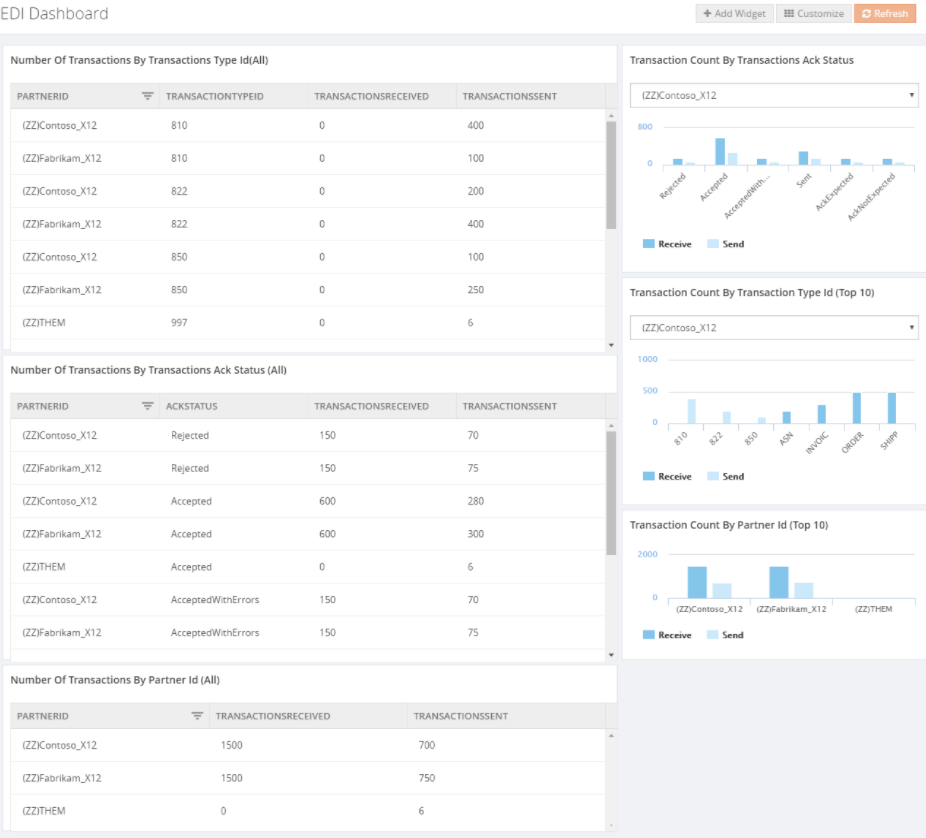
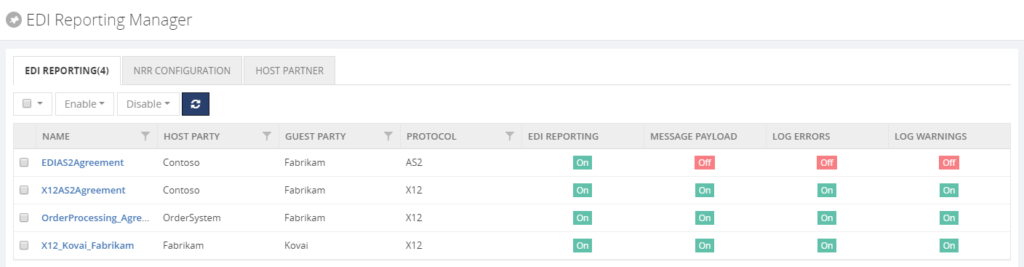
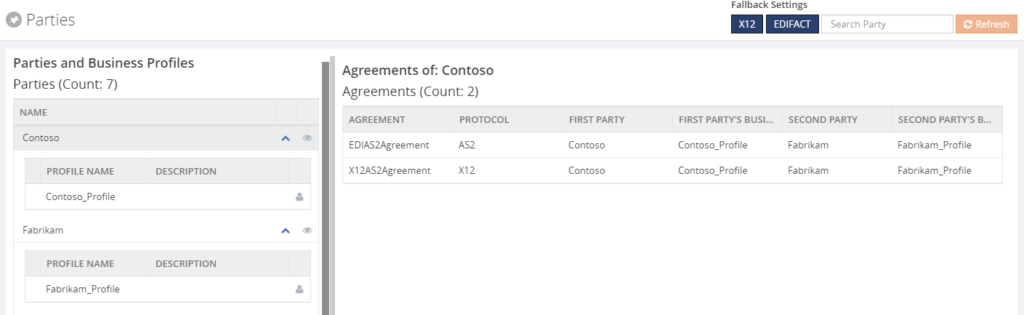

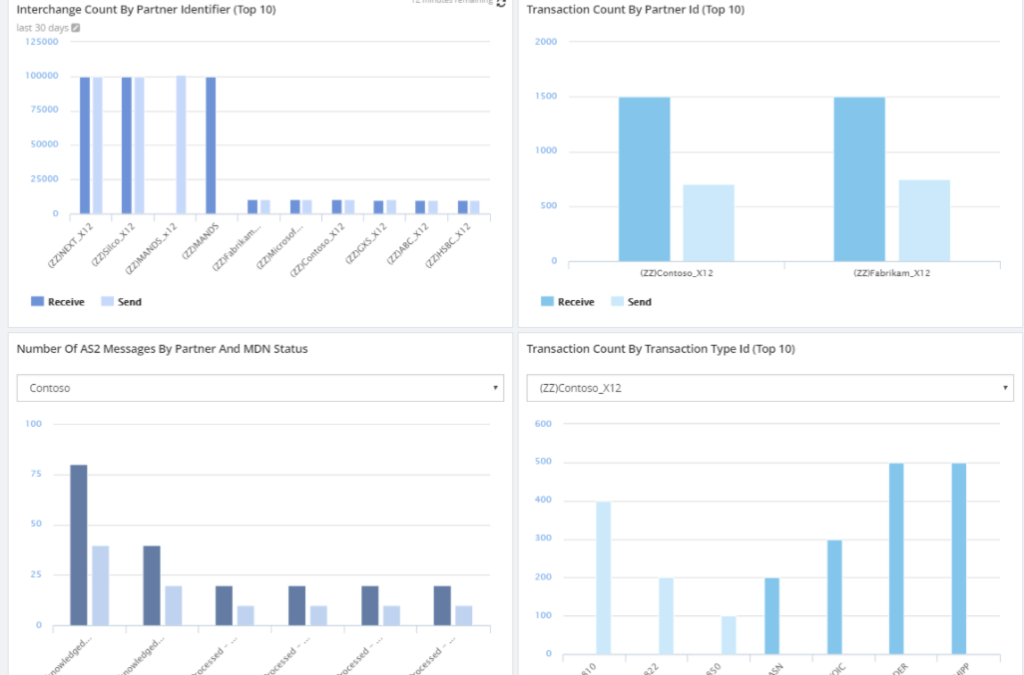
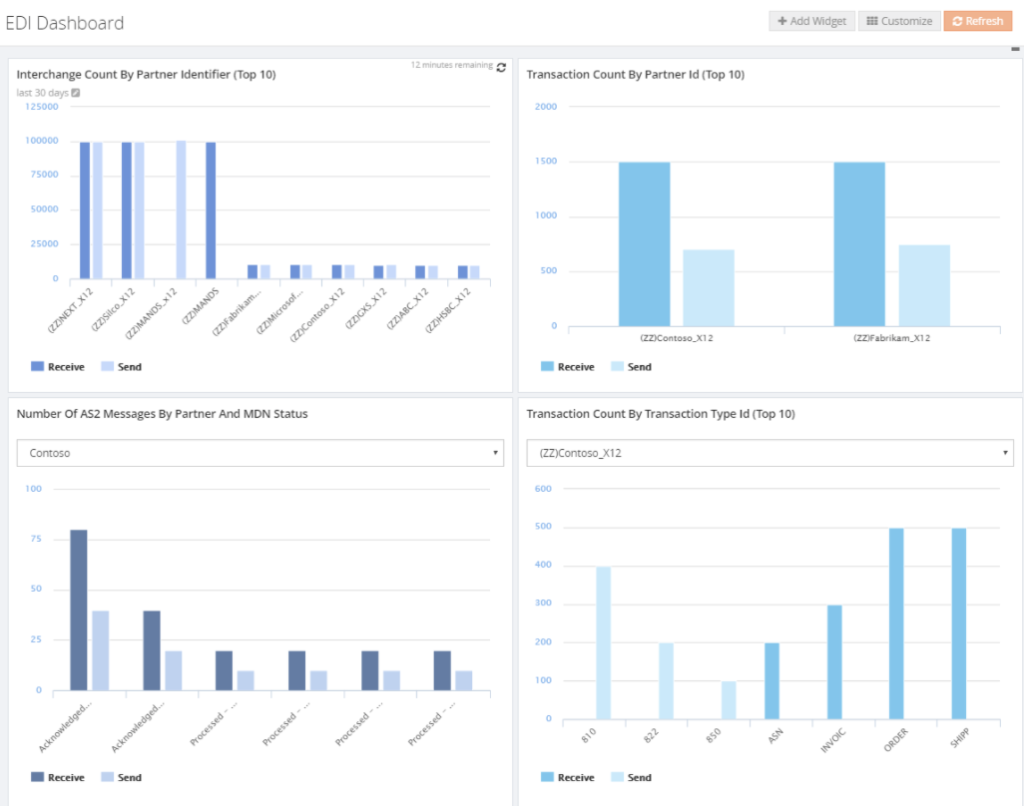
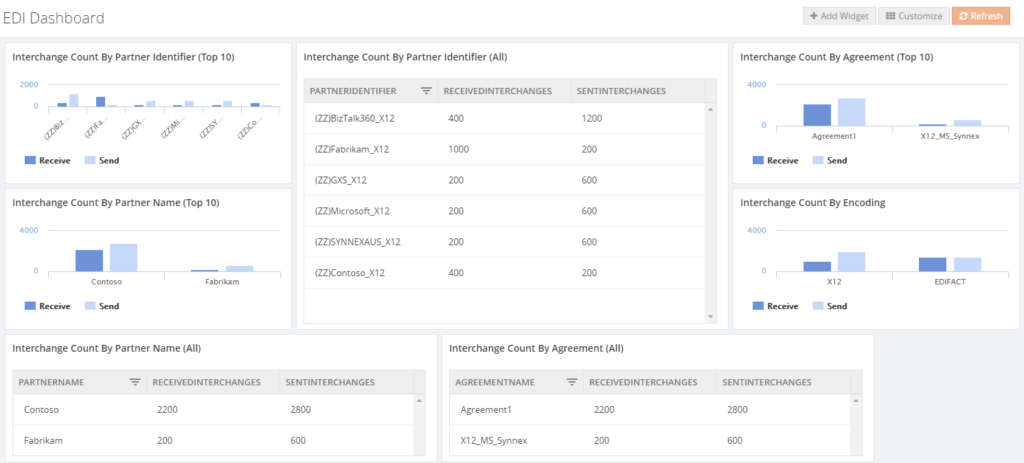
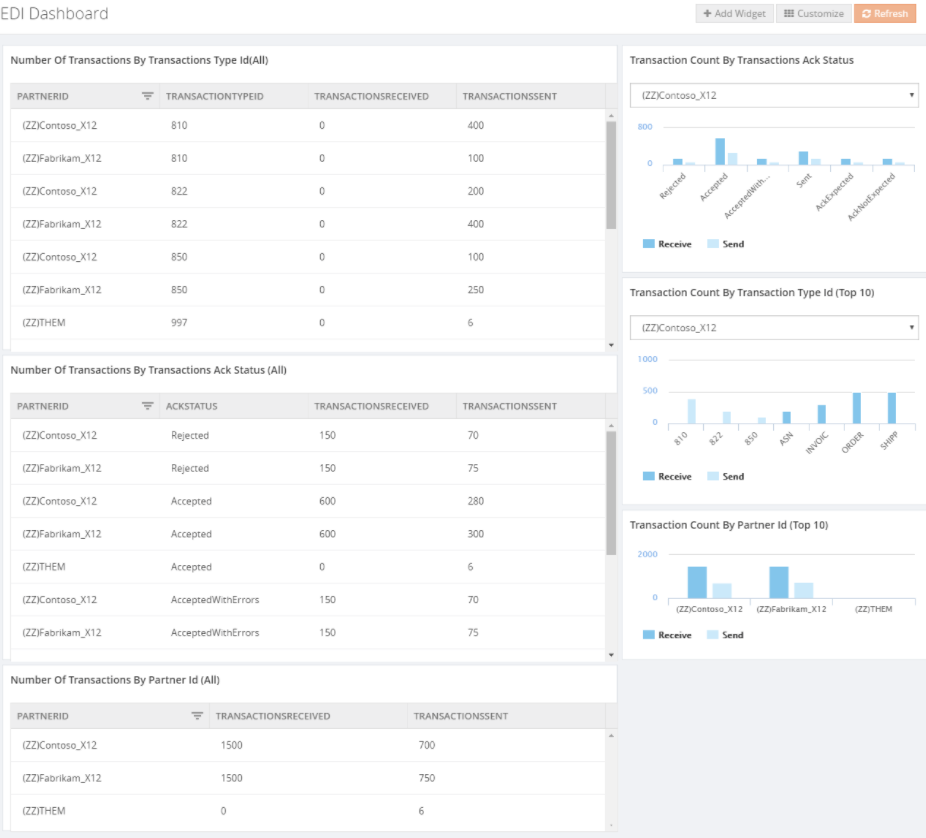
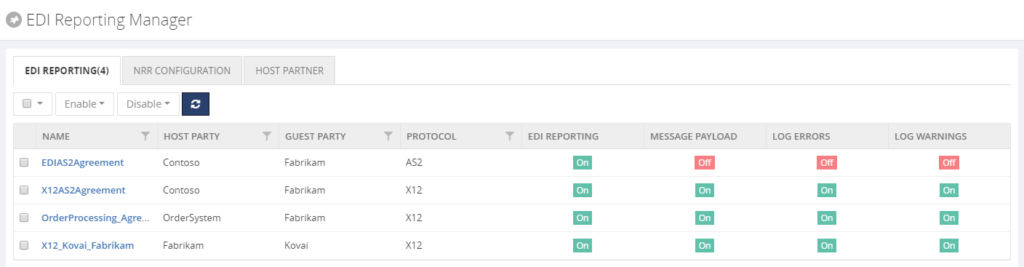
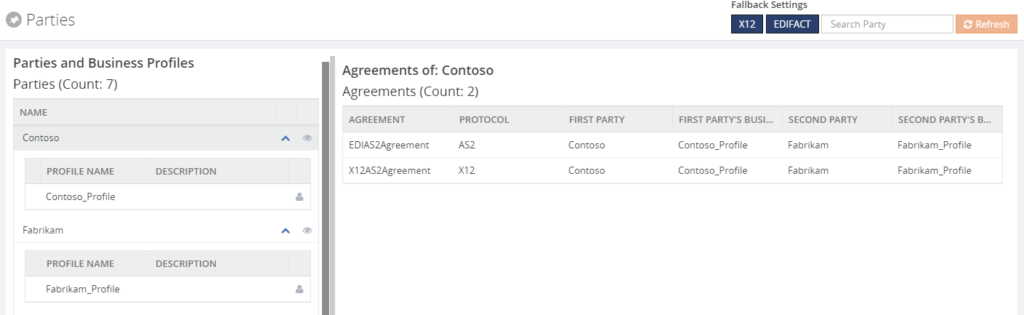

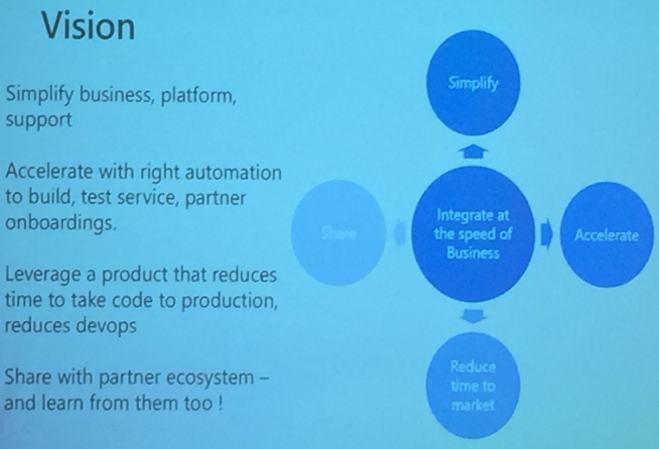
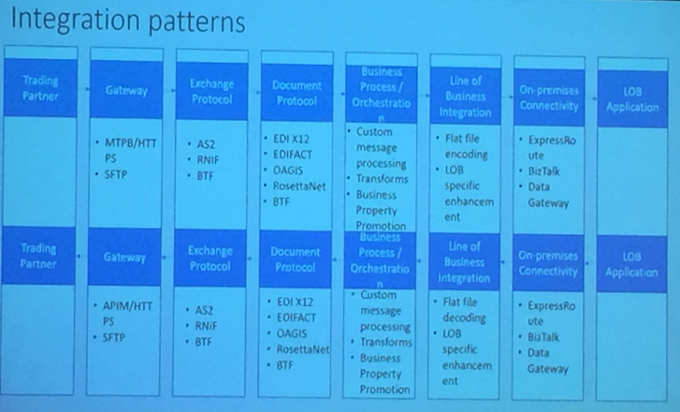
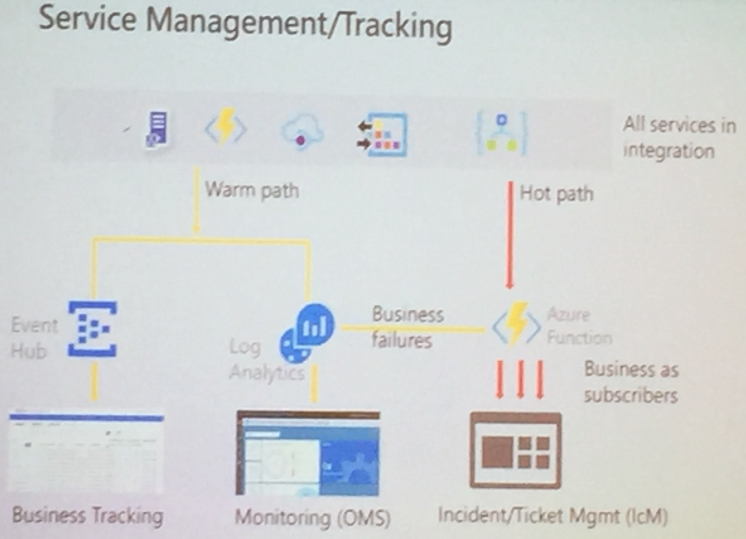
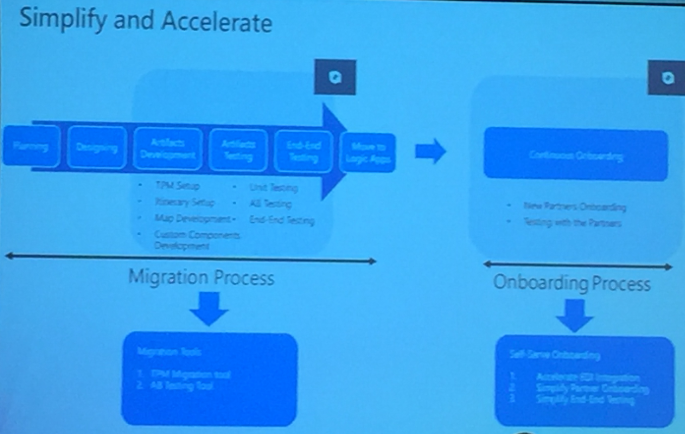
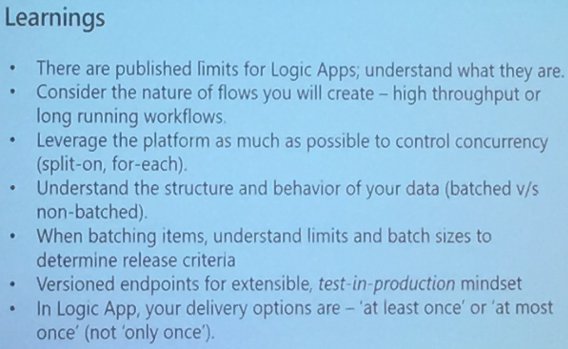
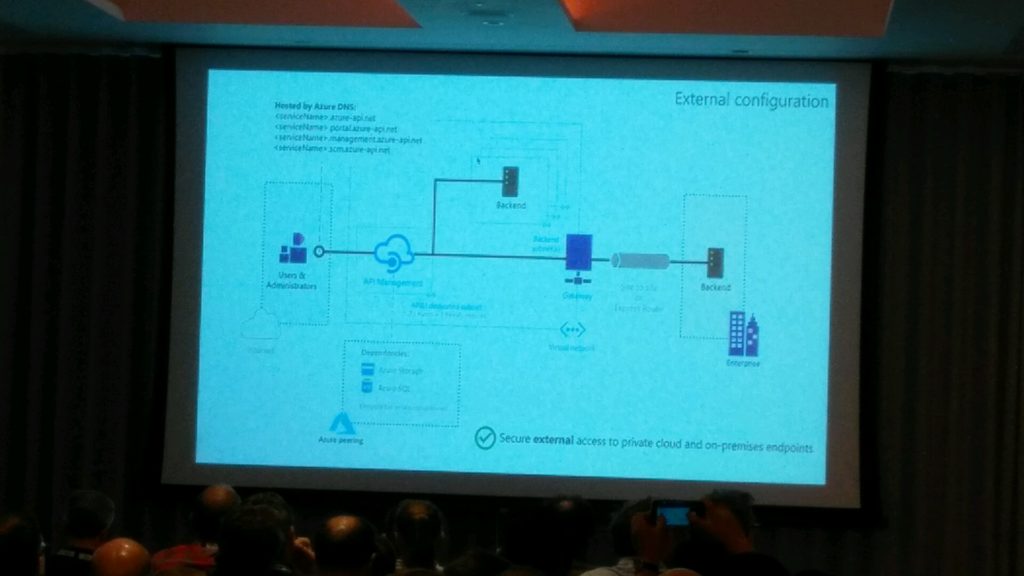
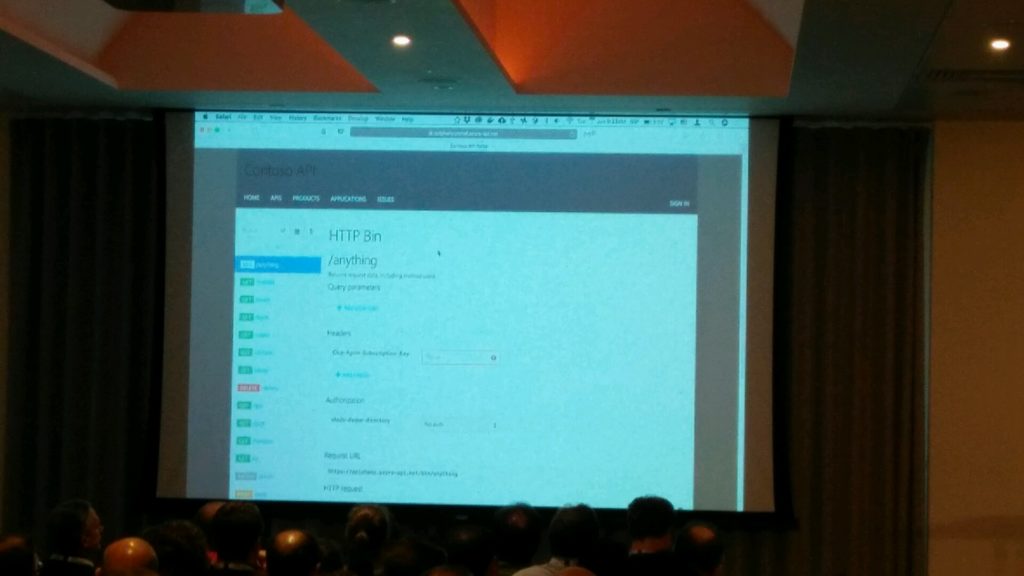
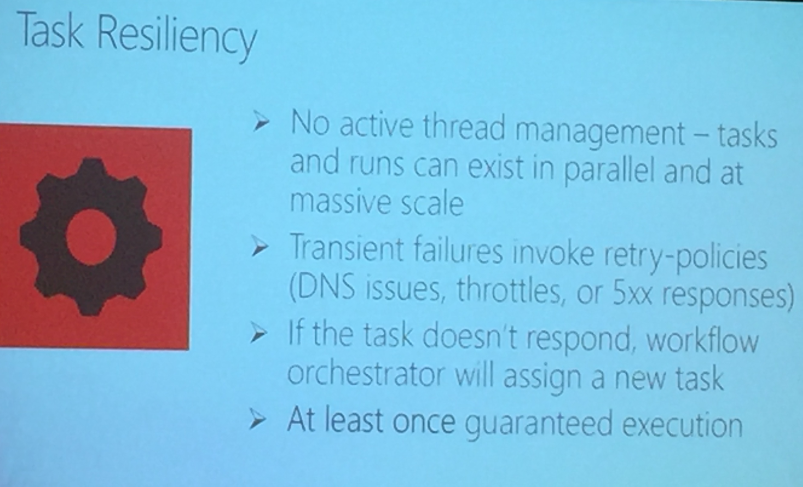
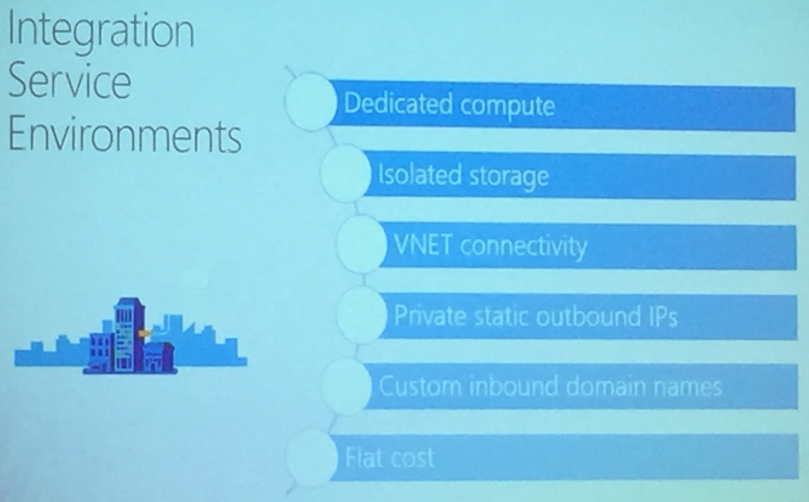
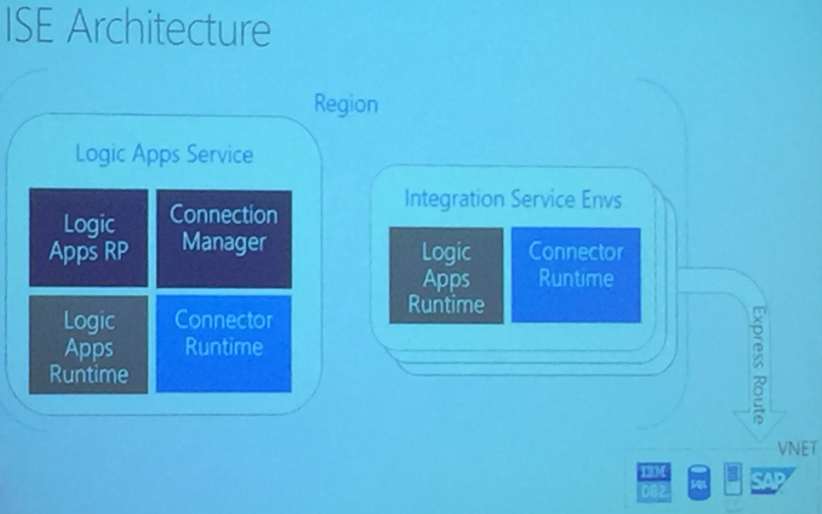
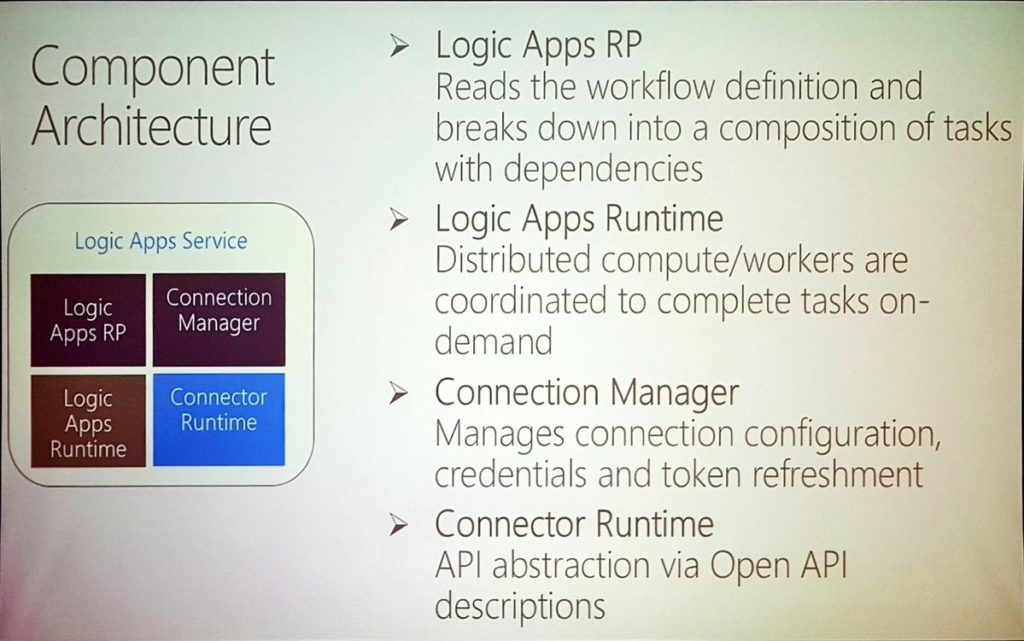
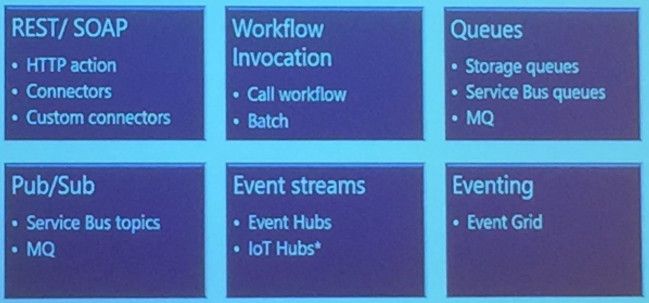
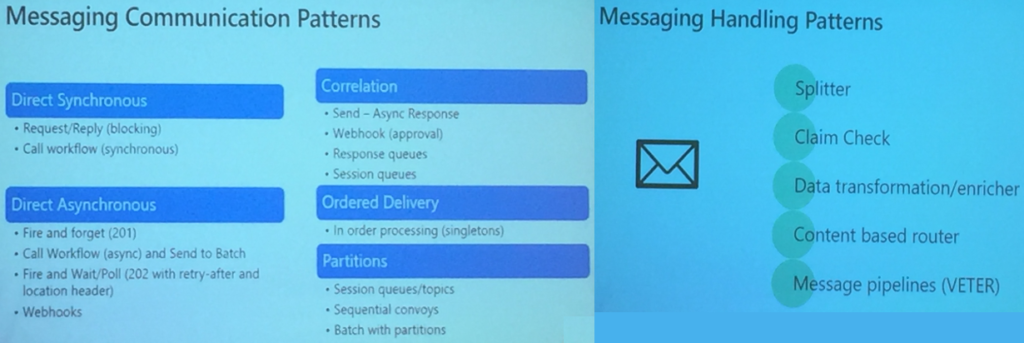
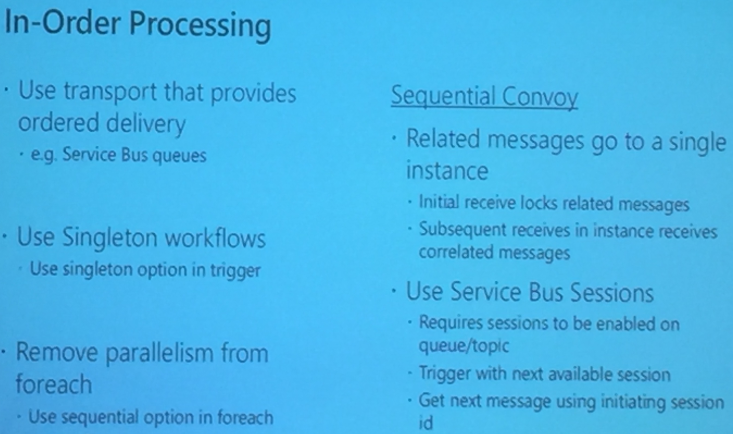
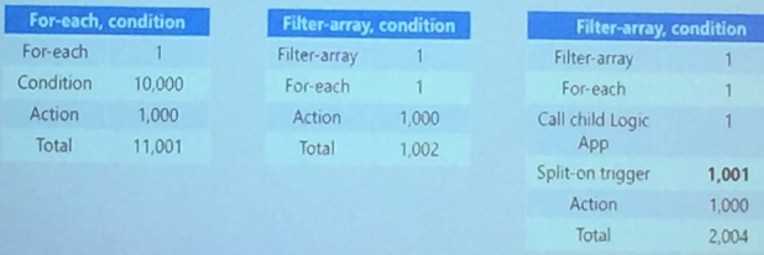
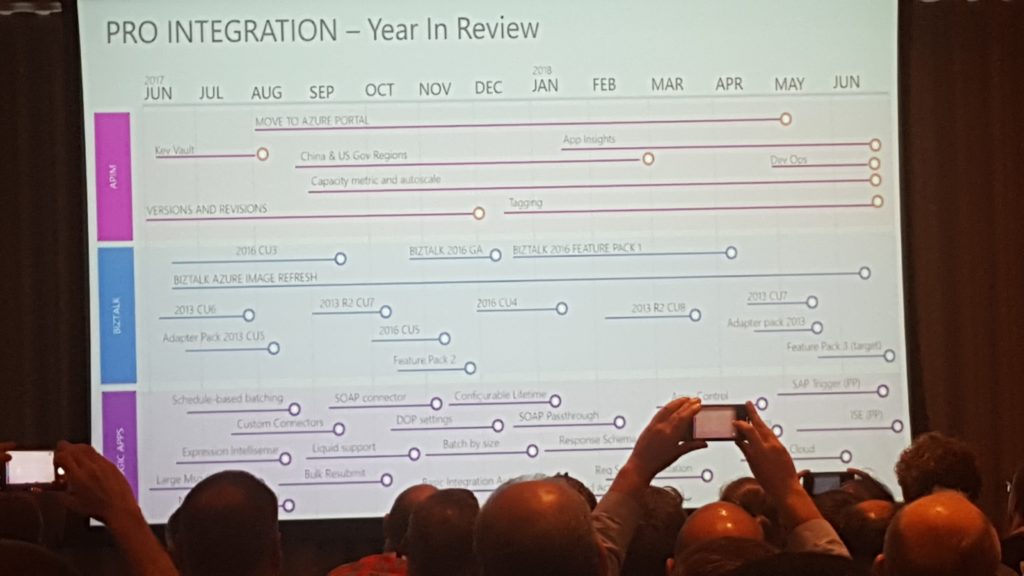
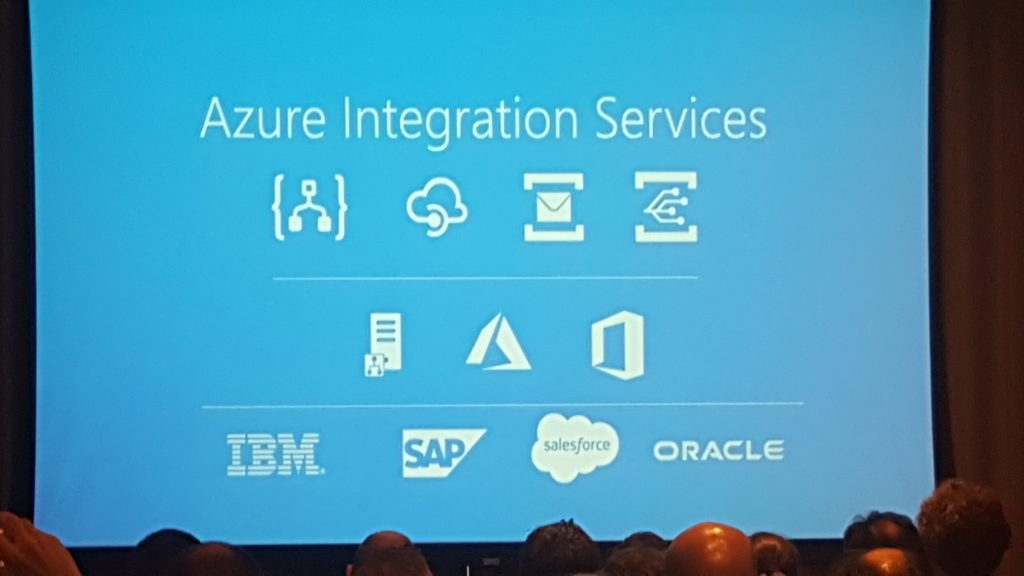
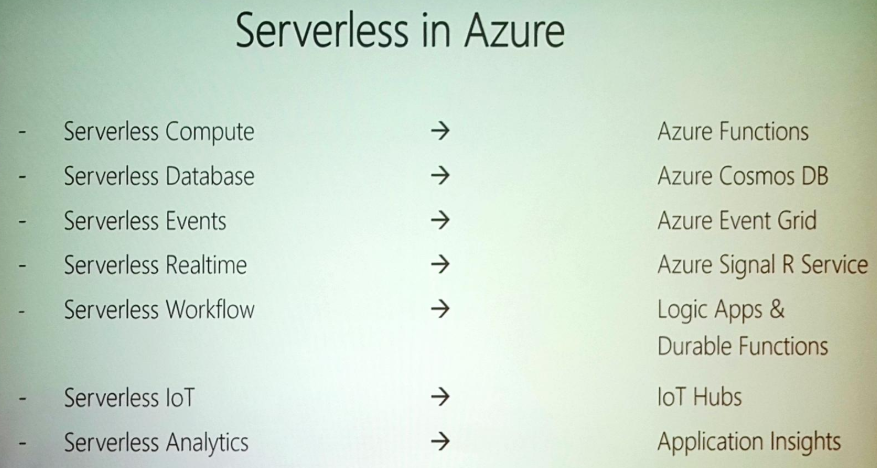
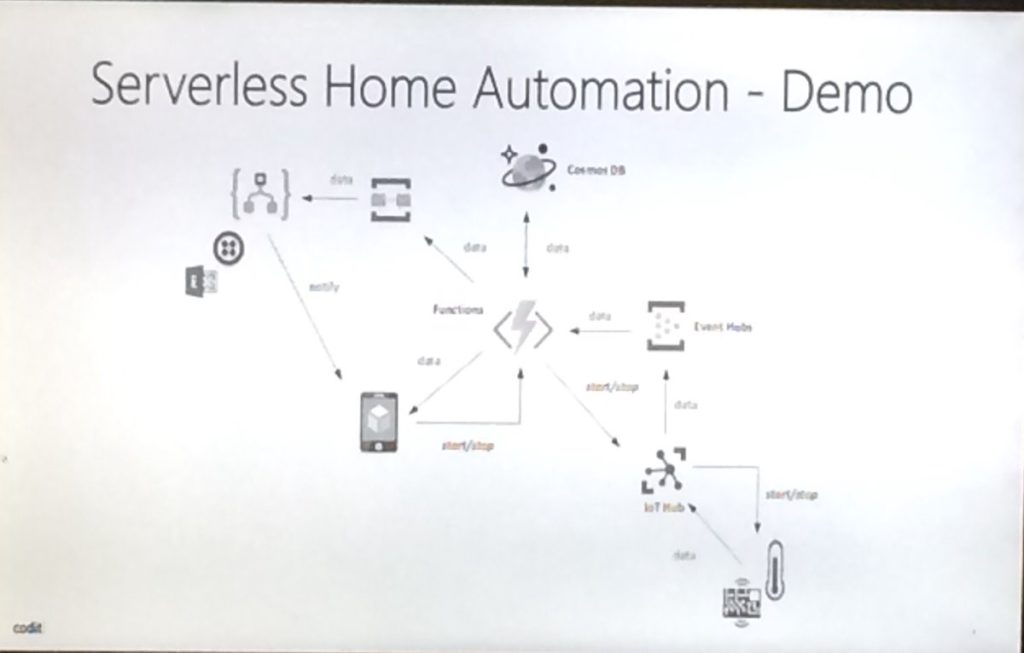 He suggested some messaging considerations: