by Gautam | Jan 9, 2017 | BizTalk Community Blogs via Syndication
Microsoft’s Cognitive services provides set of powerful intelligence APIs. These APIs can be integrated into your app on the platform of your choice to tap into ever-growing collection of powerful artificial intelligence algorithms for vision, speech, language, knowledge and search.
Integrating Cognitive Services into an application provides the app with the ability to SEE, RECOGNIZE, HEAR and even understand the SENTIMENT of your text.
In this blog post, I am trying to experiment with the Text Analytics API in Logic App. The API is a suite of text analytics services built with Azure Machine Learning to evaluate sentiment and topics of text to understand what user want.
For Sentiment analysis the API returns a numeric score between 0 and 1. Scores close to 1 indicate positive sentiment and scores close to 0 indicate negative sentiment. For Key phrase extraction the API returns a list of strings denoting the key talking points in the input text.
Cognitive Service account for the Text Analytics APIs
To build to Logic App to use Text Analytics APIs, first you need to sign up of the text analytic services.
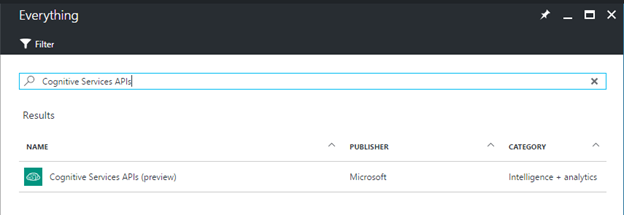
- Login to Azure Portal with your valid MSDN Subscription and Search for Cognitive Services APIs.
- Create a Cognitive Service account by providing the details as shown below.
- Make sure Text Analytics is selected as the ‘API type’ and select free plan – free tier for 5,000 transactions/month
- Complete the other fields and create your account.
- After you sign up for Text Analytics, find your API Key. Copy the primary key, as you will need it Logic App.
Logic App to detect sentiment and extract key phases
Logic Apps is a cloud-based service that you can use to create workflows that run in cloud. It provides a way to connect your applications, data and SaaS using rich set of connectors. If you are new to Logic App, please refer the Azure documentation for further details.
Now let’s create a Logic App to detect sentiment and extract key phrases from user’s text using the Text Analytic API.
Go to New >Enterprise Integration and select Logic App as shown below.
Create a Logic App by providing the details as shown below.
After our deployment success, we can start editing our Logic App.
To access it, in your left, browse All Resources > [Name of your Logic App].
Clicking in your Logic App will open the Logic Apps Designer. In welcome screen, there are a lot of templates ready to use. Choose a blank template from Logic Apps Designer
On Logic App designer, a search box is available where you can look for available Microsoft managed connectors and APIs available. Select the Request from the list which would act as a trigger to your Logic App and can receive incoming request.
Now we need to define a request body JSON Schema and the designer will generate tokens to parse and pass data from the trigger through the workflow.
We can use a tool like jsonschema.net to generate a JSON schema from a sample body payload

JSON schema for the above payload looks like below
Now use this JSON schema in the Request trigger body as shown below
Next step is to look for Cognitive Service API connector in the managed API list.
Select the Detect Sentiment and provide a connection name and Cognitive Service Account Key which we have copied in the previous section and click on Create.
Now you need to provide the Text value to the Detect Sentiment API from “text” variable of the Request trigger as shown below.
Next step would be to add Cognitive Service connector for Key Phrases same way we did for Detect Sentiment.
Now we would use the Compose and Response action to send HTTP response for the sentiment and key phrase analysis.
This is how I have composed the response using a simple new JSON message using the variable “key phrase” and “score” from the Key Phrase and Detect Sentiment APIs.
You can also use code view to compose the response message as shown below.
And finally use the output of compose action to send the HTTP response.
So here is complete workflow look like
Quick and easy! Now once you save the workflow the topmost Request trigger will have the URL for this particular Logic App.
Now let’s invoke this Logic App from one of my favorite API testing tool, Postman.
I submitted the sample JSON message to the endpoint with following text – “I had a wonderful experience! Azure cognitive services are amazing.”
Sure enough, I got the key phrase and sentiment score as below:
Conclusion
Clearly Microsoft’s Cognitive Services are easy to use in your app on the platform of your choice. The Text Analytics API is just one of many different Artificial Intelligence APIs provide by Microsoft. I am sure this new platform would mature in the coming days and different types of app can leverage this technology.
References:
https://docs.microsoft.com/en-us/azure/cognitive-services/cognitive-services-text-analytics-quick-start
https://social.technet.microsoft.com/wiki/contents/articles/36074.logic-apps-with-azure-cognitive-service.aspx
by Mark Brimble | Jan 9, 2017 | BizTalk Community Blogs via Syndication
I have been doing proof of concept where a application connects to BizTalk Server using a TCP/IP stream connection where the application will actively connect and BizTalk Server will listen for connections.
I have previously written a custom adapter called the GVCLC Adapter which actively connects to a vending machine. This was based on the Acme.Wcf.Lob.Socket Adapter example by Michael Stephenson. Another alternative that was considered was the Codeplex TCP/IP adapter. When I met Michael for the first time in Sydney two years ago I thanked him for his original post and he said to me why hadn’t I used the BizTalk MLLP adapter instead. In this post I examine whether it is possible to use MLLP adapter to connect to a socket.
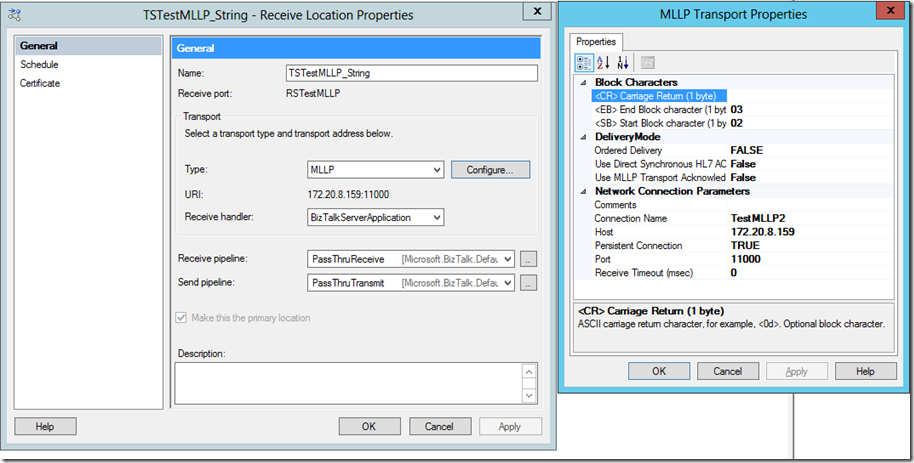
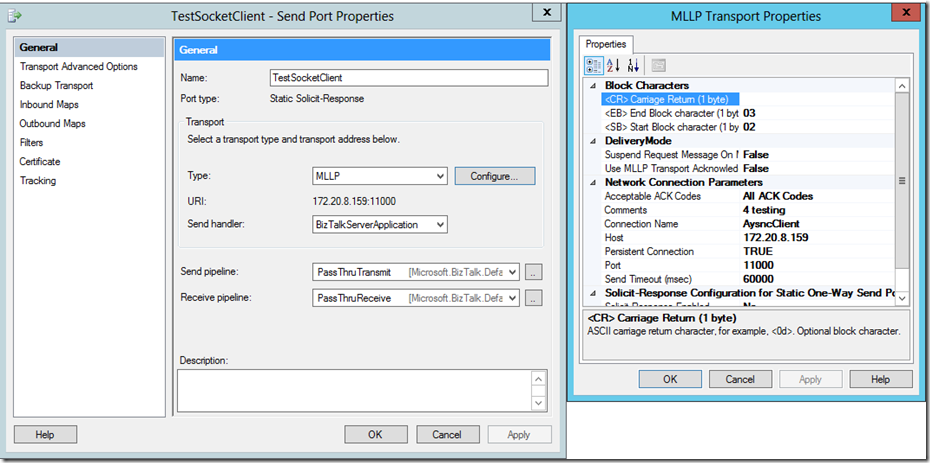
The BizTalk MLLP adapter is part of the BizTalk HL7 accelerator. This is usually used with healthcare systems. The MLLP adapter at its essence is a socket adapter as shown by the receive and send port configurations shown below. can it be used for other non-healthcare systems?
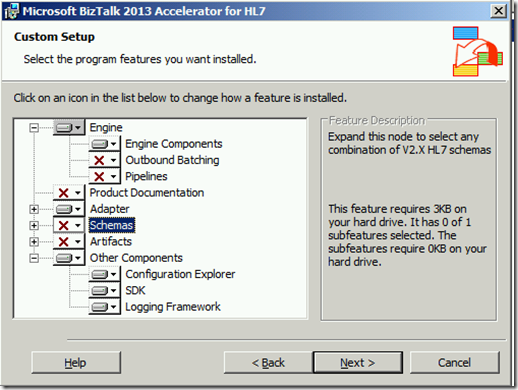
First I installed the BizTalk 2013 HL7 Accelerator with the minimal options to run the MLLP adapter. I had issues because you cannot install it if all the latest Windows Update have been installed but there is a workaround.
I setup a receive location as shown above once the MLLP adapter had been installed. Note i am not using any of the HL7 pipelines, no carriage return character, a custom start character and end character. Next I created a asynchronous socket test client very similar to the the Microsoft example here. I modified it so it would send a heart beat. I added the following lines at the right place
.//Start,End and ACK messages
protected const string STX = “02”;
protected const string ETX = “03”;
protected const string ENQ = “05”;
//…………………………….
// Send test data to the remote device.
//Send(client, “This is a test<EOF>”);
data = (char)Convert.ToInt32(STX, 16) + data + (char)Convert.ToInt32(ENQ, 16) + (char)Convert.ToInt32(ETX, 16);
Now after changing the host to 192.168.1.3, enabling the receive location and starting the socket test client, a ENQ message is received in BizTalk. This proves that the MLLP adapter can consume a socket client with a message that is not a HL7 message.
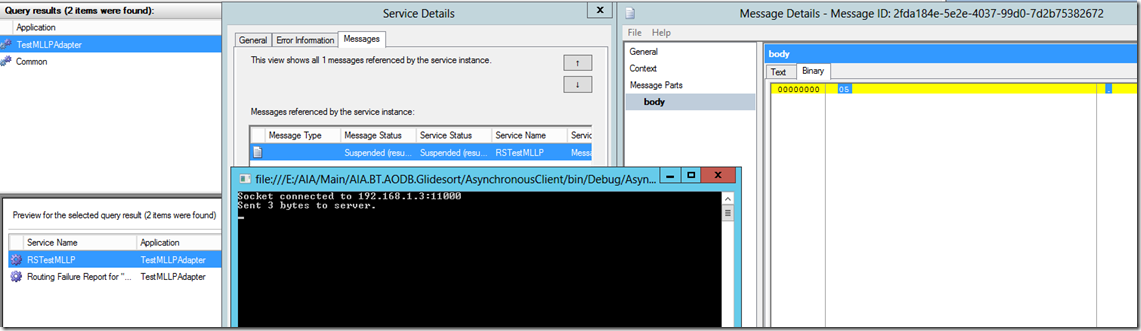
Next i set a file port to send a heartbeat message MLLP send adapter configure to send to 192.168.1.3 as above. The heartbeat message was <STX><ENQ><ETX>. I created a socket server similar to the Microsoft example here. I modified it be adding the following lines
//Start,End and ACK messages
protected const string STX = “02”;
protected const string ETX = “03”;
protected const string ACK = “06”;
//————–
// Echo the data back to the client.
//Send(handler, content);
// Send ACK message back to clinet
data = (char)Convert.ToInt32(STX, 16) + data + (char)Convert.ToInt32(ACK, 16) + (char)Convert.ToInt32(ETX, 16);
On dropping the file in the file receive port it was sent to the MLLP adapter and then sent to the socket server as shown by the printout below. There is five bytes because the configured adapter is also adding an extra STX and ETX character the message.
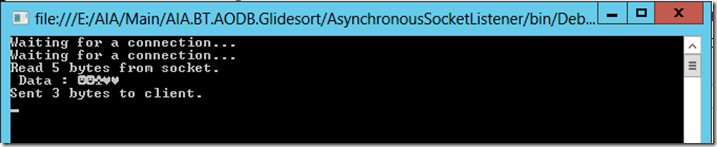
This proves the a MLLP receive adapter can consume messages from a socket client and that a send MLLP adapter can send to a socket server.
We have shown that MLLP adapter can be used instead of the Codeplex TCP/IP adapter or the Acme socket adapter
…….but this is not the end for me. My application wants to be a socket client and for BizTalk to send a heartbeat when it will send an AC i.e.
Application –>connect to BizTalk Server
BizTalk Server –>Message or heartbeat to the application
Application –> ACK message to BizTalk Server
I think I will have to create a custom adapter to do this.
In summary for the basic case the MLLP adapter can be used instead of the Codeplex TCP/IP adapter or the Acme socket adapter.
by Steef-Jan Wiggers | Jan 6, 2017 | BizTalk Community Blogs via Syndication
In the past, now and tomorrow I will keep saying that integration is relevant, even in this day and age of digitalization. Integration professionals will play an essential role in providing connectivity between systems, devices and services. Integration drives the digitalization forward by connecting everything with anything.
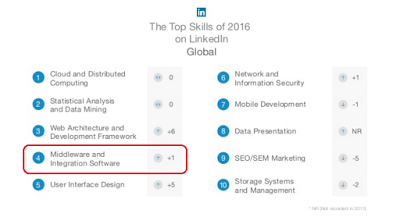
Integration skills are still in demand. A LinkedIn study revealed a top 10 with integration and middleware in top 5 with Cloud, Data Science, UX and Web. And the expectation for 2017 is that this will be similar.
Our toolbox is expanding from on premise tooling to cloud services; we have WCF, BizTalk Server, MSMQ to Logic Apps, API Management and Service Bus. Formats ranging from flat file, EDI, XML to JSON, several protocols open and proprietary, tooling from mappers to BizTalk360. It can be challenging yet much more exciting. My conclusion is more options, more fun, at least in my view.
In February I, will be travelling to Australia to meet up with my buddies Mick and Rene. And Rene is organizing a Meetup in Sydney on the 20th of February. And since I am kind of in the neighborhood, I have decided to pay my friends (Mark e.a.) in New Zealand a visit too. Hence, I will speak in Auckland on the 14th of February and in Melbourne, where Bill Chesnut resides. That’s three meet ups I will speak during my stay down under.
With Eldert I will be travelling around and our plans will look like:
• Saturday 11-2 – Monday 13-2: Sydney
• Tuesday 14-2 – Wednesday 15-2: Auckland (Meetup)
• Thursday 16-2 – Friday 17-2: Gold Coast (Eldert attends Ignite, Gold Coast)
• Saturday 18-2: Brisbane
• Sunday 19-2 – Monday 20-2: Sydney (Meetup)
• Tuesday 21-2 – Thursday 23-2: Melbourne (Meetup)
• Friday 24-2 – Monday 27-2: Sydney
Hope to see some of you there!
And that’s not all. The following month, March 25th there will be the Global Integration Bootcamp and the IntegrationMondays will start from the 9th of January onwards to end of April. And finally, there will be an Integrate 2017 in the UK and TUGAIT with an Integration Track in May.
Hence, there you go a tremendous community effort the coming months!
Author: Steef-Jan Wiggers
Steef-Jan Wiggers is all in on Microsoft Azure, Integration, and Data Science. He has over 15 years’ experience in a wide variety of scenarios such as custom .NET solution development, overseeing large enterprise integrations, building web services, managing projects, designing web services, experimenting with data, SQL Server database administration, and consulting. Steef-Jan loves challenges in the Microsoft playing field combining it with his domain knowledge in energy, utility, banking, insurance, health care, agriculture, (local) government, bio-sciences, retail, travel and logistics. He is very active in the community as a blogger, TechNet Wiki author, book author, and global public speaker. For these efforts, Microsoft has recognized him a Microsoft MVP for the past 6 years. View all posts by Steef-Jan Wiggers

by community-syndication | Jan 6, 2017 | BizTalk Community Blogs via Syndication
Here’s two incredible facts: 318576 views were made to my blog last year, being that, the country that most visited was the United States, followed by India, United Kingdom and Sweden. (In 2016, there was 50 new posts, growing the total of this blog to 534 posts) And I had the opportunity, as a speaker, […]
Blog Post by: Sandro Pereira
by stephen-w-thomas | Jan 5, 2017 | Stephen's BizTalk and Integration Blog
Are you working with Windows Azure Logic Apps inside Visual Studios and seen an error like this after you deploy?
The API connection ‘/subscriptions/{Subscription ID}/resourceGroups/{Resource Group Name}/providers/Microsoft.Web/connections/sql’ is a connection under a managed API. Connections under managed APIs can be used if and only if the API host is a managed API host. Either omit the ‘host.api’ input property, or verify that the specified runtime URL matches the regional managed API host endpoint ‘https://logic-apis-westus.azure-apim.net/’.
What I have found is the Logic App gets a little sticky to a Region. It seems to like the initial region you set when you first created the Logic App. Most of the shapes inside a Logic App are internal API calls to Microsoft hosted services. This ends up looking like this in the JSON:
"host": {
"api": {
"runtimeUrl": https://logic-apis-eastus.azure-apim.net/apim/sql},
"connection": { "name": "@parameters(‘$connections’)[‘sql’][‘connectionId’]"}}
As you can see the eastus is set in the runtimeUrl of the internal API call to the SQL API. When this is deployed to another region, at present Visual Studio does not replace this value with the correct region.
So what happens when you deploy to another region? Well these values get sent as-is.
If you run the Logic App you will get an error message like seen above.
To fix this issue it is simple, once you deploy the Logic App into a new region open it inside the Web Portal and Save It. You do not have to do anything else. This will adjust the runtimeUrl values to the correct region.
Happy Logic Apping!
by Nino Crudele | Jan 3, 2017 | BizTalk Community Blogs via Syndication
Why do people start comparing BizTalk Server to a T-Rex?
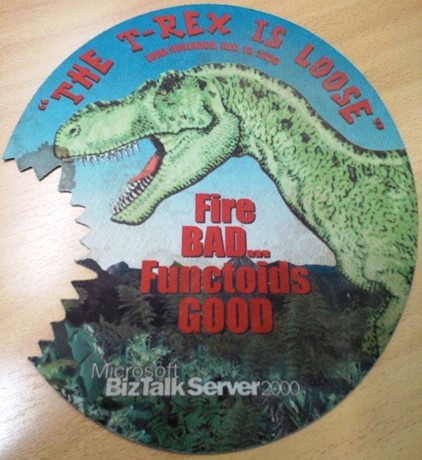
Long time ago the Microsoft marketing team created this mousepad in occasion of the BizTalk 12th birthday.
And my dear friend Sandro produced the fantastic sticker below
Time later people start comparing BizTalk Server to a T-Rex, honestly, I don’t remember the exact reasons why but I like to provide my opinion about that.
Why a T-Rex?
In the last year, I engaged many missions in UK around BizTalk Server, assessments, mentoring, development, migration, optimization and more and I heard many theories about that, let go across some of them :
Because BizTalk is old, well, in that case I’d like to say mature which is a very good point for a product, since the 2004 version the product grew up until the 2013 R2 version and in these last 10 years the community build so much material, tools and documentation that not many other products can claim.
Because BizTalk is big and monolithic, I think this is just a point of view, BizTalk can be very smart, most of the time I saw architects driving their solution in a monolithic way and, most of the times, the problem was in the lack of knowledge about BizTalk Server.
Because BizTalk is complicate, well Forrest Gump at this point would say “complicate is what complicate we do”, during my assessments and mentoring I see so many over complicated solutions which could be solved is very easy way and, the are many reasons for that, some time because we miss the knowledge, other time we don’t like to face the technology and we decide for, what I like to call, the “chicken way”.
Because now we have the cloud, well, in part I can agree with that but, believe or not, we also have the on premise and companies still use hardware, companies still integrate on premise applications and we believe or not, integrating system in productive way to send data into the cloud in efficient and reliable mode is something very complicate to do and, at the moment, BizTalk is still the number one on it.
Because BizTalk costs, the BizTalk license depends by the number of processors we need to use in order to run our solution and achieve the number of messages per second we need to consume, this is the main dilemma but, in my opinion, quite easy to solve and this is my simple development theory.
The number of messages we are able to achieve is inversely proportional to the number of wrong best practices we produce in our solution.
Many people make me this question, Nino what do you think is the future of BizTalk Server?
I don’t like to speak about future, I saw many frameworks came up and disappear after one or two years.
I like to consider the present and I think BizTalk is a solid product with tons of features and able to cover and support in great way any integration scenario.
In my opinion the main problem is how we approach to this technology.
Many times companies think about BizTalk like a single product to use in order to cover any aspect about a solution and this is deeply wrong.
I like to use many technologies together and combine them in the best way but, most important, each correct technology to solve the specific correct task.
In my opinion when we look to a technology, we need to get all the pros and cons and we must use the pros in the proper way to avoid any cons.
BizTalk can be easily extendable and we can compensate any cons in very easy way.
Below some of my personal best hints derived by my experience in the field:
If you are not comfortable or sure about BizTalk Server then call an expert, in one or two days he will be able to give you the right way, this is the most important and the best hint, I saw many people blaming BizTalk Server instead of blaming their lack of knowledge.
Use the best naming convention able to drive you in a proper way in your solution, I don’t like to follow the same one because any solution, to be well organized, needs a different structure, believe me the naming convention is all in a BizTalk Solution.
Use orchestration only when you need a strictly pattern between the processes, orchestrations are the most expensive resource in BizTalk Server, if I need to use it then I will use it for this specific reason only.
If I need to use an orchestration, then I like to simplify using code instead of using many BizTalk shapes, I like to use external libraries in my orchestrations, it’s simpler than create tons of shapes and persistent points in the orchestration.
Many times, we don’t need to use an adapter from an orchestration, which costs resources in the system, for example many times we need to retrieve data from a database or call another service and we don’t need to be reliable.
Drive your persistent points, we can drive the persistent points using atomic scopes and .Net code, I like to have the only persistent point I need to recover my process.
Anything can be extendable and reusable, when I start a new project I normally use my templates and I like to provide my templates to the customer.
I avoid the messagebox where I need real time performances, I like to use two different technics to do that, one is using Redis cache, the second is by RPC.
One of the big features provided by BizTalk Server is the possibility to reuse the artefacts separately and outside the BizTalk engine, in this way I can easily achieve real time performances in a BizTalk Server process.
Many times, we can use a Standard edition instead of an Enterprise edition, the standard edition has 2 main limitations, we can’t have multiple messageboxes and we can’t have multiple BizTalk nodes in the same group.
If the DTS (Down Time Service) is acceptable I like to use a couple of standard editions and with a proper configuration and virtual server environment I’m able to achieve a very good High Availability plan and saving costs.
I always use BAM and I implement a good notification and logging system, BizTalk Server is the middleware and, believe me, for any issue you will have in production the people will blame BizTalk, in this case, a good metrics to manage and troubleshoot in fast way any possible issue, will make you your life great.
Make the performance testing using mock services first and real external services after, in this way we are able to provide the real performances of our BizTalk solution, I saw many companies waste a lot of money trying to optimize a BizTalk process instead of the correct external service.
To conclude, when I look at BizTalk Server I don’t see a T-Rex.
BizTalk remembers me more a beautiful woman like Jessica Rabbit

full of qualities but, as any woman, sometime she plays up, we only need to know how to live together whit her 😉
Author: Nino Crudele
Nino has a deep knowledge and experience delivering world-class integration solutions using all Microsoft Azure stacks, Microsoft BizTalk Server and he has delivered world class Integration solutions using and integrating many different technologies as AS2, EDI, RosettaNet, HL7, RFID, SWIFT. View all posts by Nino Crudele

by community-syndication | Jan 1, 2017 | BizTalk Community Blogs via Syndication
And the most expected email arrived once again on 1st January, thanks Microsoft for another wonderful start of New Year. Once again, I’m delighted to share that I was renewed as a Microsoft Azure MVP (Microsoft Most Valuable Professional), This is my 7th straight year on the MVP Program, an amazing journey and experience that […]
Blog Post by: Sandro Pereira
by [email protected] Steef-Jan Wiggers | Dec 31, 2016 | BizTalk Community Blogs via Syndication
Last few hours before 2016 ends and what a year it has been as so many things happened. The year started off with finalizing and publishing an eBook on extensibility of BizTalk Server, which is available for free. My buddy Saravana made available through BizTalk360 website.
The publishing of the book marked the first major milestone in 2016. The collaboration of Eldert, Johann and myself as authors and three awesome reviewers in Mark, James and Sandro delivered a 150-page book on the power of .NET and BizTalk.
With the release of the book, Eldert and myself embarked on a speaking tour to promote the book, which we did in front of the BizTalk User Group in the Netherlands, online through integration Monday and in Sweden (Stockholm, Gothenburg). Thanks Mikael, Johan and Peter!!!
In the spring (May) I presented at Integrate 2016 on IoT end to end leveraging the Microsoft Azure Platform services. And this was in front of almost 400 people.
Who would have thought that integration is irrelevant? It’s not! Thanks for Saravana and the BizTalk360 team for making this three-day event happening. Integrate 2016 was a success and for me my second major milestone in 2016.
Before Integrate 2016 Kent, his wife Melissa travelled through the UK and Scotland enjoying various country sides. One of the best days was hanging out with Michael in Newcastle. A really nice place with some great bars and restaurants.
After Integrate I went to TUGA IT, a large two-day conference in Lisbon. Thanks to Sandro I got invited to speak together with Nino. The three of us did a full day workshop on integration on Friday and a few talks on Saturday.
We had a blast and I really enjoyed Lisbon together with Nino and Sandro. Thanks to Niko Neugebauer and other Portuguese involved! Before I left I spend a full day exploring Lisbon with Sandro.
After Integrate and TUGA IT I went to Sweden with Eldert to talk about BizTalk Extensibility and another topic Azure Web Jobs. Sweden and its user groups are awesome, great welcome, excellent hosting environments and crowd. In Stockholm, we had a great user group event with several speakers including Mikael, Johan, Eldert, Robin, Ashwin and myself. The next day Eldert and myself went to Gothenburg to speak on extensibility and Web Jobs.
The summer holidays I spent in Italy and started to seriously prepare for third major milestone in 2016, the NYC marathon. In 2013 I ran the Berlin marathon together with Kent and decided or at least I said I will do another, preferably New York. Once Kent and his brother Kurt decided they wanted to run it when they turned 40 I said I am in!
The race was brutal and the bridges were quite the experience and challenge. It was a psychical and mental test yet I managed to finish with 5 hours.
My Canadian buddies finished just a few minutes later and then we enjoyed our medals with some great food and beers.
Thanks Kent and Kurt for letting me join in this endeavor. Our next challenge might be in 2018.
The next stop after the Marathon was the MVP Summit, which started the day after NYC Marathon. And to start things of was a nice game of the Seahawks playing the Bills. Lots of MVP and some MS folks went to the game.
The MVP Summit was a great experience as there was lots to share and engagements with the product teams.
You always run into someone you know ☺
This summit took place during the elections, hence we spent an evening together at Dan and Ola, who organized a great barbeque.
The outcome was not what we thought it would be, however, we still had a great time.
One of the traditions during the Summit is visiting Joey’s in Bellevue, which of course we did.
And Moksha our favorite Indian Cuisine place.
Another thing we did was visiting Tord, PG BizTalk Server and his family in Redmond.
And the BizTalk Crew was reunited once again.
We know BizTalk Server is in good hands now!
I really enjoyed my stay in Seattle. I went to another football game with Kent. We watched the Washington Huskies.
Before I left Seattle, I spent some time with my great friend Tom and his wife JoAnn. We watched the Seahawks play the Patriots on Sunday in a bar. Yes, more American Football, I love it. And it was an epic game, with the Hawks winning the game and cheers in the bar!
It was quite a trip, New York, running the Marathon followed by the MVP Summit. Something to remember as long as I will live.
In November and December I spend time writing some quest blogs for Saravana, a LinkedIn article on today’s integration and presenting at our Local user group.
In 2017 I, will kick the tires with some speaking engagements in Australia. In February I, will spent two and a half week with Mick, Eldert, Rene, Dean, Bill, Dan and many others. This will be followed by the global integration boot camp in March, where I’ll be speaking at the location of motion10 together with Eldert, Rob, Gijs, and Tomasso. In April and May I will be on the road to probably to speak in Portugal, Sweden and some other countries or venues. It will be an interesting year 2017!
P.S. I lost some kind of bet I have to wear some jersey with a name of a soccer player I really like, NOT!!!
Cheers,
Steef-Jan

by stephen-w-thomas | Dec 30, 2016 | BizTalk Community Blogs via Syndication
It is that time of year where I like to reflect back on what the previous year has brought and also set my bearings for the road ahead. If you are interested in reading my 2015 recap, you can find it here.
Personal
2016 was a milestone birthdate for myself and my twin brother. In order to celebrate, and try to deny getting old for another year, we decided to run a marathon in New York City. The NYC Marathon is one of the 6 major marathons in the world so it acted as a fantastic backdrop for our celebration. Never one to turn down an adventure, my good friend Steef-Jan Wiggers joined us for this event. As you may recall, Steef-Jan and I ran the Berlin Marathon (another major) back in 2013.
The course was pretty tough. The long arching bridges created some challenges for me, but I fought through it and completed the race. We all finished within about 10 minutes of each and had a great experience touring the city.
Kurt, Kent and Steef-Jan in the TCS tent before the race
At the finish line with the hardware.
Celebrating our victory at Tavern on the Green in Central Park.
Speaking
Traveling and speaking is something I really like to do and the MVP program has given me many opportunities to scratch this itch. I also need to thank my previous boss and mentor Nipa Chakravarti for all of the support that she has provided which made all of this possible.
In Q2, I once again had a chance to head to Europe to speak at BizTalk360’s Integrate Event with the Microsoft Product Group. My topic was on Industrial IoT and some of the project work that we had been working on. You can find a recording of this talk here.
On stage….
I really like this photo as it reminds me of the conversation I was having with Sandro. He was trying to sell me a copy of his book, and I was trying to convince him that if he gave me a free copy, that I could help him sell more. Sandro has to be one of the hardest working MVPs I know who is recognized as one of the top Microsoft Integration Gurus. If you have ever having a problem in BizTalk, there is a good chance he has already solved it. You can find his book here in both digital and physical versions.
BizTalk360 continues to be an integral part of the Microsoft Integration community. Their 2016 event had record attendance from more than 20 countries. Thank-you BizTalk360 for another great event and for building a great product. We use BizTalk360 everyday to monitor our BizTalk and Azure services.
On a bit of a different note, this past year we had a new set of auditors come in for SOX compliance. For the first time, that I have experienced, the auditors were really interested in how we were monitoring our interfaces and what our governance model was. We passed the audit with flying colours, but that was really related to having BizTalk360. Without it, our results would not have been what they were.
Q3
Things really started to heat up in Q3. My first, of many trips, was out to Toronto to speak at Microsoft Canada’s Annual General meeting. I shared the stage with Microsoft Canada VP Chris Barry as we chatted about Digital Transformation and discuss our experiences with moving workloads to the cloud.
Next up was heading to the south east United States to participate in the BizTalk Bootcamp. This is my third time presenting at the event. I really enjoy speaking at this event as it is very well run and is in a very intimate setting. I have had the chance to meet some really passionate integration folks at this meetup so it was great to catch up once again. Thank-you Mandi Ohlinger and the Microsoft Pro Integration team for having me out in Charlotte once again.
At the Bootcamp talking about Azure Stream Analytics Windowing.
The following week, I was off to Atlanta to speak at Microsoft Ignite. Speaking at a Microsoft premier conference like Ignite (formerly TechEd) has been a bucket list item so this was a really great opportunity for me. At Ignite, I was lucky enough to participate in two sessions. The first session that I was involved in was a customer segment as part of the PowerApps session with Frank Weigel and Kees Hertogh. During this session I had the opportunity to show off one of the apps my team has built using PowerApps. This app was also featured as part of a case study here.
On stage with PowerApps team.
Next up, was a presentation with John Taubensee of the Azure Messaging team. Once again my presentation focused on some Cloud Messaging work that we had completed earlier in the year. Working with the Service Bus team has been fantastic this year. The team has been very open to our feedback and has helped validate different use cases that we have. In addition to this presentation, I also had the opportunity to work on a customer case study with them. You can find that document here. Thanks Dan Rosanova, John Taubensee, Clemens Vasters and Joe Sherman for all the support over the past year.
Lastly, at the MVP Summit in November, I had the opportunity to record a segment in the Channel 9 studio. Having watched countless videos on Channel 9, this is always a neat experience. The segment is not public yet, but I will be sure to post when it is. Once again, I had the opportunity to hang out with Sandro Pereira before our recordings.
In the booth, recording.
Prepping in the Channel 9 studio
Writing
I continue to write for InfoQ on Richard Seroter’s Cloud Editorial team. It has been a great experience writing as part of this team. Not only do I get exposed to some really smart people, I get exposed to a lot of interesting topics that only fuels my career growth. In total, I wrote 46 articles but here are my top 5 that I either really enjoyed writing or learned a tremendous amount about.
- Integration Platform as a Service (iPaaS) Virtual Panel In this article, I had the opportunity to interview some thought leaders in the iPaaS space from some industry leading organizations. Thank-you Jim Harrer (Microsoft), Dan Diephouse (MuleSoft) and Darren Cunningham (SnapLogic) for taking the time to contribute to this feature. I hope to run another panel in 2017 to gauge how far iPaaS has come.
- Building Conversational and Text Interfaces Using Amazon Lex – After researching this topic, I immediately became interested in Bots and Deep Learning. It was really this article that acted as a catalyst for spending more time in this space and writing about Google and Microsoft’s offerings.
- Azure Functions Reach General Availability – Something that I like to do, when possible, is to get a few sound bytes from people involved in the piece of news that I am covering. I met Chris Anderson at the Integrate event earlier in the year, so it was great to get more of his perspective when writing this article.
- Microsoft PowerApps Reaches General Availability – Another opportunity to interview someone directly involved in the news itself. This time it was Kees Hertogh, a Senior Director of Product Marketing at Microsoft.
- Netflix Cloud Migration Complete – Everyone in the industry knows that Netflix is a very innovative company and has disrupted and captured markets from large incumbents. I found it interesting to get more insight into how they have accomplished this. Many people probably thought the journey was very short, but what I found was that it wasn’t the case. It was a very methodical approach that actually took around 8 years to complete.
Another article that I enjoyed writing was for the Microsoft MVP blog called Technical Tuesday. My topic focused on Extending Azure Logic Apps using Azure Functions. The article was well received and I will have another Technical Tuesday article published early in the new year.
Back to School
Blockchain
I left this topic off of the top 5 deliberately as I will talk about it here, but it absolutely belongs up there. Back in June, I covered a topic for InfoQ called Microsoft Introduces Project Bletchley: A Modular Blockchain Fabric. I really picked up this topic out of our Cloud queue as my boss at the time had asked me about Blockchain and I didn’t really have a good answer. After researching and writing about the topic, I had the opportunity to attend a Microsoft presentation in Toronto for Financial organizations looking to understand Blockchain. At the Microsoft event (you can find similar talk here), Alex Tapscott gave a presentation about Blockchain and where he saw it heading. ConsenSys, a Microsoft partner and Blockchain thought leader was also there talking about the Brooklyn Microgrid. I remember walking out the venue that day thinking everything was about to change. And it did. I needed to better understand blockchain.
For those that are not familiar with blockchain, simply put, it is a paradigm that focuses on using a distributed ledger for recording transactions and providing the ability to execute smart contracts against these transactions. An underlying principle of blockchain is to address the transfer of trust amongst different parties. Historically, this has been achieved through intermediaries that act as a “middleman” between trading partners. In return, the intermediary takes a cut on the transaction, but doesn’t really add a lot of value beyond collecting and dispersing funds. Trading parties are then left to deal with the terms that the intermediary sets. Using this model typically does not provide incentives for innovation, in fact it typically does the opposite and stifles it due to complacency and entitlement by large incumbent organizations.
What you will quickly discover with blockchain is that it is more about business than technology. While technology plays a very significant role in blockchain, if your conversation starts off with technology, you are headed in the wrong direction. With this in mind, I read Blockchain Revolution by Alex and Don Tapscott which really focuses on the art of the possible and identifying some modern-day scenarios that can benefit from blockchain. While some of the content is very aspirational, it does set the tone for what blockchain could become.
Having completed the book, I decided to continue down the learning path. I wanted to now focus on the technical path. I am a firm believer that in order for me to truly understand something, I need to touch it. By taking the Blockchain Developer course from B9Lab I was able to get some hands on experience with the technology. As a person that spends a lot of time in the Microsoft ecosystem, this was a good learning opportunity to get back into Linux and more of the open source community as blockchain tools and platforms are pretty much all open source. Another technical course that I took was the following course on Udemy. The price point for this course is much lower, so it may be a good place to start without making a more significant financial investment in a longer course.
Next, I wanted to be able to apply some of my learnings. I found the Future Commerce certificate course from MIT. It was a three month course, all delivered online. There were about 1000 students, worldwide, in the course and it was very structured and based upon a lot of group work. I had a great group that I worked with on an Energy-based blockchain startup. We had to come up with a business plan, pitch deck, solution architecture and go to market strategy, Having never been involved in a start-up at this level (I did work for MuleSoft, but they were at more than 300 people at the time), it was a great experience to work through this under the tutelage of MIT instructors.
If you are interested in the future of finance, aka FinTech, I highly recommend this course. There is a great mix of Finance, Technology, Entrepreneurs, Risk and Legal folks in this class you will learn a lot.
Gary Vaynerchuk
While some people feel that Twitter is losing its relevancy, I still get tremendous value out of the platform. The following is just an example. Someone I follow on Twitter is Dona Sarkar, from Microsoft, I had the opportunity to see her speak at the Microsoft World Partner Conference and quickly became a fan. Back in October, she put out the following tweet, which required further investigation on my part.
Dona’s talks, from the ones that I have seen, are very engaging and also entertaining at the same time. If she is talking about “Gary Vee” in this manner, I am thinking there is something here. So I start to digest some of his content. I was very quickly impressed. What I like about Gary is he has a bias for action. Unfortunately, I don’t see this too often in Enterprise IT shops; we try to boil the ocean and watch initiatives fail because people have added so much baggage that the solution is unachievable or people have become disenfranchised. I have also seen people being rewarded for building “strategies” without a clue how to actual implement them. I find this really prevalent in Enterprise Architecture where some take pride in not getting into the details. While you may not need to stay in the details for long, without understanding the mechanics, a strategy is just a document. And a strategy that has not/cannot be executed is useless.
If you have not spent time listening to Gary, here are some of his quotes that really resonated with me.
- Bet on your strengths and don’t give a f&%# about what you are not good at.
- Educate…then Execute
- You didn’t grow up driving, but somehow you figured it out.
- Results are results are results
- I am just not built, to have it dictate my one at-bat at life.
- Document, Don’t Create.
- We will have people who are romantic and hold onto the old world who die and we will have people that execute and story tell on the new platform who emerge as leaders in the new world.
- I am built to get punched in the mouth, I am going spit my front tooth out and look right back at you and be like now what bitch.
If this sounds interesting to you, check out a few of his content clips that I have really enjoyed:
Looking Forward
I find it is harder and harder to do this. The world is changing so fast, why would anyone want to tie themselves down to an arbitrary list? Looking back on my recap from last year, you won’t find blockchain or bots anywhere in that post, yet those are two of the transformative topics that really interested me in 2016. But, there are some constants that I don’t see changing. I will continue to be involved in the Microsoft Integration community, developing content, really focused on iPaaS and API Management. IoT continues to be really important for us at work so I am sure I will continue to watch that space closely. In fact, I will be speaking about IoT at the next Azure Meetup in Calgary on January 10th. More details here.
I will also be focusing on blockchain and bots/artificial intelligence as I see a lot of potential in these spaces. One thing you can bet on is that I will be watching the markets closely and looking for opportunities where I see a technology disrupting or transforming incumbent business models.
Also, it looks like I will be running a marathon again in 2017. My training has begun and am just awaiting confirmation into the race.

by community-syndication | Dec 23, 2016 | BizTalk Community Blogs via Syndication
Oh, is that time of the year?… holiday season is back, and with it the, is time to enjoy and be with those we love most, time to forget the worst that happen and focus in the best and aim new challenges and goals for 2017… never forget your dreams, they can come true, never […]
Blog Post by: Sandro Pereira