by community-syndication | Nov 7, 2012 | BizTalk Community Blogs via Syndication
Many of you will have noticed or heard the buzz that the new BizTalk release will be called 2013. It was not a surprise to me or a few others in the blogosphere. Mark Burch on his blog post in July already gave hints to the name or Johan Hedberg beginning of this year Why BizTalk Server 2010 R2 should be BizTalk Server 2013. Anyways the name is now officially 2013.
What will its beta bring us? Well you can find an overview on the BizTalk Server Team Blog. Basically it aligns with the new Microsoft Platform releases like Windows Server 2012, SQL Server 2012 and Visual Studio 2012. Besides that you will find the enhancements in adapters, new adapters like the SB-Messaging, and ESB Toolkit integration (no separate download anymore).
I downloaded the BizTalk 2013 beta and installed it on a new VM. I will not detail the complete installation and configuration here as it is a pretty straight forward experience as with the previous 2010 version. Do mind that there are some slight differences when you read the documentation. For instance when installing SQL Server 2012 you will need to install SQL Server Data Tools (documentation still mentions Business Intelligence Development Studio, yet you will not find this feature in the features list of SQL Server 2012).
What I will do now is share my installation and configuration experience regarding some of the new features.
Adapters
BizTalk Server 2013 has a few new adapters:
Also notice the Windows SharePoint Services adapter that is available by default. WCF-SQL or other LOB Adapters have to be installed separately through LOB Adapter Pack. This can be done through Installation Media.
ESB Toolkit Integration
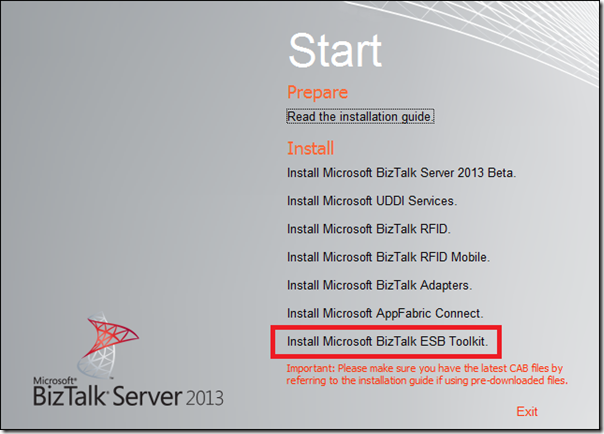
ESB Toolkit is now fully integrated with BizTalk Server, which means it does not require you to download it separately. So the ESB Toolkit is now packaged by BizTalk media like adapter pack was with the BizTalk 2010 release. The ESB Toolkit configuration experience is vastly simplified to enable a quick setup. Through Installation Wizard you can install the ESB Toolkit.
A wizard starts when clicking the Install Microsoft BizTalk ESB Toolkit link.
Click Next to continue the installation.
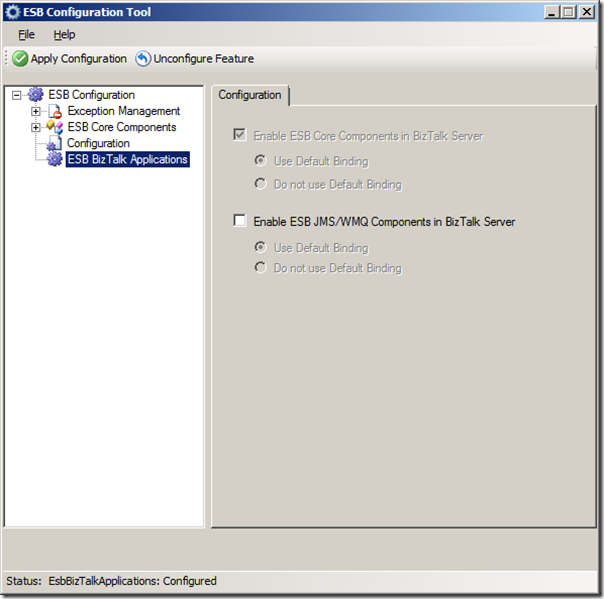
Click Install. The Installation ESB Toolkit is a very straight forward and quick. After installation you can configure the ESB Toolkit through ESB Configuration Tool. A dialog will appear where you fill detail for configuration of the ESB.
Click Apply Configuration. The ESB BizTalk Components under the ESB BizTalk applications is new.
Default the check boxes are not checked. Check the Enable ESB Core Components in BizTalk and click Apply Configuration.
Configuration is done and Microsoft.Practices.ESB application is available in the BizTalk runtime.
The final step is installing the Exception Management Portal, which needs to be installed the same way as with version 2.1. You will installation guide in C:\Program Files (x86)\Microsoft BizTalk ESB Toolkit.
Tracking Dependencies Between Artifacts in a BizTalk Server Application
In the BizTalk administration console the dependencies between artifacts can now be viewed and navigated. A BizTalk applications can have many dependencies and if for instance you need to adjust one of the artifacts. Dependency information of an artifact can be very valuable; you must know which artifacts in the dependency hierarchy must be stopped or re-deployed. The BizTalk Server Administration console displays the dependency information in modes – whether an artifact uses another artifact as well as whether an artifact is used by another artifact.
The Microsoft.Practices.ESB.Agents.Delivery has one dependency (Send Port)
Click Send Ports and you will the send port.
There are more enhancements and more new features than the ones I discussed here. I will be trying out some of the other features in the near future and share my experience.
Cheers,
Steef-Jan

by community-syndication | Nov 7, 2012 | BizTalk Community Blogs via Syndication
What a surprise today finding out that Microsoft has decided to brand it’s next versionof BizTalk Server as BizTalk Server 2013. Even better, they’ve already thrown a beta version atthe general publicwhich is a whole lot more full-fledged in terms of new features compared to some earlier builds made available to a select audience. While […]
Blog Post by: Johann

by stephen-w-thomas | Nov 6, 2012 | Stephen's BizTalk and Integration Blog
Over the past few months I have been blogging a lot about the new Windows Azure Virtual Machines. That is because I can see the huge impact on projects for having this type of infrastructure available literally at your fingertips – for pennies an hour.
Just yesterday I setup a full windows domain with 4 servers accessible worldwide in a matter of an hour or two.
I wanted to highlight the general complexity I see at many client related to setting up a new Virtual Machine. I created a video and entered it into the Windows Azure Makes Me FAST Contest. The video is called “The Story of your Life – Mr. Virtual Machine”. It is a “remake” of the old TV Show This Is Your Life well at least that was the goal.
Take a look at the video below and vote for it if you like what you see!
Step 1: Got to http://www.meetwindowsazure.com/fast and find my video. The videos are in the middle of the page. You might have to click the right arrow to see it.

Step 2: Look for video titled “The Story of your Life – Mr. Virtual Machine by Stephen W. Thomas”.

Step 3: Watch it and Vote for it if you like it.

Of course, if you do not like the video please do not vote for it. This website has a lot of other interesting videos. The coolest, next to mine of course, is the one by Alan Smith – “Rapid Massive On-Demand Scalability Makes Me Fast!”. It is well worth a watch.
by community-syndication | Nov 6, 2012 | BizTalk Community Blogs via Syndication
Congratulations to Anthony Borton on becoming a Microsoft Quality Enablement Specialist. Anthony is Quicklearn’s lead TFS trainer and courseware developer and earlier this week he passed Microsoft exam 70-497: Software Testing with Visual Studio 2012. This is one of three exams Microsoft have recently released focusing on TFS 2012.
If you’d like to become a Microsoft Quality Enablement Specialist, the best way to prepare yourself for the exam is to attend one of our upcoming courses.
- December 3rd & 4th, 2012
- February 7th & 8th, 2013
- April 15th & 16th, 2013
Our Software Testing with Visual Studio 2012 course is a 2-day course that gets you up to speed with all aspects of testing using Microsoft Test Manager 2012.
Student feedback from the most recent course has been overwhelmingly positive and here’s just one example from an attendee.
“Anthony was FANTASTIC! Did a great job of keeping it interactive for the full 2 days. He explained things very well and at a level for all attendees, especially with the diverse backgrounds and work experiences.” – October 2012.
by community-syndication | Nov 6, 2012 | BizTalk Community Blogs via Syndication
It’s finally happened!! Microsoft has officially opened a public beta for BizTalk Server 2013. The beta bits can be downloaded here.
Here are my personal top 5 new features of BizTalk Server 2013. I know that many of my customers have been asking for some of these features for a while.
- Too many new adapters to keep up with
- Integration with RESTful services – new BizTalk adapters provide CRUD operations using REST endpoints.
- New and Improved SharePoint adapter – Previous SharePoint versions did not support client-side API calls so the BizTalk Adapter required installing a special web service on the SharePoint front-end server(s). SharePoint 2010 and the soon-to-be-released SharePoint 2013 both support client-side API calls. The new BizTalk Adapter for SharePoint takes advantage of these client-side APIs to provide an easier, more seamless integration experience.
- Azure Service Bus integration – adapters to connect to Azure Service Bus endpoints
- SFTP adapter – If I had a dime for every time someone asked about an SFTP adapter…
- ESB Toolkit 2.2 – while the internals of the ESB Toolkit is largely untouched, the latest release boasts a better configuration experience, and full-fledged support.
- Dynamic send port configuration – You can now specify which adapter handler your dynamic send port will use rather than being stuck with the default handler.
- Artifact Dependency Tracking – The BizTalk Server Administration console provides better explanation of dependencies among artifacts (for example, orchestration X requires: schemas Y and Z).
- General Performance Improvements – Significant changes under the covers has improved the performance of send port when using ordered delivery as well as the mapping engine
Although not available yet, I’m also excited that a new Azure VM with the BizTalk Server 2013 Beta is on its way.
I’m also pleased to announce that QuickLearn Training is diligently working on new versions of all of our Developer and Administrator BizTalk Server courses designed for BizTalk Server 2013.
by community-syndication | Nov 6, 2012 | BizTalk Community Blogs via Syndication
It’s very exciting to see the new major release of BizTalk – BizTalk 2013 beta. There has been much speculation around what it will be called since the Tech Ed announcement this year in Orlando. Microsoft will continue to support the platform with BizTalk 2013 (not 2010 R2 as previously announced). I’m reassured that the […]
Blog Post by: Stan Kennedy
by community-syndication | Nov 6, 2012 | BizTalk Community Blogs via Syndication
We are super excited to announce the Beta release of BizTalk Server 2013 (yes, this is a major release). We announced our CTP in August and since then we have added a bunch of really cool capabilities, including SFTP support, ESBT integration, better SharePoint integration, and simplified manageability via dependency tracking in BizTalk Admin console.
We enabled a bunch of integration capabilities in CTP, and with the Beta release it just got better. You can now download the Beta bits here. All these capabilities will be available in Windows Azure Virtual Machine platform gallery soon. This beta release of BizTalk Server 2013 includes the beta version of new HIS capabilities as well.
Following is a quick overview of the capabilities in BizTalk Server 2013 Beta, including the ones that have been added since CTP
- Integration with Cloud Services – BizTalk Server 2013 Beta includes new out-of-the box adapters to send and receive messages from Windows Azure Service Bus. It also provides capabilities to transfer messages to relay endpoints hosted on Azure.
- RESTful services – BizTalk Server 2013 Beta provides adapters to invoke REST endpoints as well as expose BizTalk Server artifacts as a RESTful service.
- Enhanced SharePoint adapter – Integrating with SharePoint using BizTalk Server 2013 Beta is now as simple as integrating with a file share. We have removed the need for dependency on SharePoint farms, while still providing backward compatibility.
- SFTP adapter – BizTalk Server 2013 Beta enables sending and receiving messages from an SFTP server.
- ESB Toolkit integration – With BizTalk Server 2013 Beta, ESB Toolkit is now fully integrated with BizTalk Server. Also, the ESB Toolkit configuration experience is vastly simplified to enable a quick setup.
- Dependency tracking – The dependencies between artifacts can now be viewed and navigated in Admin console
- Improvements in dynamic send ports – BizTalk Server 2013 Beta provides the ability to set host handler per adapter, instead of always using the default send handler of the adapters.
- XslCompiledTransform – BizTalk Server mapping engine makes use of XslTransform API for mapping needs. With BizTalk Server 2013 Beta release, the mapping engine makes use of the enhanced XslCompiledTransform API. This will provide improvements in mapping engine performance.
- Ordered Send Port improvements – With BizTalk Server 2013 release, we have made changes to the BizTalk runtime engine which increases the performance of ordered send port scenarios.
- BAM Alerts update – In previous releases of BizTalk Server, BAM Alerts feature had a dependency on SSNS (SQL Server Notification Services). With the current release of SQL Server (SQL Server 2012), SSNS is no longer available. However, we have made sure your existing BAM Alerts scenario work just the same even if your backend is targeting SQL Server 2012. If your backend is SQL Server 2008 R2, you will continue to require the dependency on SSNS.
In HIS 2013 Beta, we have made significant improvements in the following areas:
- Data Integration – New OLE DB Provider for Informix and new Service for DB2 DRDA.
- Application Integration – New Transaction Integrator runtime and web configuration-based administration and deployment.
- Network Integration – New 3270 emulator and improved Session Integrator, both with direct TN3270 connectivity.
- Platform Support – Support for Window Server 2012, Visual Studio 2012, SQL Server 2012, BizTalk 2013 and new IBM Systems.
Over and above these, BizTalk Server 2013 Beta continues to enable integration solutions with heterogeneous Line-of-business systems. It helps you optimize user productivity, gain business efficiency and increase agility. BizTalk Server 2013 Beta allows .Net developers to take advantage of BizTalk capabilities right out of the box to rapidly build solutions that need to integrate transactions and data from applications like SAP, Mainframes, MS Dynamics, and Oracle. Similarly SharePoint developers can seamlessly use BizTalk capabilities directly through the new Business Connectivity Services in SharePoint.
You can use the following resources to get started
- Download BizTalk Server 2013 Beta – click here
- BizTalk Server 2013 Beta documentation – click here
Blog Post by: BizTalk Blog
by community-syndication | Nov 6, 2012 | BizTalk Community Blogs via Syndication
This must put an end to the debate going on for the past two years "BizTalk is Dead". Both as a consultant in the past and founder of BizTalk360 I meet lot of customers who invested heavily on BizTalk server. For the past couple of years with the innovation going on in the cloud space, […]
The post BizTalk Server 2013 BETA appeared first on BizTalk360 Blog.
Blog Post by: Saravana Kumar
by community-syndication | Nov 5, 2012 | BizTalk Community Blogs via Syndication
Microsoft released some exciting news on Monday for people who live and breathe Middleware. They have released BizTalk 2010 R2 CTP’s successor: BizTalk 2013 Beta. The new name signifies a major release and rightfully so, it does deserve it.
Back in June 2012, I was at TechEd North America where the BizTalk team provided a glimpse into the future of BizTalk. At that point, I did feel that they were adding enough new functionality to warrant the full release but it was only until today that they officially announced the name change.
What is included in this release?
Many of the features that they did speak to at TechEd have been included in the CTP including:
- Integration with Cloud Services via SB-Messaging Adapter
- Support for RESTful Services (both Send and Receive)
- Platform Support (Windows Server 2012, Visual Studio 2012 and SQL Server 2012)
- Azure BizTalk VMs (IaaS)
The BizTalk team has now added some more features within the Beta including:
- Enhanced SharePoint Adapter (No longer do we need to install an agent(web service) on the SharePoint Server)
- Secure FTP (SFTP) Adapter
- ESB Toolkit Integration
- Dependency Tracking (The dependencies between artifacts can now be viewed and navigated in Admin console)
- Improvements to Dynamic Send Ports (ability to set host handler per adapter, instead of always using the default send handler of the adapters)
After I discovered the Microsoft post I sent it off to my team and a lively discussion was held. There was a bit of a debate over which of the feature we can benefit from the most. The interesting thing is that we can benefit from each of these new features.
SharePoint Adapter
We do a lot of work with SharePoint and in addition to running a multi-node BizTalk farm we also have a multi-node SharePoint farm. The BizTalk team does not like installing the Adapter Web Service on the SharePoint Web Front ends so you can imagine that the SharePoint team isn’t a big fan of it either. To make things worse, try to perform an upgrade from BizTalk 2009 to BizTalk 2010 and ask a SharePoint person to come in on the weekend to assist with the install. Not going to make many friends that way.
Secure FTP (SFTP) Adapter
It is great to see a native SFTP adapter being included “in the box”. Back in BizTalk 2009, Microsoft provided an FTPS adapter but that protocol is not nearly as pervasive as SFTP, in my opinion anyways. As you may have seen on my blog previously, I do have several posts about a 3rd party SFTP adapter. The adapter has been a pretty good adapter for us. Yes there have been a few bugs, but the vendor has always provided top notch support. However, it is a pain to deal with another vendor, pay another invoice and get license keys.
ESB Toolkit Integration
We don’t do much with ESB itineraries but we do heavily leverage the Exception Management Portal that is included in the toolkit. We have made some small modifications, to the exception portal, and many of our Business Units rely upon it for Business level exceptions that occur within the Middleware or other systems like SAP. There are many opportunities for improvement and the installation is certainly one of them. So even though the description on the Microsoft link is rather vague, I am really hoping for a seamless experience this time around.
Dependency Tracking
We have a fairly large BizTalk environment. It is something that we have been building upon for the last 7 years. I can confidently say that our Business runs on top of BizTalk. If BizTalk doesn’t function, there are widespread impacts to our employees and customers. A Vice President was asking me about BizTalk and he was purely amazed that it supported so many Business processes within the company. With that said, we try to leverage common components and leverage previous investments. Overtime this can be difficult to manage so this feature is definitely welcomed.
Improvements to Dynamic Send Ports
We do have a few different scenarios where we need to determine the route that a message will take at run-time and has been a bit of a pain that these messages will always be processed by the default send handler for that Adapter. It will be nice to have some more granularity.
RESTful Services
Looking back there have been a few different integration scenarios where could have benefited by a ’lighter weight’ service construct. I don’t expect this to be our de facto standard when exposing services but I do recognize the benefit in having a more flexible option than SOAP.
Integrations with Cloud Services via SB-Messaging Adapter
If you have been following my blog recently, I have quite a few posts (Post 1, Post 2, Post 3, Post 4 and Post 5) on the new SB-Messaging Adapter which allows us to connect Service Bus Queues and Topics. I actually have a blog post currently in the works with the CTP version but I will now save it and implement it with the new Beta. So far I have been very impressed with this new capability. It is very easy to get this to work. It will be this adapter that allows for many(but not all) hybrid integration scenarios with on-premise Line of Business (LOB) systems. I fully expect BizTalk PaaS to participate in LOB integration scenarios but for those customers who have heavily invested in BizTalk, leveraging the SB-Messaging adapter has many benefits.
Azure VM BizTalk IaaS
I haven’t actually had a chance to try this out. We do a lot of On-Premise integration so it just hasn’t been a big of a priority for me. I do recognize the value for some people though. It creates a much lower barrier of entry for some organizations and allows them to get their “feet wet” with BizTalk before investing more significant capital in a larger environment.
Host Integration Services 2013 Beta
In addition to all of these BizTalk features a Beta of Host Integration Services (HIS) has also been released. This version includes the following updates:
Data Integration – Several key updates in integration with DB2.
Application Integration – Updates to Transaction Integrator designer, tools and accounting.
Network Integration – Direct connectivity from Server/Client to IBM mainframe systems using fully managed TN3270E runtime.
Message Integration – WCF Channel Support for WebSphere MQ v7.5 and v7.1.
Platform Support – Introducing the support for Window Server 2012, Visual Studio 2012, SQL Server 2012, BizTalk 2013 and IBM Systems.
Conclusion
From what I have seen with the BizTalk 2010 R2 CTP, the BizTalk team has been working very hard on this next release of BizTalk. I think they are already demonstrating that the end product will be very solid as they have put together two compelling “pre-releases” of BizTalk. I really encourage you to download the new bits and take the new BizTalk for a spin. There are a lot of great features included.

by community-syndication | Nov 5, 2012 | BizTalk Community Blogs via Syndication
Exciting news there’s a new release of “BizTalk Mapper Extensions UtilityPack” with new functoids but before talking about them there is another subject that I want to talk first I finally opened this project to other community members and the first person that I invited and gladly accepted my invitation was my good friend Nino […]
Blog Post by: Sandro Pereira