by community-syndication | Oct 14, 2009 | BizTalk Community Blogs via Syndication
We’re five weeks out from PDC09, and the rest of our sessions went live last week. I know I posted a couple weeks ago about PDC and sessions that went live, but I wanted to let folks know about the four new sessions – to help you maximize your experience around the Connected Framework technologies!
This looks to be a great event, as the team dives in deep on the enhancements coming with .NET 4, and discussing some of the thoughts around what’s to come next.
PDC Sessions of Note
The below list is a refresh of the one I posted a couple weeks ago, with additions marked out.
The larger team will be delivering the following seven sessions:
- Microsoft Application Server Technologies: Present and Future (Anil Nori)
- What’s New for Windows Communication Foundation 4 (Ed Pinto)
- Windows Workflow Foundation 4 from the Inside Out (Bob Schmidt)
- Spice up your applications with WF 4 (Matt Winkler)
- Workflow Services and ’Dublin’ (Mark Fussell)
- Microsoft BizTalk Server Futures and Roadmap (Balasubramanian Sriram)
- Connecting Applications with the Microsoft BizTalk Enterprise Service Bus (Syed Rasheed; Ron Jacobs)
In addition to the sessions being done by the team, WCF comes up in several other sessions of note at the event:
- Accelerating Applications Using Windows HPC Server 2008
- Networking and Web Services in Silverlight
- It’s All About the Services: Developing Custom Applications for Microsoft SharePoint Server 2010 Using Microsoft ASP.NET, WCF, and REST (Maxim Lukiyanov)
- Queuing and Publish/Subscribe in a Heterogeneous Environment (David Ingham; John O’Hara)
- Using ADO.NET Data Services (Pablo Castro)
- Data Programming and Modeling for the Microsoft .NET Developer (Don Box, Chris Anderson)
On the Floor of the Event
As an update, we have confirmed that we will have a small 20-seat theatre in the Framework and Tools lounge area. In the theatre area, we’ll be doing a series shorter ’chalk talks’, discussing more special interest topics. There are some real gems being planned for discussion; we’re looking forward to hearing your thoughts.
I’ll post up any additional notes as we come up on the event. And, as a reminder, drop a note if you want to catch up with someone from the team while at PDC. Let me know what you would like to discuss, and I’ll reach out to the team that will be in LA and try to connect you with someone so you can coordinate schedules.
Hope to see y’all in LA!
Cliff
by community-syndication | Oct 14, 2009 | BizTalk Community Blogs via Syndication
BizTalk 2006 R2 Service Pack 1 Beta 1has been released. It’s available through MS Technology AdoptionProgramat https://connect.microsoft.com/site/sitehome.aspx?SiteID=65.List of features http://msdn.microsoft.com/en-us/library/ee532481(BTS.20).aspx.
by community-syndication | Oct 13, 2009 | BizTalk Community Blogs via Syndication
Thanks to Jean-Pierre for a good SBUG event today, as discussed in the meeting below is some followup information.
Video
The video from this session is available here:
https://www311.livemeeting.com/cc/mvp/view?id=M56GT6
Forum/Q&A
If anyone has a question about the video please add it to the below forum.
http://sbug.org.uk/forums/p/169/253.aspx#253
Resources
A number of useful links related to todays meeting:
Terminator Tool: http://blogs.msdn.com/biztalkcpr/pages/biztalk-terminator-download-install-info.aspx
Jean-Pierres Blog: http://blogs.technet.com/jpierauc/default.aspx
by community-syndication | Oct 13, 2009 | BizTalk Community Blogs via Syndication
Hi all
Just to let all you Danes know, Alan Smith (MVP) will be delivering the famous Quicklearn
courses in BizTalk Deep Dive and BizTalk for Administrators in Copenhagen this fall.
You can see more about the courses at
BizTalk
2009 Developer Deep Dive – November 16’th
BizTalk
2009 for Administrators – November 30’th
Both courses are 5 days.
—
eliasen
by community-syndication | Oct 13, 2009 | BizTalk Community Blogs via Syndication
Johan Lindfors and Patrik L%u00f6wendahl did a duoblog titled “Everybody wants choices but nobody wants to make a choice” where they wrote about the growing opinion that software development and .net framework is getting to complex. It was later commented by Johan Hedberg among others.
It’s a very relevant issue, as many of us struggle to convince other developers and organizations to embrace new technology. But even though I agree with most of what’s been said, there is one part I strongly disagree with:
Patrik L%u00f6wendahl wrote:
“..developers seem to not understand the basics of the job requirements. As a software developer, my job always include constant learning and constant improvement of my skills. If I can’t agree with that I am a bad developer. This is not the tool vendors fault, this is because business change, improve and learn as well. If we don’t do that with them, we will be left behind.”
Only a tiny fraction of the worlds software is currently being built, some is being re-factored but the overwhelming majority is in “maintenance mode”. Of course this allocation is also reflected among developers, as many are working with already existing applications, adding new features, fixing bugs etc.
Naturally, these developers grow more focus and understanding of business requirements rather than the evolvement of the underlying technique. This is only natural as transition from already established standards such as Visual Source Safe, ODBC and ASMX, will not be prioritized in comparison with new features and capabilities of an already working system.
One could argue that if they don’t keep up with the latest technology, their system will eventually become unmanageable. When key resources find better (and more interesting jobs), they will face a challenge finding anyone willing to take the job. But if this is the reason for adapting to the latest technology, it’s not the technology in it self they will benefit from, but the access to “good developers”.
As Johan pointed out, this is a problem for the management. -Sure there are bad developers, but focusing on the business needs and prioritizing your family and friends does not make you one!
If I’d call for the janitor to come and help me with a problem in my apartment, I’d rather see the a person with years of experience from my building than an outsider with a cool tool belt. The knowledge about every pipe in the building, will impress me more then the DeWalt DC927KLV in his hand.
Everyone who knows me, knows that the last comment is a lie. I would drool over the DC927, in fact begging to try it out. But the point is, my passion for technology (and power tools), does not necessary make me a good developer, for the same reason the employee with a deep understanding of the business is not necessary a “bad developer”.
It’s all about being the right person for the job, eager to solve the business need. Sometimes, and especially in new projects, the passionate developer is essential to make life easier for the ones making sure it will evolve with the change of the business.

by community-syndication | Oct 13, 2009 | BizTalk Community Blogs via Syndication
[In addition to blogging, I have recently been using Twitter to-do quick posts and share links. You can follow me on Twitter at: www.twitter.com/scottgu (@scottgu is my twitter name)]
This is the eighth in a series of blog posts I’m doing on the upcoming VS 2010 and .NET 4 release. Today’s post covers a cool new runtime feature in ASP.NET 4 – which is the ability to use URL routing with Web Forms based pages.
What is URL Routing?
URL routing was a capability we first introduced with ASP.NET 3.5 SP1, and which is already used within ASP.NET MVC applications to expose clean, SEO-friendly “web 2.0” URLs. URL routing lets you configure an application to accept request URLs that do not map to physical files. Instead, you can use routing to define URLs that are semantically meaningful to users and that can help with search-engine optimization (SEO).
For example, the URL for a traditional page that displays product categories might look like below:
http://www.mysite.com/products.aspx?category=software
Using the URL routing engine in ASP.NET 4 you can now configure the application to accept the following URL instead to render the same information:
http://www.mysite.com/products/software
With ASP.NET 4.0, URLs like above can now be mapped to both ASP.NET MVC Controller classes, as well as ASP.NET Web Forms based pages.
Mapping URLs using ASP.NET MVC
The URL Routing engine introduced with ASP.NET 3.5 SP1 provides a powerful way to handle incoming URLs. Typically you write code as part of application startup to register/map URLs that match a specific URL format to code handlers.
Below is an example of how you can use ASP.NET MVC today to map the /products/software URL to a controller class called “Products” that has an action method named “Browse”:
The first “products-browse” parameter to the MapRoute() helper method above is a friendly name for the route. The second “products/{category}” parameter is the URL filter that matches the /products/software URL – and which treats the second segment of the URL as a parameter value called “category”. This parameter will then be passed to the ProductsController’s Browse() action method to process.
Mapping URLs using ASP.NET Web Forms
ASP.NET 4.0 now allows you to also use the URL Routing engine to map URLs to ASP.NET Web Forms pages as well as ASP.NET MVC Controllers.
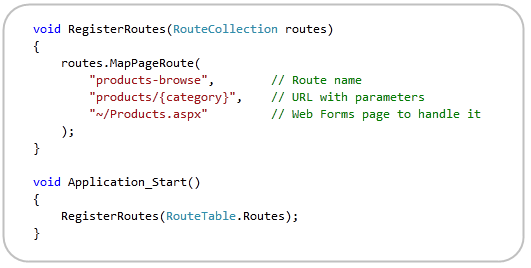
Below is an example of how you can use the new MapPageRoute() helper method in ASP.NET 4.0 to map the /products/software URL to a “Products.aspx” page that lives immediately under the application root directory:
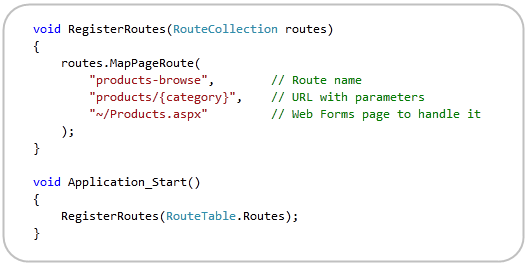
The first two parameters to the MapPageRoute() helper are the same as in MapRoute(). The first parameter provides a friendly name for the route, and the second specifies the URL format to match. The third parameter, though, points to a Products.aspx page to handle the URL instead of a controller class. You can optionally specify additional parameters to MapPageRoute() that take advantage of features like “route constraints” and provide “default values for parameters” just like you can with ASP.NET MVC based route registrations.
Within the Products.aspx page you can then write code like below that uses the new Page.RouteData property in ASP.NET 4.0 to retrieve the “category” parameter value mapped using the /products/{category} URL filter, and then databind the category products to display them:

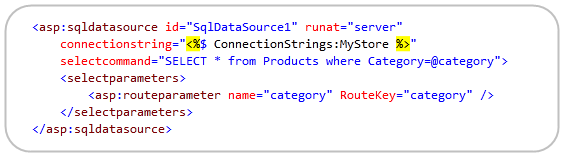
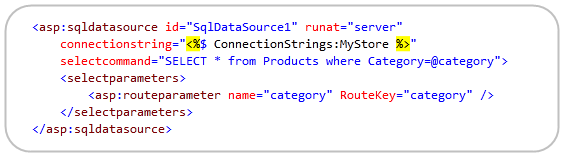
In addition to programmatically accessing incoming route parameters using code like above, you can also take advantage of the new declarative <asp:routeparameter> control with any ASP.NET DataSource control to declaratively bind a value from a route as well. For example, below we are using a <asp:routeparameter> statement to bind the select statement’s @category parameter from the /products/{category} parameter in the URL route:
Retrieving URLs within an ASP.NET Web Form
The URL routing engine in ASP.NET can be used to both map incoming URLs to code handlers, as well as be used to programmatically generate outgoing URLs using the same mapping registration logic.
For example, above when we mapped the /products/{category} URL we gave it a “friendly name” of “products-browse”. This allows us to now also use the new Page.GetRouteUrl() helper method to lookup the route within the URL routing system, optionally specify parameters to it, and then retrieve an actual URL that it maps back to. For example, the below code would retrieve a URL value of “/products/software”:

You can access the above helper method within either your code-behind file or within your .aspx markup.
There is also now a Response.RedirectToRoute() set of methods that you can use to redirect users to a route (regardless of whether it is a MVC or Web Forms handled one) and optionally pass parameters to it.
Handling PostBack Scenarios
URL Routing with ASP.NET 4.0 fully supports postback scenarios. The <form runat=”server”> control will automatically emit the same URL that caused the page to be rendered. For example, if you access a page with a /products/software URL then any server-side <form runat=”server”> control within it would render out a <form action=”/products/software”> HTML element back to the client – which means that any postback scenarios that happen on the page will preserve the original URL.
This makes supporting clean, SEO friendly, URLs easy with Web Forms and postback scenarios – and avoids some of the tricks people need to use today when using URL rewriting modules to achieve similar effects.
Summary
ASP.NET 4.0 makes it easy to implement clean, SEO friendly, URLs using both ASP.NET MVC and now ASP.NET Web Forms (you can also have applications that mix the two).
The URL routing engine makes it easy to register URLs of any shape or format and map them to any handler you want. Because the URL routing engine can be used for both mapping incoming URLs as well as generating outgoing URLs, you can at a later point change the URL mappings and not have to modify any page or controller specific code to reflect them – which makes building SEO optimized applications much easier.
Hope this helps,
Scott
by community-syndication | Oct 13, 2009 | BizTalk Community Blogs via Syndication
I will be speaking at TechEd Europe 2009 in Berlin Germany November 9th through the 13th.
I will be presenting two sessions. My first is a ‘Deep Dive with Microsoft BizTalk Server 2009 Development Platform’ and my second is ‘Customizing and Extending the BizTalk WCF Adapters’.
If you are going to be there stop by and say hello.
by community-syndication | Oct 12, 2009 | BizTalk Community Blogs via Syndication
The following blog post by Atin nicely explains how to go about doing this
http://blogs.msdn.com/biztalkcpr/archive/2009/10/05/inserting-parent-child-records-with-identity-column-using-wcf-sql-adapter-in-one-transaction.aspx
by community-syndication | Oct 12, 2009 | BizTalk Community Blogs via Syndication
Hi all
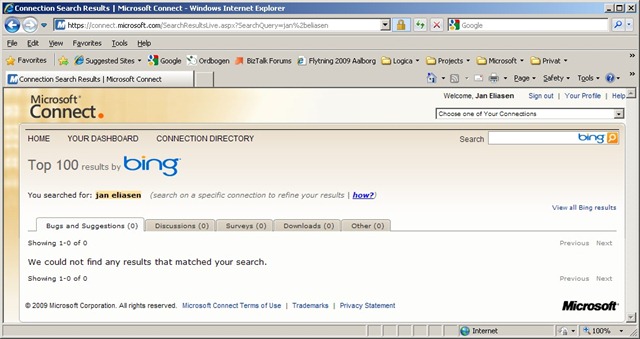
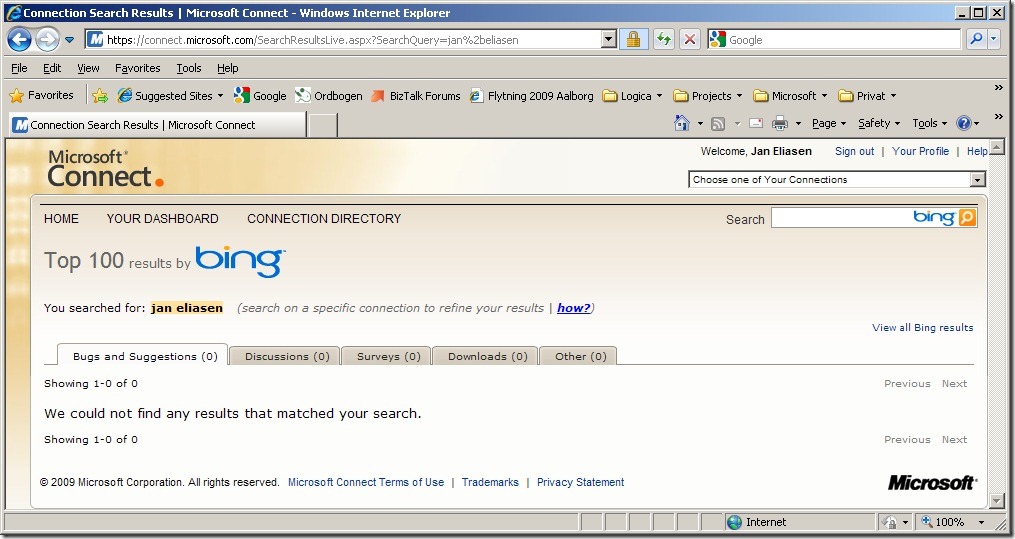
I just discovered a funny “feature” of the Bing Search on the Connect site:
So it is showing me results 1-0 of 0
Funny, eh? No? Maybe? Oh, nevermind 🙂
—
eliasen
by community-syndication | Oct 12, 2009 | BizTalk Community Blogs via Syndication
Microsoft BizTalk Server 2006 R2 Service Pack 1 (SP1) is an update for BizTalk Server 2006 R2. It includes fixes to issues that have been reported through our customer feedback platforms, as well as internally discovered issues.
It is available for download on the Microsoft Connect site to any customers that sign in to that site with their Live ID. Any feedback or issues you encounter can be reported here.
To see a listing of the customer-reported issues that are fixed in this service pack, click here.
For a description of some of the other updates included in this service pack, see What’s new in BizTalk Server 2006 R2 SP1. For a list of of BizTalk Server hot fixes that are included in BizTalk Server 2006 R2 Service Pack 1 Beta click here.