by community-syndication | Mar 13, 2007 | BizTalk Community Blogs via Syndication
To enable the keyboard shortcuts, logon to Gmail and click on Settings, then select Keyboard shortcuts on in the Keyboard shortcuts configuration section and then click on Save Changes at the bottom.
by community-syndication | Mar 13, 2007 | BizTalk Community Blogs via Syndication
If you’re interested in running Windows Vista natively on your MacBook (Pro) hardware, here are some simple instructions to follow:
- Defragment and compact your hard drive using a tool like iDefrag.
- Download and install Apple’s Boot Camp.
- Run Boot Camp Assistant and follow the instructions to create CD containing MacBook drivers and the new hard drive partition for Windows Vista.
- Install Windows Vistafrom your installation media (whenever you boot, you’ll need to hold the Option key down to select the new Windows partition).
- Once installed, do a Windows Update and install any critical updates.
- Extract the MacBook drivers from the CD to your Vista drive. You can do so by executing the following command: “Install Macintosh Drivers for Windows XP.exe” /A /v
- Open Device Manager and try to update the driver for each device showing an exclamation, pointing to your directory of MacBook drivers when prompted. At this point, most things will work except for wireless, one USB Human Interface Device, and Performance Counters.
- Download and install this driver to get wireless working.Thinkpad 60’s use the same chipset. I still haven’t found drivers for the other two, and haven’t heard of anyone else who has.
- Download and install Input Remapper to configure your MacBook keyboard, to control the screen/keyboard backlights, and to get right click back.
- Enjoy your new Windows Vista Mac.
You’ll be amazed at how beautifully Vista runs on Apple’s hardware.
by community-syndication | Mar 13, 2007 | BizTalk Community Blogs via Syndication
Yesterday I was working on some XSLT stylesheets, and was testing them in Internet Explorer. That is, I was applying the <?xml-stylesheet type=”text/xsl” href=”<stylesheet>.xsl”?> declaration to the top of my XML document, and then viewing the transformed output in IE. However, you can’t view the underlying result of the output in IE, only […]
by community-syndication | Mar 13, 2007 | BizTalk Community Blogs via Syndication
If you like to see the latest version of the RuleManager with support for Microsoft Windows Workflow Foundation, you can request to see the product in action at the Business Rules Forum. Fill in the form here.
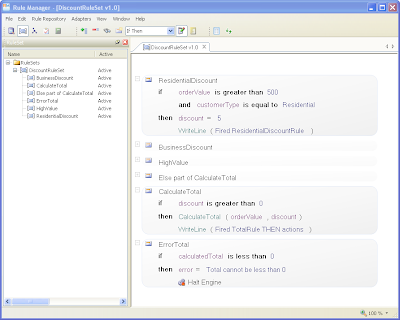
The image shows the imported DiscountRuleSet from the Microsoft Windows Worklow Foundation advanced policy example.
by community-syndication | Mar 13, 2007 | BizTalk Community Blogs via Syndication
One of my favourite blogs at the moment is ‘Worse than Failure‘ (formerly ‘The Daily WTF’ – I’ll let you guess what that means).
Todays entry – Shooting Xml – is about Xml, or rather how not to do Xml; I’m sure there is an adequate business case here for BizTalk…
I think my favourite quote is: […]
by community-syndication | Mar 13, 2007 | BizTalk Community Blogs via Syndication
I would like to thank the Academy, the audience and … 🙂
This morning Yves Hanoulle IM-ed me to congratulate me. It’s not my birthday, I did not win any lottery so I had no clue what happened to me! Yves told me that my blog made it in BVLG’s list of 20 most influential Flemish blog personalities in Belgium (freely translated from the Dutch blog post). I have no idea about how this list was calculated but as Yves point out there are quite a few bloggers who discuss .NET/IT related topics (like my blog). Anyway it’s always fun when somebody says something nice about you. Flemish people actually have an abbreviation for famous people: BV or Bekende Vlaming (translated: Famous Flemish person), so am I a BB now (Bekende Blogger)? (just kidding!)
This is what BVLG has to say about me (in Dutch): Jan Tielens is .NET Architect / Trainer bij U2U waarbij hij zich gespecialiseerd heeft in Sharepoint ontwikkeling. Jan Tielens is de ontwikkelaar van %u00e9%u00e9n van de meest populaire Sharepoint webparts, de SmartPart. In 2005 kreeg Jan Tielens erkenning als Microsoft Most Valued Professional (MVP) voor SharePoint Portal Server. Jan Tielens zijn blog “Jan Tielens’ Bloggings” is wereldwijd erkend als informatiebron over SharePoint en BizTalk Server 2004. Zijn blog, gestart in februari 2003, telt dagelijks meer dan 1500 bezoekers, waarvan de Belgische bezoekers slechts een kleine minderheid van vormen. Zijn WordPress fotoblog is veel minder gekend, net zoals zijn collectie foto’s op Flickr. Jan Tielens komt in deze rangschikking een plaatsje hoger te staan dan Patrick Tilleghem, collega bij U2U. Jan is vroeger gestart met zijn blog, zijn blog wordt door meer mensen gelezen en heeft een hogere Technorati rank. Bovendien is het Google Quoti%u00ebnt en het Blog Quoti%u00ebnt van Jan Tielens ook hoger. full blog post here
It seems that BVLG has done some research since he mentioned my photoblog as well. Photography is just a hobby for me and I don’t pretend I’m a good photographer in any way. I just like to take pictures of all the things around me and I love to share that with the rest of the world, so if you’re interested feel free to visit http://jantielens.wordpress.com or my Flickr Photo Stream.
Technorati tags: blogosphere, belgium, jan tielens, yves hanoulle
by community-syndication | Mar 13, 2007 | BizTalk Community Blogs via Syndication
I'm in soggy Seattle at the MVP Global Summit, and, like so many of my fellow MVPs, it seems appropriate to keep some kind of daily journal – you know the form – let you know how fortunate I am to be on a big Microsoft freebie, and how unfortunate you are to, er…, not be…and, of course, get a bit of name-dropping in as well.
The first round of name-dropping has nothing to do with the summit. A week ago I was at the Microsoft Architect Insight conference at the Celtic Manor outside Newport, Wales. The Celtic Manor is famous for golf and is the venue for the 2010 Ryder Cup. It is also famous, these days, for software architects working on the Microsoft platform. This was the second year of the conference, and SolidSoft, having attended last year, was a co-sponsor of the event this year. The conference started with a keynote from Merlin Hay who, later in the bar, entertained a group of us with his views on hereditary peerage and 'breeding' (what else – he is the 24th Lord Erroll!), and, more seriously, provided some interesting insights into the way that political decision-making happens at a national level. Later that evening, the SolidSoft team had the pleasure of a couple of hours with Ivar Jacobson, one of the 'three amigos' (the gentlemen responsible for UML) and an early advocate of component development. Perhaps the best thing was that, instead of deep discussions on the applicability of agile methodologies in enterprise integration, we instead talked love, live and the pursuit of happiness. Hey, we do have lives! I enjoyed the final plenary with Ivar, Jack Greenfield (the software factory guy) and Colin Bird sharing their collective insights and views on a range of architecture and methodological subjects.
It was nice to briefly meet Ed Gibson again. Ed is Microsoft's Chief Security Advisor in the UK, and always a great pleasure to talk to. I was also glad to, oh so briefly, catch up with Planky (Steve Plank) from Microsoft who fronted a series of sessions on security and identity management. Well done to Matt Deacon and Daniel Nissel who made the whole event happen. It was good to see my old colleague, James Saul, and I enjoyed his session on real world architecture (I left the heckling to Andrew Rivers 😉 ). Most embarrassing moment was parading the SolidSoft corporate train set (don't ask!) in front of rival companies' stands. The train set did fulfil its role, though, as a talking point around RFID, and Simon Holloway did a great presentation on the subject at the end of the conference. Thanks to Andy James for keeping the SolidSoft team on the straight and narrow, and well done to Pam McClelland who fronted the SolidSoft stand.
The conference, itself, was very worthwhile. Software, infrastructure and enterprise architecture covers very wide territory. Real effort was made to focus the conference on a range of architectural issues, and to capture the collective wisdom of the delegates. I have personally never attended an IT conference that was so interactive, and hope that this aspect is continued and built on in future years. Listening to discussions on issues like the development of IT skills in higher education or the effective presentation of enterprise architectures to business stakeholders took me into unfamiliar territory which broadened my horizons and provided food for thought.
Well, that’s a lot of name-dropping from the Welsh event. Now back to Seattle. Today was the first day of the conference, and has mainly been a matter of registration and networking. However, things really got underway yesterday evening when a group of BizTalk MVPs got together at Kells, an Irish pub in downtown Seattle. Mike Woods, the BizTalk Server Senior Technical Product Manager, was there, and he surprised us by paying for the meal – thanks to him for that. I had already spent a pleasant couple of hours with Gregory Van de Wiele in the hotel bar (mainly drinking orange juice, honest), and Kells provided the opportunity to meet a whole lot of people I know via their blogs – Alan Smith, Paul Somers, Jon Flanders, Brian Loesgen, Romualdas Stonkus, Jon Fancey and Evangelos Hadjichristodoulou. We were amused by the live Irish music – roughly equivalent to several rounds of 'Old MacDonald had a farm…' sung with Irish accents. We eventually decided to head off to the relative quiet of one of the hotels where we discussed all the things we would like to raise with the BizTalk product team while we are here.
Today, after registration, I attended the expo. It was nice to see Lorna Williamson, our UK MVP lead. I still need to introduce myself to Akim Boukhelif who I saw from a distance. Much to my delight, I ran into Mick Badran. I've know Mick for ages, but haven't seen him since he moved back to Australia four or five years ago. He now has two kids and a thriving business based on BizTalk and MOSS training and consulting. Fantastic. I always felt Mick and I saw technology from a similar perspective, and after all this time we soon fell into sharing development experiences and violently agreeing with each other. His story about a client whose $AU700,000 BizTalk project turned overnight into a $AU10,000,000 BizTalk project was horrifying, but somehow sounded familiar. Romualdas joined us after a while, and he and I got some late lunch. Romualdas is Lithuanian and works closely with Microsoft in that corner of Europe.
This evening, Microsoft hosted various regional dinners. The EMEA dinner was well attended, and buzzing. After a couple of hours the EMEA BizTalk MVPs decided to gatecrash the Americas dinner, which meant walking past or through the APAC and Japan regional dinners. I am therefore in a position to authoritatively state that, of the four groups, it was the EMEAns who clearly were in the lead in terms of party spirit, despite being uniformly jet-lagged. The other regions have some catching up to do.
by community-syndication | Mar 12, 2007 | BizTalk Community Blogs via Syndication
At the request of our customers, we recently created a course schedule blog — our internal system automatically publishes upcoming events to it as soon as they are scheduled. You can browse to it or subscribe to receive the list of upcoming courses along with their dates/locations.
At first, we decided to include this machine-generated-blog in our aggregated feed so our existing customers wouldn’t need to bother adding the new feed. But after re-thinking the situation, we concluded that many subscribers would probably prefer to have us to keep the course schedule blog separate. So that’s what we’ve done. If you browse to our aggregated blog, you’ll no longer see the course schedule posts show up.
Soif you’re interested in automatically hearing about our upcoming courses, you’ll need to explicitly subscribe to the individual course schedule feed. Please let us know if you have any feedback/questions.
by community-syndication | Mar 12, 2007 | BizTalk Community Blogs via Syndication
In my ongoing quest to keep my children engaged while off-track, I dropped by the local Game Stop to grab Fuzion Frenzy for the 360 — it has been their favorite XBox game so I wanted to upgrade. I found it quickly and went straight to check-out. The conversation that followed just blew me away.
Salesperson: “Is that it for you today?”
Me: “Yup, that’s it.”
Salesperson: “Have you heard about our preferred customer program?”
Me: (Oh no, not again) “Nope”
Salesperson: “Well, here’s how it worksyou spend an extra $10 today to join and then you get 10% off your future purchases with us, plus you’ll get a cool gamer’s magazine subscription for a whole year. How does that sound?”
Me: “Ummnope, not interested today.”
Salesperson: “Are you sure? It will pay for itself in a heartbeat. It’s a no-brainer.”
Me: “No thanks.”
Salesperson #2 standing nearby: “You really should do it, man, you’ll make your money back almost immediately and you’ll get the mag…it’s sweet!”
Me: “I don’t want the magazine, mostly because I don’t want my kids seeing all the games I don’t want them to have. It just creates another problem for me. And I hardly ever shop here so I really don’t want your deal. It will just become another card that won’t fit in my wallet.”
Both salespeople look at each other, obviously in disgust, rolling their eyes to say how could this customer possibly be so stupid.
Me: “If you’d rather not sell this to me,givenmy decision, I’ll happily go elsewhere. If you guys push too hard, folks like me simply won’t come back.”
Salesperson: “It’s just that most people can see the value and sign-up.” (with a tone that once again clearly implied my ignorance)
Me: “What ever happened to the-customer-is-always-right?”
Me: (as I turn to the door) “You know,there’s a really nice Super Target just across the street”
So, apparently, I’m the first person ignorant enough to turn them down on their great deal. The reality is I’m really getting tired of all these preferred savings programs that attempt to trackmy information and purchasing patterns. I tend to turn them all down on principle and it’s always interesting to see how they react.
Anyway, a great anti-pattern for customer service.

by community-syndication | Mar 12, 2007 | BizTalk Community Blogs via Syndication
Software developers write code. By definition. Sure a lot of folks who are involved in the software making business don’t write code, but these people generally have job titles like “architect” or “program manager” or “tester”. And so, for instance, when a .Net developer moves into a BizTalk project for the first time they’re gonna expect to write code. Because that’s what they do. But here’s the thing: BizTalk development doesn’t need code. It is entirely possible to build an enterprise scale BizTalk application with either no custom code at all or very very little. Every .Net developer who read that just went “say what!?” But its true. With BizTalk development you have to have a very good reason to drop into code, and it takes time to understand when that is. And that’s the crux of the BizTalk development paradigm.
I’ll bet you that the first thing the majority of developers do when encountering BizTalk for the first time is go for the Expression Shape. Its the natural reaction. And there’s nothing wrong with that, but if you’re learning BizTalk and you don’t spend the time to understand when and why you shouldwrite codeand have helper classes etc and when and why you shouldn’t, then you’re not really a BizTalk developer. You’re a .Net developer who can use BizTalk (sort of). If you take the time to understand the purpose of BizTalk, the way the MessageBox works, the way all the moving parts interact, then you’re a BizTalk developer who can also do .Net development.
Let me put it this way: if I was a tech lead of a BizTalk developmentteam and I was onboarding a new guy, as part of his wax on wax off training to become a BizTalk developer, I’d disallow him from writing code for the first couple of weeks (maybe a month). Only after you’ve learned to build stuff in BizTalk without code, can you learn to do stuff in BizTalk with code.
I’d be interested to hear comments/feedback on this if you findit provocative.
Mark


