by community-syndication | Nov 14, 2008 | BizTalk Community Blogs via Syndication
Silverlight 2 provides a rich platform for building cross-browser/cross-platform RIA applications.
One of the things that makes Silverlight so powerful is the ease with which developers and designers can collaborate together on projects. Developers can use Visual Studio to open and edit Silverlight 2 projects and get a powerful code-focused .NET development environment, and designers can use Expression Blend 2 SP1 to open and edit the exact same project and use a creative tool to sculpt and create optimal user experience designs.
The WPF UI framework shipped in Silverlight further enables a great designer/developer workflow by supporting concepts like layout management, controls, styles, templates, and resources – which help avoid scenarios where designers and developers end up tripping over each other when integrating functionality, behavior and expressive design.
Silverlight 2 Twitter Sample
Last month I posted an in-depth blog tutorial on how to build a Silverlight 2 Digg application which you can read here. This tutorial was aimed primarily at developers, and focused on introducing the fundamental programming concepts involved when building a Silverlight 2 application.
Today Celso Gomes and Peter Blois posted a cool 10 minute video tutorial that shows off using Expression Blend to stylize a Silverlight 2 Twitter Messenger application. You can watch the video here. You can download the source code for the completed Silverlight Twitter application here.
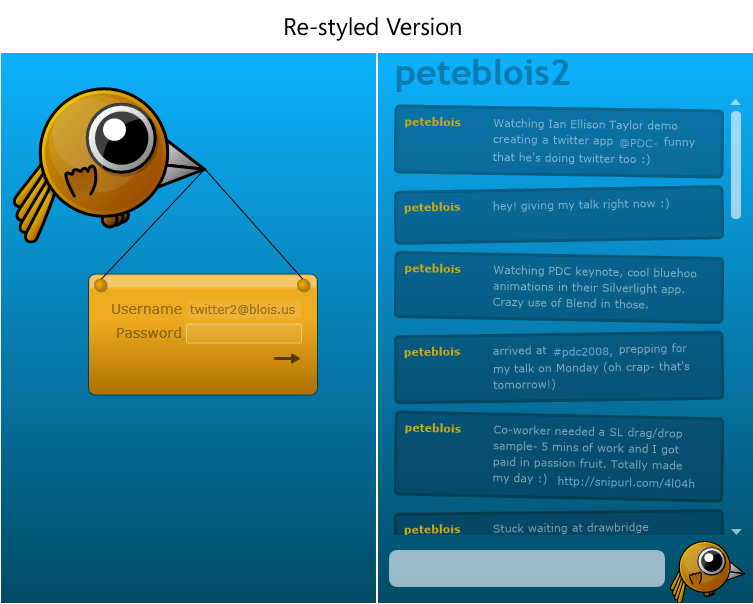
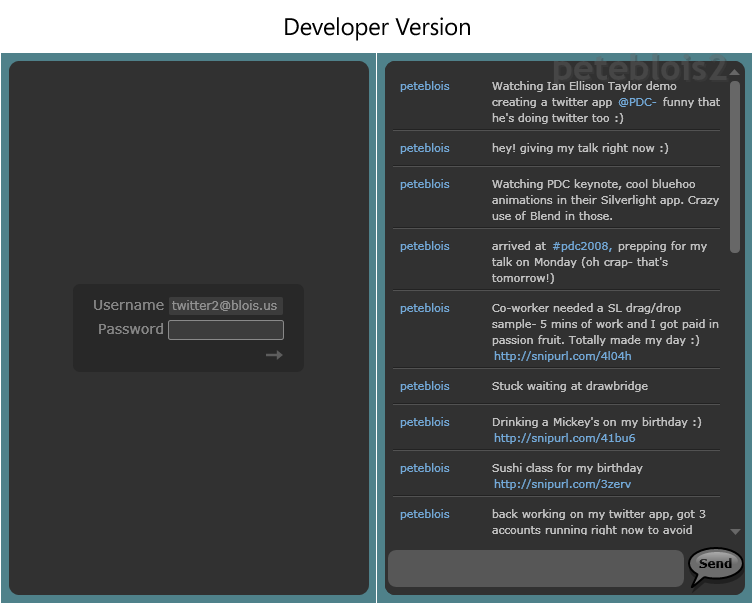
The video does a nice job demonstrating how designers can re-style a Silverlight application without having to mess with the code behind it. In the process it shows some of the power and capability that Expression Blend 2 provides to build really rich user experiences. Celso starts with a developer version of the application, and then customizes and sculpts the UI to have a fun twitter character theme:
The Application Model
The Silverlight Twitter client is hosted within an ASP.NET server application that exposes a web service that enables the Silverlight Twitter application to communicate to the Twitter service (since Twitter does not allow direct access from client applications). Communication between the Silverlight client and the ASP.NET web server is done using Windows Communication Foundation (WCF).
The client application uses a Model-View-Presenter (MVP) pattern (also known as the Model-View-ViewModel pattern) which is commonly used in large WPF applications. Even though this is a fairly simple application they wanted to take advantage of the flexibility that MVP allows and allow room for future growth.
Maintaining the separation between the visuals and the application logic also enables designers to make fairly complex visual changes without impacting the basic application flow. The video goes through some examples of the styling flexibility this architecture facilitates.
The Styling Process
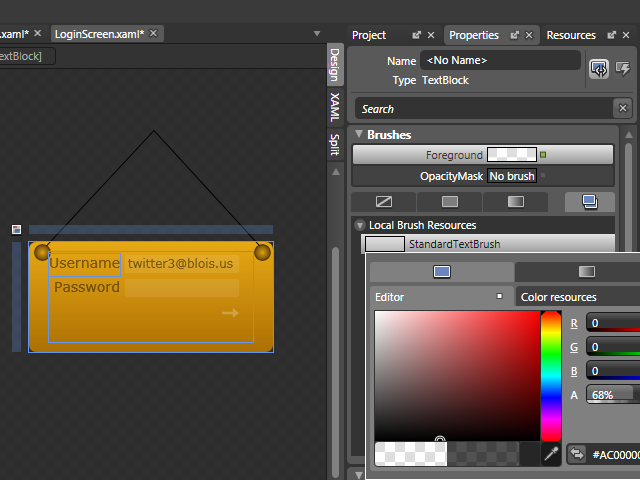
In the video, Celso highlights how Resources can help designers quickly change colors. A common Brush Resource, for example, can be used to change the color of all the text elements in the application:
Celso shows how easy is to create new User Controls from graphics using Expression Blend 2 SP1 (just select multiple elements in the designer, right-click, and choose the "Make Control" menu option):
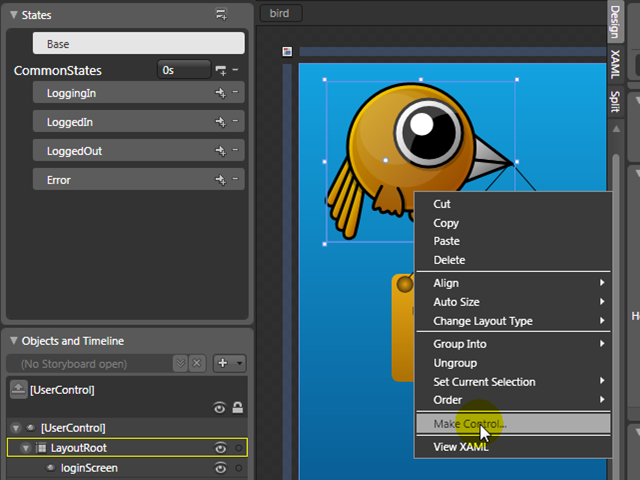
And also how to create new states inside this new User Control (using the Visual State Manager feature – which is also now supported with WPF), to animate the bird (fly, blink, etc…)
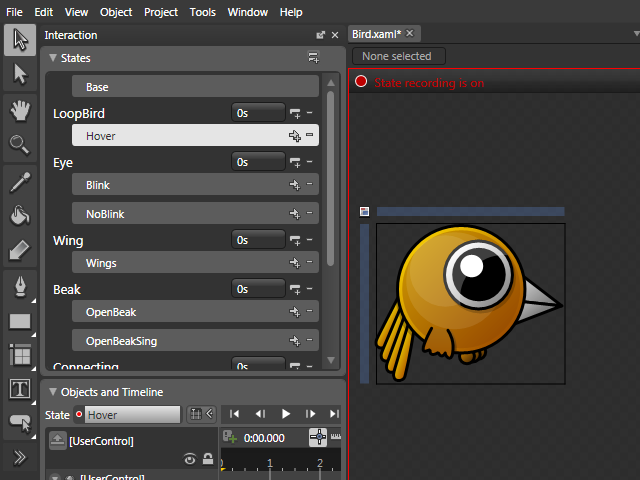
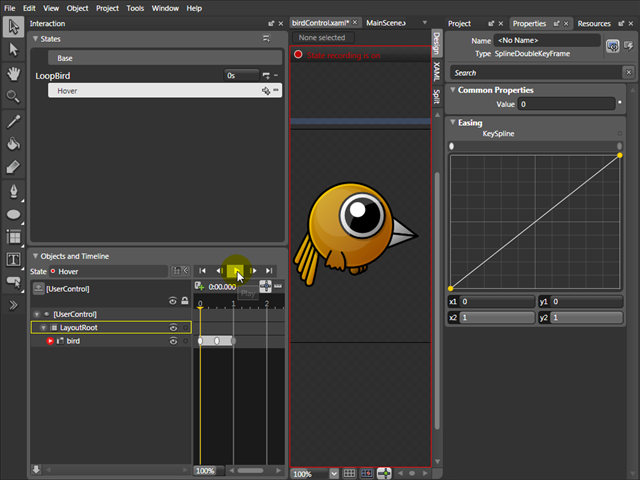
Celso also shows how to create animations for each state, changing advanced properties like Key Spline curves, and Repeat Behavior:
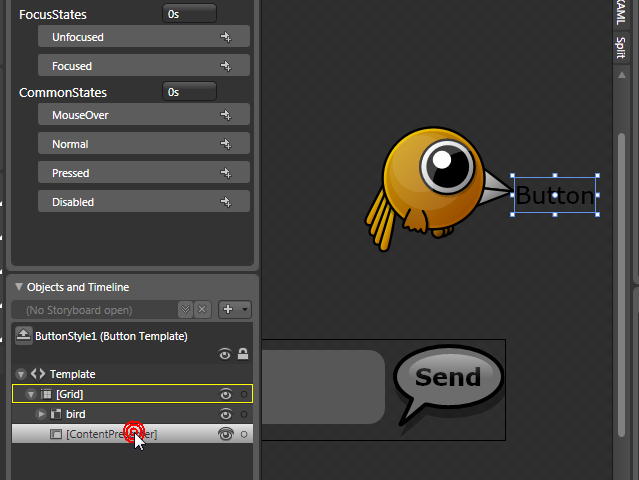
He also shows how to create custom buttons from drawings (which can come from XAML or any other design tool like Photoshop or Illustrator). All the states of a Button Control are available out of the box.
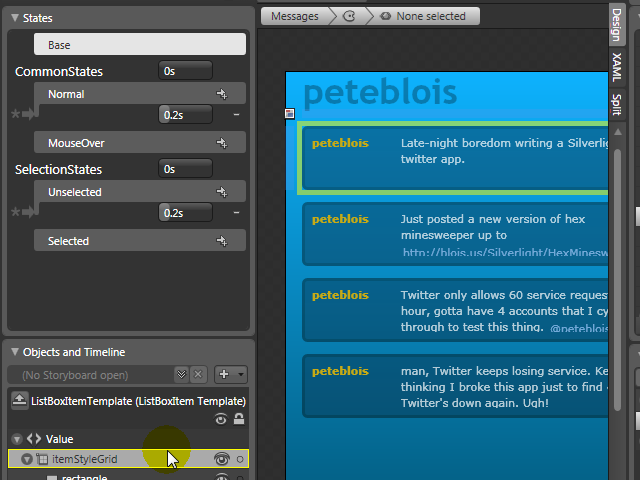
Expression Blend also enables you to easily change complex controls like List Boxes. Designers have access to all Styles, Templates, and states – and can completely customize all the parts of a List Box without having to write any code:
You can watch the video and download the code to check out the above Twitter application.
To learn more about Expression Blend, I also recommend watching the Expression Blend: Tips and Tricks presentation from the PDC conference two weeks ago.
Update: Also check out Shawn Wildermuth’s Deep Control Skinning with Styles webcast.
Hope this helps,
Scott
by community-syndication | Nov 13, 2008 | BizTalk Community Blogs via Syndication
Hi all
I have had on my to do list for ages, that I should start developing some functoids
that might be nice to have.
Well, finally I have started, and my first functoid can be downloaded from http://www.eliasen.eu/DownloadSoftware.aspx.
Note, that the eliasen.eu domain has just been moved from one hosting company to another,
which means that the link might not work for another day or so.
Comments, bug reports, suggestions, and so on are very welcome.
—
eliasen

by community-syndication | Nov 13, 2008 | BizTalk Community Blogs via Syndication
Yipee!!!!

Check out my new book on REST.
by community-syndication | Nov 13, 2008 | BizTalk Community Blogs via Syndication
I’ve just published version 1.0 of “Bloggers Guide to Connected Systems”, which will be covering the Oslo, WCF/WF 4.0, Dublin and Azure technologies. The first version has 24 articles from some of the leading developers working with Connected Systems technologies, including members of the “Oslo” team.
It is expected that the guide will grow on a monthly basis as more people start working and blogging about the new technologies, and should be a valuable resource for newbies and experienced developers.
The bloggers that are included so far are Darren Jefford, Charles Young, Andreas Erben, Imran Shafqat, Don Box, Brian Losegen, Aaron Skonnard, Jeff “Pinkey” Pinkston and Martin Fowler. If you have been blogging about Connected Systems technologies, and would like to be included, feel free to contact me via the blog. There’s no additional work involved form your part, and all contributions are acknowledged.
by community-syndication | Nov 12, 2008 | BizTalk Community Blogs via Syndication
Hi all
I have changed the config of my blog software (dasBlog) so all comments have to be
approved by me. I hate to have to do this, but apparently, the upgrade to a newer
version has made it easy for spammers to write silly comments with links to all sorts
of weird web sites (I guess they are weird – naturally, I have never clicked on one…).
I have already delete 5 inappropriate comments to posts, and they seem to come faster
and faster.
I will ask the programmers of dasBlog to see what is happening, and then disable the
approval flow once I have it solved.
I apologize for the inconvenience.
—
eliasen
by community-syndication | Nov 12, 2008 | BizTalk Community Blogs via Syndication
Back on the old Microsoft blog, I built and demonstrated a tool that exploits the built-in (but hidden) BizTalk Business Rules Engine API for securing access to business rules.
I have a link to this Rules Authorization Manager on the downloads page of this blog, but up until now, I had only included the executable. After […]
by community-syndication | Nov 12, 2008 | BizTalk Community Blogs via Syndication
I had the pleasure of being in Barcelona this week for the TechEd Developer conference. Highlights – getting to talk to several hundred developers about WF / WCF / Dublin /Oslo. Lowlights – it’s Barcelona, what could be a lowlight? TechEd capped off the most interesting 8 weeks I’ve ever had in software. In under two months we’ve had major iterations on virtually all the technologies that we drive in CSD. It started out with a roadmap update on BizTalk Server where we provided some more detail on BTS2009 and also talked about the next two major releases.
Next, we announced major updates to WF and WCF and introduced “Dublin”. After that, I hit the road with Robert Wahbe, VP of CSD, our fearless leader. We talked to several RDs and various members of the press about Oslo – and progress we’ve made in the last year. We were getting ready to ship the Oslo CTP and wanted to give folks a sense of how it had developed and what they’d see at PDC.
Two weeks ago at PDC we made good on the promise to provide CTPs on WF, WCF, Dublin, and Oslo (including “M”, “Quadrant” and the Repository). For those scoring at home that’s a promise kept – one year from the Oslo announcement to code. For those of you who didn’t make it to the conference, take a look at Oslo at the new Dev Center or www.modelsremixed.com. Going further, we announced the Azure Services Platform and opened it up to attendees for an early CTP. As a company we’ve spent the last 20 years democratizing the desktop, we’ll spend the next 10 democratizing the cloud.
Last week we kicked off a new “Real World SOA happens {here}” theme. This features a new online video portal that will showcase the successes of our customers around the globe. This update to the web also highlights a set of events that we’re running to broadly connect with thousands of customers worldwide as part of a 20+ city road show. If you’re interested in learning more about SOA and how you can be successful – check out the new site at www.microsoft.com/soa/launch.
by community-syndication | Nov 12, 2008 | BizTalk Community Blogs via Syndication
I spent some time today looking at Microsoft’s Enterprise Service Bus (ESB) Guidance Toolkit, and this reminded me of an issue which we noticed a year ago, and did attempt to raise with Microsoft at the time, but which I never blogged about. It’s always a little uncomfortable taking the good people at Redmond to task, but, while this is hardly the most urgent problem facing today’s world, it is, nevertheless, a bit of a problem and something which should be addressed.
In the article, I discuss the problem, where the Toolkit goes wrong, how UDDI should be used, and a possible remedy. The article is at http://geekswithblogs.net/cyoung/archive/2008/11/12/126975.aspx.

by community-syndication | Nov 12, 2008 | BizTalk Community Blogs via Syndication
This has happened to me in the past – sometimes randomly, sometimes consistently. After a quick search I found that all you need to do is make sure you select “Workflow” as the type of code you want to attach to, as described nicely in this article:
How to solve Visual studio crash on attach process for debugging a sharepoint workflow

by community-syndication | Nov 12, 2008 | BizTalk Community Blogs via Syndication
This is a very specific problem but I’m sure some of you stumbled over it. When disassembling a XML message in a SOAP port BizTalk can’t read the message type. This causes problems when for example trying to handle an envelope message and split it to smaller independent messages in the port. It’s a known […]
