Error while importing BizTalk binding files remotely
The solution to enable the import of binding files for remote execution. Some extra BizTalk software installation is required, when using the WCF adapter.

The solution to enable the import of binding files for remote execution. Some extra BizTalk software installation is required, when using the WCF adapter.
I had the interesting request that it was important to a system (SalesForce) to set the right time including the timezone.
So I created a .Net function with a string as input and a string as output. This function is call from a map. Here are the function:
The Id of the zone can be found by running through all the names by running this code:
ReadOnlyCollection<TimeZoneInfo> zones = TimeZoneInfo.GetSystemTimeZones();
Console.WriteLine("The local system has the following {0} time zones", zones.Count);
foreach (TimeZoneInfo zone in zones)
   Console.WriteLine(zone.Id);
The result is in a format that this, which also takes care of DST (Daylight saving time):2012-07-02T02:12:00.0000000+02:00 (input --> 02-07-2012 02:12) 2012-02-28T14:00:00.0000000+01:00 (input --> 28-02-2012 14:00)
Random posts:
Help me, help you. You know how 😉 (click, click, click…)
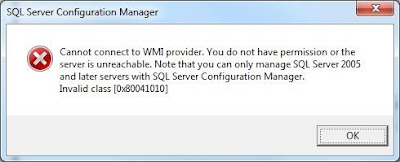
When opening the SQL Server Configuration manager (for SQL Server 2008 R2 in my case), I kept getting following error:
Cannot connect to WMI provider. You do not have permission or the server is unreachable. Note that you can only manage SQL Server 2005 and later servers with SQL Server Configuration Manager. Invalid class [0x80041010]

The solution to resolve this turned out to be quite simple. Just open a command prompt and execute following command:
C:\Program Files\Microsoft SQL Server\100\Shared>mofcomp “C:\Program Files\Microsoft SQL Server\100\Shared\sqlmgmproviderxpsp2up.mof”
Depending on the SQL version installed the path to the file could also be something like C:\Program Files\Microsoft SQL Server\90\Shared\sqlmgmproviderxpsp2up.mof
So the news have been out there for a while, and it’s time for me to update you all admins on some of the new stuff that has changed with the new release. First of all, we have gotten a few new adapters, most to enhance the experience and usability towards the cloud but […]
Blog Post by: Tord Glad Nordahl

Finally I had some free time available to be able to update and fix some minor bugs which existed in the latest version of this adapter and already had been reported by community members. I have to give a special thanks to maakku that reported a problem related to the Daily schedule properties and the […]
Blog Post by: Sandro Pereira
Last month I updated my main laptop MacBook Pro to Windows 8 and I’ve written about the experience here "Installing Windows 8 on MacBook Pro experience". There are no noticeable issues and I’m quite pleased with it. Even though technically all of the applications that run in Windows 7 should run on Windows 8, still […]
The post Running both Windows 7 and Windows 8 in a MacBook Pro appeared first on BizTalk360 Blog.
Blog Post by: Saravana Kumar

Union In set theory, the union (denoted by %u222a) of a collection of sets is the set of all distinct elements in the collection. It is one of the fundamental operations through which sets can be combined and related to each other. (http://en.wikipedia.org/wiki/Union_(set_theory)). For example, if A = {1, 2, 3, 4, 5, 6, 7} […]
Blog Post by: mbrimble
Normal
0
false
false
false
EN-AU
X-NONE
X-NONE
MicrosoftInternetExplorer4
/* Style Definitions */
table.MsoNormalTable
{mso-style-name:”Table Normal”;
mso-tstyle-rowband-size:0;
mso-tstyle-colband-size:0;
mso-style-noshow:yes;
mso-style-priority:99;
mso-style-parent:””;
mso-padding-alt:0cm 5.4pt 0cm 5.4pt;
mso-para-margin-top:0cm;
mso-para-margin-right:0cm;
mso-para-margin-bottom:10.0pt;
mso-para-margin-left:0cm;
line-height:115%;
mso-pagination:widow-orphan;
font-size:11.0pt;
font-family:”Calibri”,”sans-serif”;
mso-ascii-font-family:Calibri;
mso-ascii-theme-font:minor-latin;
mso-hansi-font-family:Calibri;
mso-hansi-theme-font:minor-latin;
mso-bidi-font-family:”Times New Roman”;
mso-bidi-theme-font:minor-bidi;
mso-fareast-language:EN-US;}
TableOp/Update/dbo/Employee
Then there is of course stored procedures for both send and receive ports.
|
Operation
|
Soap Action
Header |
|
ExecuteNonQuery
Request |
GenericOp/ExecuteNonQuery
|
|
ExecuteNonQuery
Response |
GenericOp/ExecuteNonQuery/response
|
|
ExecuteReader
Request |
GenericOp/ExecuteReader
|
|
ExecuteReader
Response |
GenericOp/ExecuteReader/response
|
|
ExecuteScalar
Request |
GenericOp/ExecuteScalar
|
|
ExecuteScalar
Response |
GenericOp/ExecuteScalar/response
|
Refer to this link for more: http://msdn.microsoft.com/en-us/library/dd788372%28v=bts.10%29.aspx

After conducting this event across various major European cities: Amsterdam (Netherland), Milan (Italy), and Stavanger (Norway) since Feb 2011, it is really exciting to announce that the next event will take place in London – England on January 16, 2013! What is BizTalk Innovation Day/Event? BizTalk Innovation Day (BID) or sometimes called BizTalk Innovation Event […]
Blog Post by: Sandro Pereira
In the REST world, ETags are your gateway to performance boosts by letting clients cache responses. In the non-REST world, you may also want to add an ETag to an entity definition inside a traditional service contract – think of a scenario where a consumer persists its own representation of your entity, and wants to keep it in sync. Rather than load every entity by ID and check for changes, the consumer can send in a set of linked IDs and ETags, and you can return only the entities where the current ETag is different from the consumer’s version.
If your entity is a projection from various sources, you may not have a persistent ETag, so you need an efficient way to generate an ETag which is deterministic, so an entity with the same state always generates the same ETag.
I have an implementation for a generic ETag generator on GitHub here: EntityTagger code sample. The essence is simple – we get the entity, serialize it and build a hash from the serialized value. Any changes to either the state or the structure of the entity will result in a different hash. To use it, just call SetETag, passing your populated object and a Func<> which acts as an accessor to the ETag property:
EntityTagger.SetETag(user, x => x.ETag);
The implementation is all in at 80 lines of code, which is all pretty straightforward:
var eTagProperty = AsPropertyInfo(eTagPropertyAccessor);
var originalETag = eTagProperty.GetValue(entity, null);
try
{
	ResetETag(entity, eTagPropertyAccessor);
	string json;
	var serializer = new DataContractJsonSerializer(entity.GetType());
	using (var stream = new MemoryStream())
	{
		serializer.WriteObject(stream, entity);
		json = Encoding.UTF8.GetString(stream.GetBuffer(), 0, (int)stream.Length);
	}
	var guid = GetDeterministicGuid(json);
	eTagProperty.SetValue(entity, guid.ToString(), null);
	//...
There are a couple of helper methods to check if the object has changed since the ETag value was last set, and to reset the ETag.
This implementation uses JSON to do the serializing rather than XML. Benefit – should be marginally more efficient as your hashing a much smaller serialized string; downside, JSON doesn’t include namespaces or class names at the root level, so if you have two classes with the exact same structure but different names, then instances which have the same content will have the same ETag. You may want that behaviour, but change to use the XML DataContractSerializer if you think that will be an issue.
If you can persist the ETag somewhere, it will save you server processing to load up the entity, but that will only apply to scenarios where you can reliably invalidate your ETag (e.g. if you control all the entry points where entity contents can be updated, then you can calculate and persist the new ETag with each update).