
by community-syndication | Jun 13, 2012 | BizTalk Community Blogs via Syndication
Day 2 Keynote
Day 2 opened with another Keynote this time led by Antoine Leblond. It did address some of my concerns with Day 1’s keynote. This time the focus was on Windows 8 and they did demonstrate the OS running on a few different devices. The demos were nice and relevant, however they did not demonstrate it on new hardware. They used the Samsung Series 7 slate with the Samsung Series 9 laptop. They also demonstrated Windows 8 on a Lenovo laptop(sorry nothing cool about a Lenovo). If they wanted to generate some excitement, and didn’t want to pull out a shiny new beta Samsung, they should have just bought a new MacBook Pro and run Windows 8 on it. I think Microsoft missed another big opportunity but I digress.
Line of Business Apps
They did demonstrate some good looking Metro applications on the devices. They did provide a quick overview of the Beer Ranger app that I mentioned in a previous post. They also demonstrated a native SAP application that is part of their Sales Automation Pipeline lineup. The application was a nice looking app, but much like many other SAP applications, I had no idea what it was suppose to do (opps did I say that out loud).
Trackpad
My primary personal (non-work) machine is a MacBook Air that runs Windows 7. Many people ask why I do this and how I am missing out on all of these touch gestures. For me I love my Microsoft Arc Touch mouse and quite frankly could care less about the gestures that you can use on a trackpad. But for those of you who like using gestures on a trackpad there is some good news for you. Windows 8 will support “Apple like” gestures including Semantic zoom and access to the new “App bar” to name a few.
Developing for Windows 8
Antoine provided us with a rundown of what is involved in building applications for Windows 8. Here are some of the highlights.
- Windows Runtime (WinRT)
- New API set that allows you to build apps and games
- Supports touch, keyboard and mouse
- Support for “contracts” so that apps can leverage OS functions like “share”. Much like you can Share “data’ on a Windows Phone 7, you will be able to perform a similar function with your own application but hooking into these contracts.
- Tool Support
- new release of Visual Studio (2012)
- C++, C#, JavaScript, css, html are all supported technologies
- Language and platform support for inline async calls.
- I really like this feature. I was never a big fan of all of the delegate spaghetti code a person previously had to write to support async methods. In a previous post, I had to write async REST methods to support calling REST based services from a Windows Phone 7 app. I expect it to get much simpler now.
- Visual Studio Simulators
- Can simulate different types of hardware(slates, desktops, large displays, small displays etc)
- Rotate screen
- Higher/lower resolutions
- Touch gestures
ARM Support
This was interesting to see as I have heard a little bit about ARM support but just have not seen it in action.
Some of the benefits of leveraging ARM based devices include:
- Low power consumption
- Long Battery life
- Trusted boot
- Validate all code in boot path before it runs
- Device encryption is always on
- App model
- Geared at making apps that don’t alter the state of the machine (Security benefit)
- Can use same Management infrastructure to manage devices
- Metro apps work on WinRT as well
- An RDP client does exist so that you can log into other Windows PCs/Servers
- Apps must be signed by known trusted authority or have appropriate cert
- Apps must must have been run through “WAC” approval application
- used to honor design principals about not altering the state of the machine
- Key office applications are available
Essential Tips for the Windows Azure Startup
This was a really interesting session. Michele Leroux Bustamante is well known in the WCF and MVP community as a person with deep technical skills. I have seen her speak before at a previous TechEd so I thought this would be a good session to attend. Something that I appreciate about Michele’s presentation style is that she remains composed through out the entire presentation. Even when she runs into some issues, such as a demo not quite working out, she is able to recover with a tremendous amount of poise. I believe she is Canadian, maybe this has something to do with it.
This time around she was giving guidance on developing a Startup based upon Windows Azure. It was a very enlightening session and it was quite evident that she “gets it”. She has acted as a consultant to many start-ups and provided the following tips when building applications for Start up companies. Something to keep in mind is that these principles, while applicable to Startups, also just good practices to follow even if you are a well established brick and mortar company.
- Startups need to show some traction early on
- Go fast, maintain quality
- Monitor status, analytics and adjust accordingly
- watch for conversion rates
- do visitors create accounts
10 Essential Tips
Here they are as they were presented to the audience:
1. Design for Role Scale out
- Needs to happen up front. By the time you need to scale it will probably be too late or more difficult to
- Need to design for scale, may want to segregate or isolate controllers to allow to further scale out functions that may be more popular or have more access patterns (Mobile, API)
- Domain Mapping
- Create a CNAME or A Record for the IP address of your production deployment
2. Use an SMTP relay service
- Most applications require some form of email communication
- Can use System.Net.Mail.SMTPClient
- Write email “messages” to a queue and then dequeue and send
- Need to use a relay service so that your “From Email” address does not get blocked/spam
- smtp4Dev is a great tool for use in Development
- authsmtp is a production ready email relay service that may be beneficial
3. Configuration Profiles
- Avoid web.config for
- settings that vary between staging, production
- settings that require experimentation for performance
- settings that support diagnostics and test
- Use the Azure Service config files instead
- ServiceConfig.Local.cscfg
- ServiceConfig.Cloud.cscfg
4. Don’t forget to Cache
- You don’t realize how much latency that accessing frequent data creates
- Co-locate Cache with across roles
- Together produce distributed cache total
- Any role can access
- Be careful, Cache is not durable, may not live forever
- Use for optimization
- Performance increases are phenomenal
5. Watch your Queuing costs
- Costs may escalate due to the amount of polling
- If you are polling, you are paying
- Understand the differences between Service Bus and Azure Storage Queues
- Message lifetime
- Max message size
- Max total storage
- Duplicate detection
- Order guarantees
- Dead letter queue
- Storage metrics
- Purge capability
- Long polling/manual back-off polling
- Initial decisions are about cost and agility
- consider Storage Queues due to back-off polling
6. Collect Diagnostics
- When writing new project, there is a lot of hacking going on because you are trying to be fast
- Difference between getting it done and getting it done properly
- Create a diagnostic helper and establish patterns
7. Monitor from outside
- Azure Ping free monitoring tools
- Sends SMS or email when monitoring
- Storage
- SQL
- Queues
- Is site running?
- Azure Watch
8. Don’t drink the no-SQL Kool-Aid
- VCs love “NoSQL”
- Can be pressure from VCs to use it
- VCs think it is cheaper to manage because you don’t need a DBA
- Asking for trouble if you don’t understand your relational data model
- Need people who understand SQL to look into NOSQL and report back to the group on what the pitfalls are
- Go to NoSQL for obvious stuff
- search indexes
- GEO data
- profile data (coming from social media)
- Keep core competencies in RDBMS
- Then reach out to NoSQL experts to help bridge the two worlds
9. Enable Social Logins and Simplify Sign Up
- You want conversion rates – make it dead simple then!
- ACS facilitates this – simple to use
- Dirt cheap per transaction
- The more you ask from a user to register, the less likely they are to sign up
- Keep it simple you will get conversions
- Pinterest – only email address to sign up?
10. Estimate your costs
- Layers of cost
- Storage
- Storage Transactions
- Bandwidth (# 1 thing if you have a lot of media)
- Cache
- ServiceBus
- SQL Azure
- Bandwidth
- Need to run estimates
- BizSpark may offer some cost savings for new startups
Service Bus Overview – Clemens Vasters and Abhishek Lal
As usual Clemens put on a good show. This time Abhishek joined him in this presentation and provided some solid demos. The first half of the presentation was largely a review for me as Service Bus is an area that I try to stay up to speed on. The second half of the presentation introduced some new tooling and features as part of the June 2012 release. Selfishly, I don’t want to go into too many details here as I would like to actually play with some of these features and then provide a more complete blog post(s) in order to provide these subjects with some additional context. Stay tuned!
by community-syndication | Jun 12, 2012 | BizTalk Community Blogs via Syndication
Hi folks, you’ve probably heard a fair bit about the make over of Azure into ‘Azure
2.0’ (the SDK is still 1.7)
There’s some great new tools within VS.NET to manage your environment better, even
a Service Bus ‘explorer’ which was much needed.
I’ve collected a few links to start with for you guys to read up on when you’ve got
a moment:
Azure 2.0 Details on:
-
Virtual Machines – FAQs etc – http://msdn.microsoft.com/en-us/library/windowsazure/jj156003
-
Windows Azure Virtual Network – http://msdn.microsoft.com/en-us/library/windowsazure/jj156007
-
Get slides from my previous presentation here – Azure
Virtual Network 2.0
-
Windows Azure Media Services – http://msdn.microsoft.com/en-us/library/windowsazure/hh973629
-
Create and Deploying WebSite walk through – https://www.windowsazure.com/en-us/manage/services/web-sites/how-to-create-websites/
-
(like we need this one – seriously takes 3 minutes! – well done MS!)
-
Azure Chalk Talk Videos – http://www.meetwindowsazure.com/DigitalChalkTalks
-
Azure Virtual Machines – Part
I & Part
II
-
Web
Sites with ASP.NET (NB: SSL
is not supported, but it will arrive when Win Server 2012)
-
Web
Sites with node.js
-
Web
Sites with OSS Apps & Web Matrix
-
Azure
Cross Platform Command Line Tools
-
Cloud
Services (aka perviously web+worker roles)
-
Apache
Hadoop Based Services On Windows Azure
-
TFS
Service Preview Intro
-
Azure
Websites – Continuous Integration with TFS.
-
Azure
SQL Databases Intro
-
Azure
Storage Introduction
Blog Post by: Mick Badran

by community-syndication | Jun 12, 2012 | BizTalk Community Blogs via Syndication
Introduction The BizTalk Scheduled Task Adapter is an in-process receive adapter that executes a prescribed task on a daily, weekly or monthly schedule. The adapter is configured entirely within BizTalk, all configurations is stored within the SSODB and can be exported and imported via binding files. The schedule capabilities are similar to those available with […]
Blog Post by: Sandro Pereira

by community-syndication | Jun 12, 2012 | BizTalk Community Blogs via Syndication
First of all I would like to thank Greg Forsythe for their kindness and for added me as coordinator on this project. In the past weeks I have been working on this new version of this adapter, mostly making small improvements and documentation, and now I can say A new version of BizTalk Scheduled Task […]
Blog Post by: Sandro Pereira

by community-syndication | Jun 12, 2012 | BizTalk Community Blogs via Syndication
In my previous post I showed how to provision a Virtual Machine in Windows Azure. The Virtual Machine was used to create a BizTalk 2010 Development environment. Now in this post I would like to go into creating an image of this Virtual Machine and then use it to create a new Virtual Machine.
An image is a virtual hard disk (VHD) file that is used as a template for creating a virtual machine. This can be useful when you want to create multiple virtual machines that are set up the same way. Another reason can be to capture the image as you do not want to use it for a while and prevent incurring costs.
Capturing a Virtual Machine
To capture a Virtual Machine you need to perform a few steps. One is to sysprep the virtual machine. For Window Server 2008 R2, like my BizTalk Development environment, I followed instructions from article “How to Capture an Image of a Virtual Machine Running Windows Server 2008 R2“. After sysprepping your machine you need to capture it. Sysprepping the machine according to the article will shutdown the virtual machine and changes the status of the machine in the Management Portal to Stopped. Capturing the VM means selecting it. You will then fill some details in dialog box.
Now notice the name I gave to the image. This name was deemed invalid after I clicked check mark. The error was:
Failed to capture image BizTalk_Development of virtual machine BTS2010.
The image name is invalid.
I renamed it to BizTalkDev. It went trough and took a while before image was captured.

That is basically it. Image is created and Virtual Machine is deleted and you’ll not be billed.
Creating a virtual machine from the Image
If you want to create a new virtual machine you can select your image from the Gallery. Steps below a similar if you create a Windows 2008 R2 machine from scratch. From My Images you will see images you have created. In my case only BizTalkDev is available.

Next step (2) is filling in details for the VM Configuration.

Following step (3) is filling in details for VM mode.

Last step (4) is selecting the availability set in case you require a group a virtual machine in case of outages (i.e. higher availability).

Click the check mark and Virtual Machine is being provisioned. This may take a while before it is up and running. When it is up and running I can connect to machine again through remote desktop. Machine will need a few minutes to warm up again, before I could fire up BizTalk administration, SQL Server and Visual Studio.

This way I can spin up a Virtual Machine with BizTalk when I want it and remove it when I done. I can use it to spin up a few machines in case I want to work with a team or for training purposes at a client. There can be many more useful scenario’s than the ones I mention here.
If you are experiencing problems with Virtual Machines you can ask questions in the Windows Azure Virtual Machines for Windows forum or study the online documentation.
My experience so far with Virtual Machines and the Windows Azure Portal are positive. I am seeing more and more its potential. The User Experience (UX) with Portal is very satisfactory to me personally. I must say Microsoft Windows Azure team have done a good job.
Finally I also like to thank Thiago Almeida (Microsoft New Zealand) for giving me some tips that lead to this post.
Cheers,
– Steef-Jan
by community-syndication | Jun 12, 2012 | BizTalk Community Blogs via Syndication
I announced in a previus post that I joined the blogging team on biztalkadminsblogging.com.
However it took untill today before my first blog post was created.
I gave it a long thought what my first blog post should cover. the result is a post on some best practices for the usage of tracking in BizTalk… hope you like it!
The actual post can be found here http://www.biztalkadminsblogging.com/index.php/item/83-best-practices-for-tracking
by community-syndication | Jun 12, 2012 | BizTalk Community Blogs via Syndication
Original article from blog.biztalk360.com
In the previous post we explained how easy it’s to setup BizTalk servers in Windows Azure using the new durable virtual machine support.
In the article we mainly focused on some of the common low risk use cases like, setting up the environment for
- Development,
- QA,
- May be for support, training etc.
But, how about running your production BizTalk environment in the cloud. Is it a supported configuration?
Technically the virtual machines in windows azure are regular VHD files fully compatible with Hyper-V. One of the key offering from Microsoft in this space is, customer can freely move their VM’s between Azure and on-premise. One step ahead, during Scott Guthrie http://meetwindowsazure.com talk he demonstrated customers will be able to move the VHD files between cloud providers like Amazon freely.
Given the complete support of BizTalk running in Hyper-V (http://support.microsoft.com/kb/842301) as shown below
Production BizTalk environment in Windows Azure virtual machine should also be supported. But you need to be fully aware, the support will be within the SLA boundaries of Windows Azure for IaaS (Infrastructure as Service) offering, which currently is 99.95% monthly SLA.
If your application can coupe with the occasional downtime (it may not happen, but still there is .05% possible downtime), then you should be able to run your BizTalk production environment in Windows Azure virtual machine.
NOTE: There is no endorsement from Microsoft on this subject at this point, things will get much clearer when BizTalk 2010 R2 is released. However with one of the recent unofficial conversation I had with senior Microsoft executive, this is the statement I heard. I’m just giving you a head start, sure we will hear more official news in the future.
Nandri!
Saravana Kumar
by community-syndication | Jun 11, 2012 | BizTalk Community Blogs via Syndication
If you are interested in how Microsoft has changed Hyper-V in Windows Server 2012, you need to watch todays TechEd US sessions from Jeff Woolsey.
http://channel9.msdn.com/Events/TechEd/NorthAmerica/2012/VIR308
http://channel9.msdn.com/Events/TechEd/NorthAmerica/2012/VIR309
I think these change are a real game changer in the Virtualization Landscape, lookout VMware.
More …
by community-syndication | Jun 11, 2012 | BizTalk Community Blogs via Syndication
Today at TechEd US in Orlando, it was good to hear Scott Guthrie during his foundation session: Windows Azure Today and Tomorrow, mention BizTalk as a possible workload that could be hosted in the new Azure Infrastructure as a Service (IaaS) feature released last week. The new IaaS feature opens many possibilities for those workloads that are not easy to host in a Azure web or worker role; allowing them to move from your data centre to Azure. Some of the primary uses that I can see for BizTalk running in Azure IaaS are:
- Rapid POC of BizTalk solutions without the assistance of the client’s infrastructure group
- Rapid provisioning of BizTalk Developer environments with the use of the Azure IaaS virtual machine templating feature
- Occasional Demoing of BizTalk solutions, the IaaS virtual machine are only charged while running, otherwise you pay only for the storage of the VHD files in Azure Storage.
The use of BizTalk in the cloud will be further enhanced with the release of BizTalk 2010 R2 (Scheduled for release approximately 6 months after Windows 8)
To view Scott Guthrie complete session on Windows Azure Today and Tomorrow, it can be found on Channel9 at http://channel9.msdn.com/Events/TechEd/NorthAmerica/2012/FDN05
More …
by community-syndication | Jun 11, 2012 | BizTalk Community Blogs via Syndication
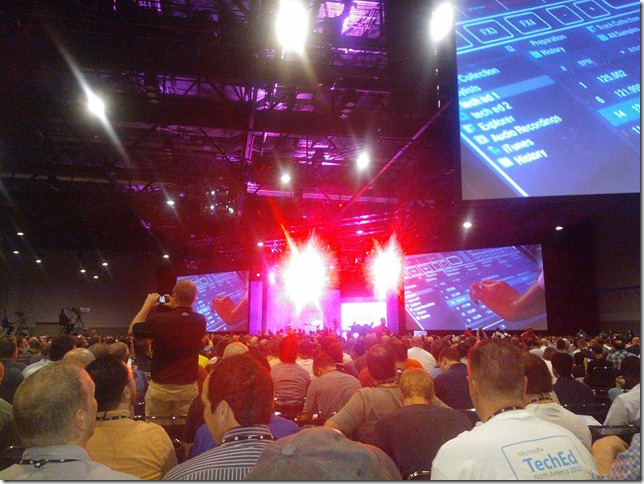
Keynote
The Keynote started off like a Keynote from another technology company. A DJ was spinning tunes and also showed off his new ’turntable’ that runs on Windows technology and is all the rage these days (so he says).
Post DJ dialog, Satya Nadella stepped up to the mic and provided some insight into the state of computing inside and outside of Microsoft. He provided the following:
- We are at the shift of a new paradigm. Much like at the dawn of Client-Server, we find ourselves in a position where we need to re-invent ourselves by leveraging new technologies such as the cloud.
- Microsoft is focused on providing Services at internet scale
- Microsoft currently runs some of the worlds biggest apps (Xbox live, Bing, Exchange, CRM)
- feedback loop
- global scale, 24 x7
- ultra-modularity.
- 16 major Microsoft Data centers around the world
- Bing 300 petabytes of data
- Microsoft battle testing each piece of new technology released
- Bing is running on top of the the Windows Server 2012 RC
- You can’t “head fake” this type scale
Next up was Jason Zander and he was here to speak about some of the advancements in the Windows Server and System Center product space. Jason added that datacenters, no matter on-premise or cloud, are required to be more responsive to ever changing business needs. Much like everything, it seems, these days people want services cheaper, faster and delivered yesterday. The advancements in Windows Server and System Center have been created to address these needs(well except the yesterday bit).
The Modern Datacenter needs to be:
Windows Server 2012
Mark Russinovich was up next. He wanted to discuss some of the advances that the Azure team has made in the area of supporting durable Virtual Machines in Azure. One of the more humorous moments was when he referred to a slide that had a Linux logo on it: “no we didn’t get hacked, we do support Linux”.
Provisioning Cloud infrastructure
-
New Metro interfaces in portal
-
VMs now supported includes
-
OpenLogic
-
SUSE
-
Ubunto
-
Windows Server 2008 R2
-
Windows Server 2012 RC
-
We can deploy a new VM into a segregated “corporate network” in Azure (I assume this means what previously was known as Brooklyn")
The CIO from Aflac, an insurance company, who has deployed a SharePoint solution to Azure was brought on stage to share his experiences with Azure. They have built a solution by provisioning VMs into Azure. Aflac chose Azure based upon the agility and flexibility that it provides.
Cloud and Aflac (CIO)
Requirements
-
Need Agility
-
Flexibility
-
Performance
Solution
-
SharePoint 2010
-
12 VMs support solution including
-
Use availability sets to further mitigate failure points
-
Looking to use Azure for extranet and customer scenarios
The Keynote then shifted towards the Developer experience including new Azure and Visual Studio 2012 functionality.
Inside the modern Application
-
Personal App experiences are now mandatory
-
Social is something that needs to be built into application and can’t be a “bolt” on
-
Build, Measure, Learn, Move
New Tools:
Frameworks
Comprehensive Runtime
ASP.NET MVC4/VS 2012 RC
HTML is now supported for LightSwitch
Keynote Summary
Having the DJ out there at the beginning was a nice touch. I am sure they wanted to pump up the crowd and generate some excitement. I think they hit the mark here but slowly the energy started to drain. There were several demos that didn’t work or required a second take for them to run. This is a bit of a let down as an attendee. Sure “stuff happens” but it seems like there could have been more rehearsing happening before hand.
I also felt Microsoft missed an opportunity to talk about Windows 8 and consumer devices. Arguably this is not the right time or place to do this but everyone in the building uses a computer on a day to day basis as part of their job. I would have loved to seen some demos of some slick new tablets or ultra books running the latest offerings. Ironically I heard more people talking about the newly released MacBook Pro today than Windows 8 devices. I see this as suitable evidence that they missed the mark considering the “pro” Microsoft audience at this conference.
Windows Azure Today and Tomorrow (Scott Guthrie)
If you have never seen Scott speakyou are missing out. He has this uncanny ability to take an awkward situation and make people laugh. He did this at Summit with his “Bob” Azure site and once again today with his “Dude” Azure site. He is very engaging and enjoys ’pop-star’ status amongst the Microsoft loyalists.
In his presentation, he elaborated on some of the recent news that he shared at the Meet Azure event. More specifically he focused on the new durable VM support, Azure Websites and ServiceBus. Surprisingly he even included “BizTalk” a couple times and he did not include the words “death, dead, soon to be dead or shot dead” in the same sentence.
General Update
-
Azure is flexible, open and solid
-
Microsoft has opened their minds to new platforms and open source
-
99.95% monthly SLA
-
Pay only for what you use
MSDN
Scott then reminded the attendees with MSDN that it includes Azure benefits
Durable VMs
-
Websites
-
Build with ASP.Net, Node.js or PHP
-
Deploy in seconds with FTP, GIT or TFS
-
Start for free, scale up as your traffic grows
-
Shared Mode (Free)
-
10 websites for free
-
other tenants co-hosted
-
Reserve Mode (Pay as you go)
-
Dedicated VMs
-
No other tenants
-
Charge for VMs on a per hour basis
-
Converting existing applications to cloud is easy
-
VMs are always being monitored and if a failure does exist, your application will be migrated to a new VM to ensure of business continuity
-
You have the granularity to spin up or down a particular worker role.
-
You can RDP into a Role instance as well
-
Cloud allows you to focus on apps and not infrastructure
-
Azure is great for the following scenarios:
-
Many SDKs are supported
-
.net
-
java
-
python
-
php
-
node.js
-
SQL Database
-
Relational SQL Server Engine in the cloud
-
Clustered for HA
-
Fully managed service
-
SQL Reporting support
-
Provisioned in seconds
-
Can scale to 150 gb in seconds
-
Can be accessed from ADO.Net
-
BLOB storage
-
HA, scalable and secure file system
-
Blobs can be exposed publically over http
-
Continuous geo-replication
-
Distributed Cache
-
low latency, in memory distributed cache
-
Dynamically grow and shrink cache size
-
ha support
-
memcached protocol support
-
Twitter demo went from 1.6 seconds to retrieve tweets from twitter down to .29 ms
-
ServiceBus
Windows Azure Today and Tomorrow Summary
Overall it was a good session. Like I mentioned before, Scott is a great speaker and I enjoyed listening to him. Some of the content he provided I have seen at Summit, but I certainly can’t hold that against him. I think this was a great introduction to Azure for people that have not seen it before or for those who took a look a few years back and are now interested in learning more about it.



