
by community-syndication | Jun 6, 2013 | BizTalk Community Blogs via Syndication
I have now releasedversion 1.3.0 of the BizTalk BRE (Business Rules Engine) Pipeline Framework to the Codeplex project page. The goal of the framework is to leverage the business rules engine in BizTalk pipelines to evaluate conditions and perform actions against a BizTalk message’s content or context in a flexible manner which allows for an […]
Blog Post by: Johann

by community-syndication | Jun 6, 2013 | BizTalk Community Blogs via Syndication
The BizTalk BRE Pipeline Framework has now reached v1.3.0 and I thought it is about time I wrote a blog post on how it can be effectively used, and before I can do that I must also explain how it works. The very first thing you need to get your head around is the concept […]
Blog Post by: Johann
by community-syndication | Jun 6, 2013 | BizTalk Community Blogs via Syndication
One of the big advantage of having Microsoft Surface against any other tablet is it’s is a full blown Windows 8 PC (we are taking about PRO version here not RT). From an operating system perspective you’ll be able to install any application you typically can install on your Windows 8 Desktop/Laptop. I bought a […]
The post Installing BizTalk Server 2013 on Microsoft Surface PRO appeared first on BizTalk360 Blog.
Blog Post by: Saravana Kumar
by community-syndication | Jun 5, 2013 | BizTalk Community Blogs via Syndication
Last year in December 2012 during the BizTalk Summit we first as a preview saw the progress Microsoft BizTalk Product Team made on the BizTalk Services. Now it is here as preview for the general audience. Fellow Microsoft Integration MVP’s Kent Weare (Introducing Windows Azure BizTalk Services Preview -Part 1, Part 2) and Richard Seroter (Walkthrough of New Windows Azure BizTalk Services) shared
by community-syndication | Jun 5, 2013 | BizTalk Community Blogs via Syndication
One of the most commonly asked about and requested “features” of the BizTalk ESB Toolkit is the ESB Management Portal. I say “features” because I think we sometimes forget that this is just a sample application, and not something that is production ready. So the task I’ve undertaken is to not only make the necessary modifications to make the portal production ready, but also to add a few features. In an upcoming post I’ll review the changes made to prep the portal for production, but for now, I will share the new features I’ve been working on.
Itinerary Tracking/Monitoring
Possibly my favorite feature of the ESB Toolkit is the BAM activity that comes with the Itinerary engine. As we strive for better intelligence and instrumentation of our solutions, having this low hanging fruit available seems like an easy win. To begin collecting basic metrics of your itineraries, only two steps are required:
- Deploy the BAM Activity Definition. This is described in the ESB Toolkit installation guide:
Install BAM itinerary tracking activity definition. BAM itinerary tracking can be used to track the progress and eventual completion of itineraries as they advance through various steps. The BAM definition file (Microsoft.BizTalk.ESB.BAM.Itinerary.xml) is located in the BAM folder in the installation directory and can be installed using the Bm.exe tool. Use the following command as an example.
Bm.exe deploy-all -DefinitionFile:"C:\Program Files\Microsoft BizTalk ESB Toolkit 2.1\Bam\Microsoft.BizTalk.ESB.BAM.Itinerary.xml"
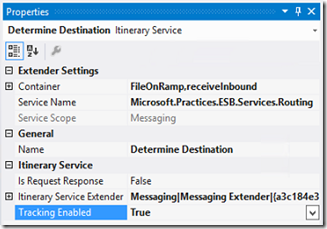
- Enable tracking on your Itinerary shapes. This is as simple as setting the “Enable Tracking” property on each Itinerary Service in the Itinerary Designer to “True”.
Now you have some basic tracking information being collected for your Itinerary. However, there is no way out of the box to view this tracking data other than the BAM Portaluntil now. By simple adding a few components to the ESB Portal web application, and simply querying the BAMPrimaryImport and EsbItineraryDb databases, we can now see tracking information for our itineraries. Here is what the new pages look like (at least these early “beta” versions):
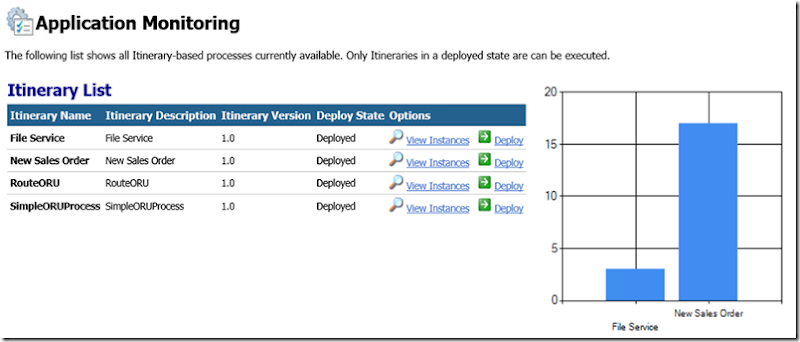
List of Itineraries
This is a list of all the Itineraries in the EsbItineraryDb, providing a simple inventory of my itinerary-based processes. The chart just shows what is possible in terms of easy reporting
View of Instances for a selected Itinerary Type
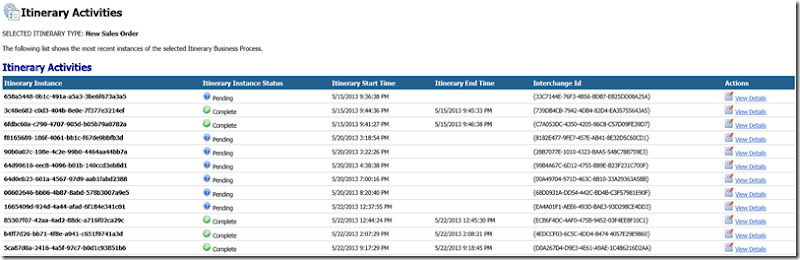
Details of each step of a selected Itinerary Instance

Notice the links here for each step. We can drill down even further to view any Tracked Messages in DTA, as well as view the Fault (something we already have with the portal out of the box). Here you can see I’ve enabled DTA tracking for just the after-port-processing message:
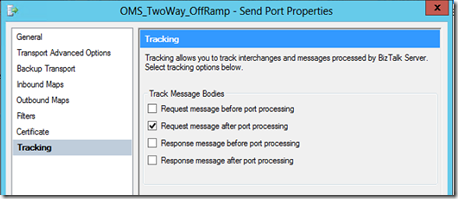
and I get a message body in the ESB Portal for that one message.
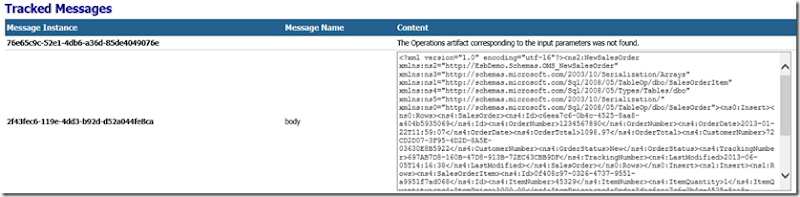
The great thing about this is that no changes are necessary to accommodate new itineraries. Just enable tracking on your Itinerary Services before you deploy, and it will automatically show up.
SSO Application Configuration Management
I’m sure more than a few of us have used SSO as a configuration store for BizTalk solutions. I grew increasingly annoyed that I had to use a separate tool to manage those key-value pairs, not to mention that the tools available didn’t work very well. So, I also added SSO Configuration management to this modified ESB Portal. Very simple and straightforward, but being able to do all of this in one place I feel is a big value-add. One note on this functionality was the creation of a SSO WCF service to give the portal access to the configuration data in the SSO database. This service not only make these portal pages possible, but provide a way for non-BizTalk applications to use SSO as a configuration store without a requirement to execute on a BizTalk Server or a server licensed to run SSO dll’s.
View SSO Configuration Applications
Notice how only my custom SSO configurations show upanything native to BizTalk is filtered out.

View/Edit SSO Configuration Application

Obviously I’ve got some clean-up work to do on the UIbeing a BizTalk-person, my front-end skills are rusty to say the least! I hope this gives you some ideas on what is possible when you combine the power of Itinerary-based processing using the ESB Toolkit with some enhancements to the ESB Portal.
Cheers,
Dan
by community-syndication | Jun 4, 2013 | BizTalk Community Blogs via Syndication
Unexpected high traffic and high demand causes Myers website to fail..
These stories are becoming more and more common place in todays world and the interesting
thing is, that we have solutions available to this exact problem in place for several
years.
Cloud – Azure – elastic scale, on-demand etc.
The secret is how do we go from on premise #fail to a hybrid blend
scenario where we can use the best of both worlds – that is what we’ve been doing
for years.
Read more here – http://www.breeze.net/news/breezetalk/traffic-causes-myer-stocktake-fail-let%27s-talk-cloud.aspx
Blog Post by: Mick Badran
by community-syndication | Jun 4, 2013 | BizTalk Community Blogs via Syndication
Introduction
Earlier today we announced the public preview of our Windows Azure BizTalk Service (WABS). We have collaborated with multiple partners and customers to build a simple, powerful and extensible cloud-based integration service that provides Business-to-Business (B2B) and Enterprise Application Integration (EAI) capabilities for delivering cloud and hybrid integration solutions. The service runs on a secure, dedicated per tenant environment that you can provision on demand, while it is being managed and operated by Microsoft.
Let’s look at a brief overview of our B2B offering in WABS.
B2B in WABS
To be successful as a business, enterprises must effectively manage data exchanged with other organizations such as vendors and business partners. Data received from partner organizations is often categorized as business-to-business (B2B) data transfer. One of the standard and most commonly used suite of protocols for B2B data transfer is Electronic Data Interchange or EDI.
Some of the challenges that customers face while opting for a B2B solution are:
- Total cost of ownership (TCO) for setting up a B2B solution, especially for the small and medium business (SMB) shops
- High maintenance cost for the B2B solutions including onboarding partners, managing agreements, etc.
Using B2B in WABS enables customers to:
- Lower their TCO with the pay-as-you-use model.
- Easily manage and onboard trading partners using the BizTalk Services Portal. With the BizTalk Services Portal, customers will be able to cut down the on-boarding time from weeks to days.
- Leverage Microsoft hosted B2B pipelines as services to exchange B2B documents and run them at scale for customers. This minimizes overhead in managing B2B pipelines and their corresponding scale issues with dedicated servers.
The WABS B2B solution, which comprises of the BizTalk Services Portal and B2B pipelines, enables customers to add trading partners and configure B2B pipelines that can be deployed to WABS. The trading partners will then be able to send EDI messages using Http, AS2, and FTP transports. Once the message is received, it will be processed by the B2B pipeline deployed on the cloud and will be routed to the destination configured in the B2B pipeline.
Feature outline and overview
B2B in WABS provides a multitude of features with the goal of making it Simple, Powerful and Extensible at the same time. To fulfill business needs, Service Providers need to model, store, and manage information about:
Partners and their businesses
Rules of engagement with the partners, which include details such as message encoding protocol (EDI standards like X12), transport protocol (AS2), etc.
Let us review some of these and how WABS B2B helps solve this.
Partners
Each participating organization in a business relationship is a trading partner. A trading partner is at the root level and forms the base for a trading partner solution. A trading partner is one of the two or more participants in an ongoing business relationship.
Using the Windows Azure BizTalk Portal, one can easily set up partners representing all the organizations involved in a business trade. Each partner has an associated profile with it which can be updated as per business need. Multiple profiles may be created representing the different divisions of the organization.
Agreements
A Trading Partner Agreement (TPA) is defined as a definitive and binding agreement between two trading partners for transacting messages over a specific B2B protocol. It is a comprehensive collection of all aspects governing the business transaction between the two trading partners.
The Windows Azure BizTalk Portal allows easy setting up of agreements between Trading Partners. Using the profiles created for Partners, one can very easily and quickly come up with templates for settings up agreements while reducing configuration errors.
Artifacts
WABS portal allows one to manage the artifacts used for B2B operations. There are currently 4 kinds of artifacts supported – schemas, maps, certificates and assemblies. The portal allows users to upload and delete artifacts related to the partner agreements easily.
You are also able to manage the bridges created as part of the agreement deployments.
Tracking
WABS provides the ability to monitor EDI and AS2 messages, batches, and bridges deployed in an Azure BizTalk Services subscription. The tracking information helps you in the following ways:
- · Helps troubleshoot message processing issues.
- · Provides specific details of a message’s properties
- · Creates copies of messages
- · Helps determine the flow of events when a message is being processing
You must enable tracking as part of an agreement before you can view tracking data
Extensibility
The Windows Azure BizTalk Services Portal offers a rich user experience to create and manage partners and agreements for business-to-business messaging. However, at times you need to programmatically create the different entities that are part of BizTalk Services Portal. Windows Azure BizTalk Services offers a WCF Data Service-based object model to programmatically create and maintain different entities such as partners, agreement, etc. for the BizTalk Services Portal.
Along with this, Powershell Cmdlets are exposed for activities like creating artifacts, deleting artifacts, Start/Stop source, etc. to provide users with rich automation & scripting capabilities. These Powershell Cmdlets will be captured in more detail in an additional blog. The documentation has more information about these as well.
Important links
Please refer to the below links for more information.
Keep a lookout for more blogs in the near future explaining more of WABS capabilities. We hope that the community will continue to invest in WABS as we have and drive its evolution.
Blog Post by: BizTalk Blog
by community-syndication | Jun 4, 2013 | BizTalk Community Blogs via Syndication
Introduction
Earlier today we announced the public preview of our Windows Azure BizTalk Service (WABS). We have collaborated with multiple partners and customers to build a simple, powerful and extensible cloud-based integration service that provides Business-to-Business (B2B) and Enterprise Application Integration (EAI) capabilities for delivering cloud and hybrid integration solutions. The service runs on a secure, dedicated per tenant environment that you can provision on demand, while it is being managed and operated by Microsoft.
Let’s look at a brief overview of our EAI offering in WABS.
EAI in WABS
One of the core requirements for WABS is to bridge the message and transport protocol mismatch between two disparate systems. In cloud parlance, we should think of each system on the cloud as an endpoint. A message exchange between these two endpoints (which are either extensions of on-premises applications or representing an application running on the cloud) happens through Service Bus. Service Bus being a purely relay service, just passes on the message originating from one endpoint to another. However, given that the two systems are disparate and probably follow different messaging format and protocols, it becomes imperative that the Service Bus provides rich processing capabilities between the two endpoints. The processing capabilities could include the following:
- · The ability to connect systems following different transport protocols
- · The ability to validate the message originating from the source endpoint against a standard schema
- · The ability to transform the message as required by destination endpoints
- · The ability to enrich the message and extract specified properties from the message. The extracted properties can then be used to route the message to a destination or an intermediary endpoint.
These capabilities are made available through EAI on WABS. WABS Services provides these capabilities as different stages of a ‘message processing bridge’. Each of these stages can be configured as part of the bridge. Let’s overview some of these capabilities.
Feature outline and overview
Bridges
Conceptually, a bridge is a single message processing unit composed of 3 parts – sources, pipelines & destinations. This is the basic building block to design ones integration platform.
Pipelines are message mediation patterns. Message mediation, as the name implies, is an intermediate processing stage of the message as it travels from the originating to the final destination. Mediating the message might involve decoding the message, inspecting the message, transforming the message, validating the message, routing the message, enriching the message, etc. In a stricter sense with respect to WABS, bridges offer one kind of message mediation, which is to bridge message-related mismatches in scenarios where the origin and the destination of the message are heterogeneous but are still part of a message flow. Following are certain characteristics of bridges provided as part of Windows Azure BizTalk Services.
Pipelines are composed of stages and activities where each stage is a message processing unit in itself.
Each stage of a pipeline is atomic, which means either a message completes a stage or not. A stage can be turned on or off, indicating whether to process a message or simply let it pass through.
WABS also provides a rich set of sources and destinations to build ones message interchange platform along with the flexibility of configuring different types of pipelines.
VS Design Experience
WABS EAI provides connectivity to different protocols and applications, and provide message-processing capabilities such as validation, transformation, extraction, and enrichment on the cloud. However, neither of these can be used in isolation and ‘tie up’ with other entities on the cloud like topics, queues, etc. to provide an end-to-end message flow. For example, you could have a scenario where the a client sends a request message that needs to be processed on the cloud, routed to a queue, and then eventually inserted into a SQL Server database. To configure this scenario, you need to use an XML bridge, a Service Bus queue, followed by BizTalk Adapter Service in a sequence. This presents a need for a design surface where you could stitch different components of a message flow together. Azure BizTalk Services provides a design surface called BizTalk Service project that helps you achieve this. The BizTalk Service project design surface is available as a Visual Studio project type and is installed with Azure BizTalk Services SDK.
The project provides a friendly tool-box from which one can drag and drop pipelines, sources, destinations including LOB entities. It allows for easy configuration of all involved entities and once done, also allows deploying this solution into your WABS service. You can also upload artifacts required by your project.
Flat file/XML file support
Flat file message transfer is a key requirement in real world Azure BizTalk Services scenarios. Many enterprise applications receive flat file messages from client applications, such as SAP IDOCs. To enable flat-file processing over the cloud, you can use bridges available as part of Azure BizTalk Services.
Similar to flat files, EAI also supports XML file processing. XML is more of a standard message format and easy to work with.
Custom code
While the fixed pattern of bridges (Validate, Enrich, Transform, and Enrich) provided with Azure BizTalk Services serves the requirements of many integration scenarios, sometimes you need to include custom processing as part of your bridge configuration. For example, you might want to convert a message from a flat-file or an XML format to other popular formats, such as XLS or PDF before sending the message out. Similarly, at each stage of message processing, you might want to archive the message to a central data store. In such cases, the fixed pattern of the out-of-box bridges becomes insufficient. Hence, to enable such scenarios, bridges include the option of executing custom code at some key stages of the bridge.
Tracking
Within a bridge, a message undergoes processing under various stages and can be routed to configured endpoints. Specific details of the message such as transport properties, message properties, etc. need to be tracked and queried separately by the bridge developers to keep a track of message processing. Additionally, while a message is being processed by the bridge, there can be failures of many types. These failures must be propagated back to the bridge developers/administrators or the message sending client so that appropriate actions can be taken to fix these errors.
Bridges now provide support for tracking the messages thereby enabling the bridge developer and message sending clients to track message properties defined during the bridge configuration. You can configure the bridge to track the messages using options available from the Bridge Configuration surface.
Important Links
Please refer to the below links for more information.
Keep a lookout for more blogs in the near future explaining more of WABS capabilities. We hope that the community will continue to invest in WABS as we have and drive its evolution.
Blog Post by: BizTalk Blog
by community-syndication | Jun 4, 2013 | BizTalk Community Blogs via Syndication
Today we are proudly announcing the preview release of Windows Azure BizTalk Services (WABS). We have collaborated with multiple partners and customers to build a simple, powerful and extensible cloud-based integration service that provides Business-to-Business (B2B) and Enterprise Application Integration (EAI) capabilities for delivering cloud and hybrid integration solutions. The service runs on a secure, dedicated per tenant environment that you can provision on demand, while it is being managed and operated by Microsoft.
Using the different offerings from Windows Azure users can create applications that run on the cloud. However, given the fact that these applications operate in their own ‘space’ on the cloud but at the same time need to interact with other on-premise or cloud applications, there is a need to bridge the message and transport protocol mismatch between these disparate applications. Bridging these mismatches is the realm of integration. There can be different forms of integration.
EAI
WABS provides rich EAI capabilities in providing config driven design tools to bridge the message and transport protocol mismatch between two disparate systems. To name just a few of WABS EAI capabilities:
- The ability to connect systems following different transport protocols
- The ability to validate the message originating from the source endpoint against a standard schema
- The ability to transform the message as required by destination endpoints
- The ability to enrich the message and extract specified properties from the message. The extracted properties can then be used to route the message to a destination or an intermediary endpoint.
- The ability to track messages.
B2B
The WABS B2B solution, which comprises of the BizTalk Services Portal and B2B pipelines, enables customers to add trading partners and configure B2B pipelines that can be deployed to WABS. The trading partners will then be able to send EDI messages using HTTP, AS2, and FTP transports. Once the message is received, it will be processed by the B2B pipeline deployed on the cloud and will be routed to the destination configured in the B2B pipeline. Few of the WABS EDI capabilities are:
- Easily manage and onboard trading partners using the BizTalk Services Portal. With the BizTalk Services Portal, customers will be able to cut down the on-boarding time from weeks to days.
- Leverage Microsoft hosted B2B pipelines as services to exchange B2B documents and run them at scale for customers. This minimizes overhead in managing B2B pipelines and their corresponding scale issues with dedicated servers.
- Ability to track messages.
Getting Started
Follow this link to get started with provisioning your own BizTalk Service. You will need a Windows Azure account. If you do not have one, you can sign up for a no-obligation Free Trial.
Important Links
Please refer to the below links for more information.
Keep a lookout for more blogs in the near future explaining more of WABS capabilities. We are extremely excited by the opportunities that WABS is going to open up and hope that the community will continue to invest in WABS as we have, driving its evolution.
Blog Post by: BizTalk Blog
by community-syndication | Jun 3, 2013 | BizTalk Community Blogs via Syndication
Previously known as Azure EAI EDI Labs, the public preview launched today. I am especially excited about the EDI B2B solution in this new Platform as a Service (PaaS) offering.
Some of the tutorial links on Microsoft’s website are still being sorted out, but you can start with the Windows Azure BizTalk Services SDK here: […]
Blog Post by: Stan Kennedy



