by community-syndication | Nov 22, 2010 | BizTalk Community Blogs via Syndication
Earlier this year I blogged about some Web Camp events that Microsoft is sponsoring around the world. These training events provide a great way to learn about a variety of technologies including ASP.NET 4, ASP.NET MVC, VS 2010, Web Matrix, Silverlight, and IE9. The events are free and the feedback from people attending them has been great.
A bunch of additional Web Camp events are coming up in the months ahead. You can find our more about the events and register to attend them for free here.
Below is a snapshot of the upcoming schedule as of today:
One Day Events
One day events focus on teaching you how to build websites using ASP.NET MVC, WebMatrix, OData and more, and include presentations & hands on development. They will be available in 30 countries worldwide. Below are the current known dates with links to register to attend them for free:
| City |
Country |
Date |
Technology |
Registration Link |
| Bangalore |
India |
16-Nov-10 |
ASP.NET MVC |
Already Happened |
| Paris |
France |
25-Nov-10 |
TBA |
Register Here |
| Bad Homburg |
Germany |
30-Nov-10 |
ASP.NET MVC |
Register Here |
| Bogota |
Colombia |
30-Nov-10 |
Multiple |
Register Here |
| Chennai |
India |
1-Dec-10 |
ASP.NET MVC |
Register Here |
| Seoul |
Korea |
2-Dec-10 |
Web Matrix |
Coming Soon |
| Pune |
India |
3-Dec-10 |
ASP.NET MVC |
Register Here |
| Moulineaux |
France |
8-Dec-10 |
TBA |
Register Here |
| Sarajevo |
Bosnia and Herzegovina |
10-Dec-10 |
ASP.NET MVC |
Register Here |
| Toronto |
Canada |
11-Dec-10 |
ASP.NET MVC |
Register Here |
| Bad Homburg |
Germany |
16-Dec-10 |
ASP.NET MVC |
Register Here |
| Moulineaux |
France |
11-Jan-11 |
TBA |
Register Here |
| Cape Town |
South Africa |
22-Jan-11 |
Web Matrix |
Coming Soon |
| Johannesburg |
South Africa |
29-Jan-11 |
Web Matrix |
Coming Soon |
| Tunis |
Tunisia |
1-Feb-11 |
ASP.Net MVC |
Register Here |
| Cape Town |
South Africa |
12-Feb-11 |
ASP.Net MVC |
Coming Soon |
| San Francisco, CA |
USA-West |
18-Feb-11 |
ASP.NET MVC |
Coming Soon |
| Johannesburg |
South Africa |
19-Feb-11 |
ASP.Net MVC |
Coming Soon |
| Redmond, WA |
USA-West |
18-Mar-11 |
Odata |
Coming Soon |
| Munich |
Germany |
31-Mar-11 |
Web Matrix |
Register Here |
| Moulineaux |
France |
5-Apr-11 |
TBA |
Register Here |
| Moulineaux |
France |
17-May-11 |
TBA |
Register Here |
| Irvine, CA |
USA-West |
10-Jun-11 |
ASP.NET MVC |
Coming Soon |
| Moulineaux |
France |
14-Jun-11 |
TBA |
Register Here |
Two Day Events
Two day Web Camps go into even more depth. These events will cover ASP.NET, ASP.NET MVC, WebMatrix and OData, and will have presentations on day 1 with hands on development on day 2. Below are the current dates for the events:
| City |
Country |
Date |
Presenters |
Registration Link |
| Hyderabad |
India |
18-Nov-10 |
James Senior &
Jon Galloway |
Already Happened |
| Amsterdam |
Netherlands |
20-Jan-11 |
James Senior &
Scott Hanselman |
Coming Soon |
| Paris |
France |
25-Jan-11 |
James Senior &
Scott Hanselman |
Coming Soon |
| Austin, TX |
USA |
7-Mar-11 |
James Senior &
Scott Hanselman |
Coming Soon |
| Buenos Aires |
Argentina |
14-Mar-11 |
James Senior &
Phil Haack |
Coming Soon |
| S%u00e3o Paulo |
Brazil |
18-Mar-11 |
James Senior &
Phil Haack |
Coming Soon |
| Silicon Valley |
USA |
6-May-11 |
James Senior &
Doris Chen |
Coming Soon |
More Details
You can find the latest details and registration information about upcoming Web Camp events here.
Hope this helps,
Scott
by community-syndication | Nov 21, 2010 | BizTalk Community Blogs via Syndication
We are a little slow getting invitations out and details published, but there are two Windows Azure events coming up in San Diego in the next couple of weeks:
- On Sat December 4th, we will be hosting our second all-day Azure event
- Prior to that, this Tuesday, I will be doing a “pre-conference” event at the main user group meeting, description below
The Tuesday meeting will be at the Intuit campus, details at http://sandiegodotnet.com. Registration for the conference will be available there shortly.
=============================
Windows Azure Pre-con
Cloud technologies are transformational, and one of those rare paradigm shifts that we don’t see often. The Windows Azure platform represents a tremendous investment by Microsoft, one that developers can benefit from today. Some of the results of those investments are live today, and you can use them to enable solutions that previously would have been impossible or prohibitively expensive to create.
The San Diego .NET user group is committed to our mission of bringing you the knowledge you need on current and emerging technologies, and as such will be hosting our second Azure conference on Saturday December 4th (invitations/details in the next couple of days). The conference will cover a variety of topics, and will dive relatively deeply into architecture and development (covering architecture, data, migration, green-field and more).
To ensure our members get maximum benefit our of the conference content, Brian Loesgen, an architect evangelist with the Microsoft ISV team, will be doing a pre-conference meeting to help our members ramp up on, and get current with, the Azure platform.
This session will provide:
- Windows Azure, technical overview, covering all the components in the Azure platform
- Windows Azure tooling: the developer experience (demo, demo, demo)
- PDC 2010 Azure update: what’s new? What changed? What’s coming?

by community-syndication | Nov 21, 2010 | BizTalk Community Blogs via Syndication
I am delighted to announce “BizTalk Mapper Extensions UtilityPack”. This is my first contribution in CodePlex with a BizTalk Open Source project. Project Description BizTalk Mapper Extensions UtilityPack is a set of libraries with several useful functoids to include and use it in a map, which will provide an extension of BizTalk Mapper capabilities. Conversion […]

by community-syndication | Nov 20, 2010 | BizTalk Community Blogs via Syndication
My article on Windows Azure AppFabric has been published last month in Dutch TechNet Magazine. The October edition was a special around Cloud Computing. It is online now and can be read digitally (in Dutch).
by community-syndication | Nov 20, 2010 | BizTalk Community Blogs via Syndication
Ron Jacobs showed a number of really cool new workflow features we can be expecting in the next version of Windows Workflow Foundation during the last PDC in Redmond and Tech-Ed Europe in Berlin. One of the new features he demonstrated where the activities we can use to load data from a SQL server database into our workflow. Most of the new features are really cool but the database activities are not.
Why don’t I like the new database activities
With the new ExecuteSqlQuery<T> we are back to typing in a literal SQL string to be executed on the server and the related connection string directly into a workflow. Not only does this feel like stepping 5 years back in time, back to plain ADO.NET, it also means that we get no compile time checking or IntelliSense whatsoever. Given that a workflow should be a high level concept this seems pretty harsh.
These days most .NET developers have gotten used to, and expect, the power and beauty or LINQ with the related IntelliSense and compile time checking. The fact that we can’t do so in a workflow but have to revert back to basic ADO.NET as it was released with .NET 1.0 nearly 10 years ago feels bad.
What I do like
There are some good parts though. The fact that it uses plain old ADO.NET means it can use the asynchronous model of calling the database, something still very much missing from the Entity Framework today. Another benefit is we can use any ADO.NET provider out there. So no problems reading data from Access or Oracle here.
Conclusion
While the async IO and ADO.NET provider model are nice they don’t make up for the big step backwards by not giving us LINQ, IntelliSense and compile time validation of our queries. So I am afraid I have to give this a thumbs down [:(].
Enjoy
www.TheProblemSolver.nl
Wiki.WindowsWorkflowFoundation.eu
by community-syndication | Nov 20, 2010 | BizTalk Community Blogs via Syndication
Hi all
Just a quick post to provide the slides and the code from my latest presentation at
the Swedish BizTalk UserGroup. I talked about transactions, exception handling and
compensation.
Slides:
Code:
Thanks
—
eliasen

by community-syndication | Nov 19, 2010 | BizTalk Community Blogs via Syndication
Microsoft StreamInsight does not formally ship with any input or output adapters. That team stresses the ease of adapter development using their framework. It is easier to connect to StreamInsight with the new IEnumerable and IObservable support in the StreamInsight 1.1 release. All that said, it’s always easier to rely on previously-built adapters to either […]
by community-syndication | Nov 19, 2010 | BizTalk Community Blogs via Syndication
The BizTalk Adapter Pack 2010 provides connectivity to SAP, Oracle E-Business Suite, Siebel and SQL and Oracle Databases. The BizTalk Adapter Pack can be installed in conjunction with, or separately from, BizTalk Server.
The BizTalk Adapter Pack 2010 includes support for new versions of the following line-of-business applications and databases: SAP 7, Oracle EBS 12.1 and SQL Server 2008 R2. The Adapter Pack also provides support for Visual Studio 2010 and .NET Framework 4.
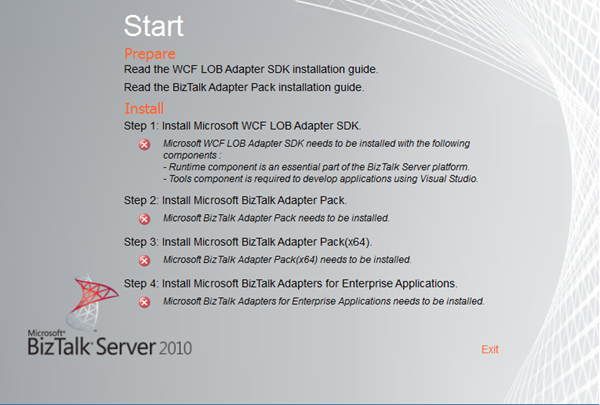
It is included in both the Enterprise and Standard Editions of BizTalk. When you install the adapter pack on x64 environment you have to perform a few steps. These steps were described in earlier versions through installation guides, although for some it was not always clear (i.e. I saw couple of questions on forum about how to install or problems people had). There is documentation to install adapters pack, but now during installation one is guided through the necessary steps.
This is a definite improvement towards installing Adapter Pack on for instance x64 environment as shown on the screenshot above. So first step is installing WCF LOB Adapter SDK and by clicking on the first step an installer of SDK is launched.

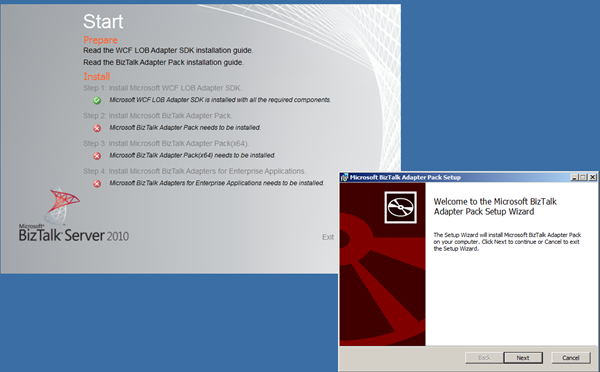
By clicking next and selecting one of installation options the SDK is installed. After installation you will see that first step is completed in the overall process. Second step is installation of the Adapter Pack (x86). By clicking Microsoft BizTalk Adapter Pack needs to be installed an installer is launched again.
After installation of this pack the screen is updated again stating second step is completed successfully.
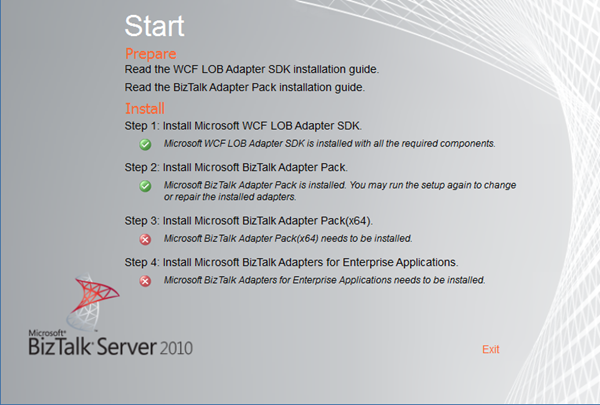
You will sometime see windows update screen or screen with question if you want to join the improvement program. Next step is installing the Microsoft BizTalk Adapter Pack(x64). Before installing this pack you have to install x86 first, which is overlooked a lot of times in past by people. Can’t happen having guidance.

Having installed the x64 Adapter Pack the final step can be performed.
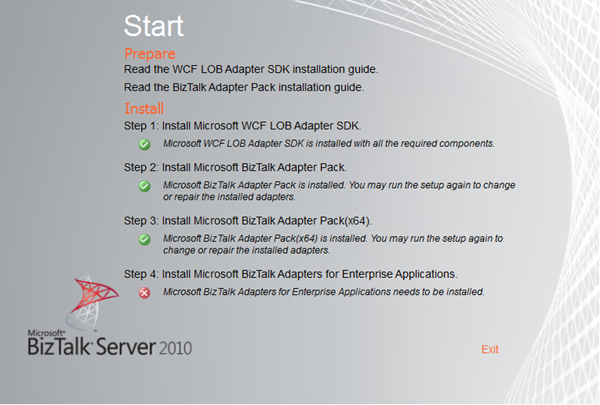
By clicking on Install Microsoft BizTalk Adapters for Enterprise Applications an installer is launched.
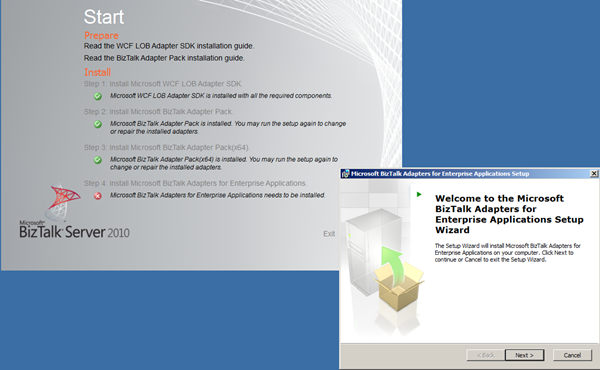
As this installation has been successfully completed the process of installing the LOB Adapters is complete.
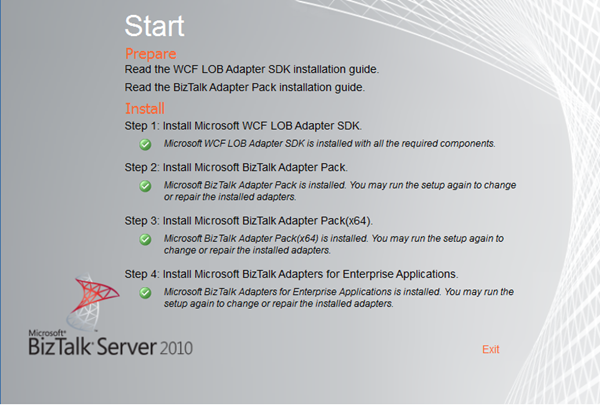
I recommend to always choose complete installation of SDK, Adapter Packs and Microsoft BizTalk Adapters for Enterprise Applications.You the have documentation at you disposal. Going through this process you now have full set of adapters ranging from new WCF Adapters to old (non-WCF) Adapters. Next step is adding the appropriate adapters in BizTalk Administration Console.
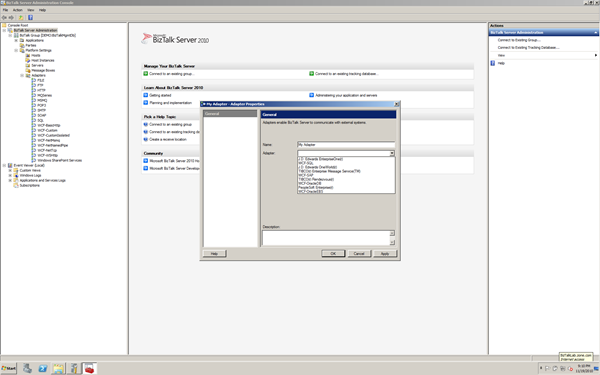
You have to go navigate to Platform Settings -> Adapters and then right click New -> Adapter.
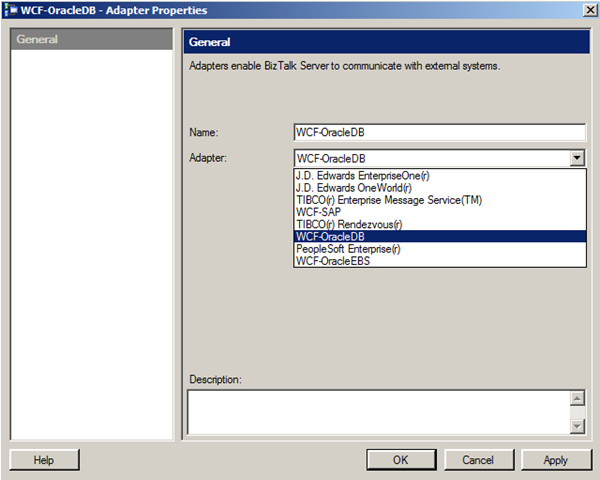
Note: When installing the adapter pack you do not see a new adapter show up under the Adapters folder or in the drop down for Add new Adapter. The adapter pack installs new custom bindings.The BizTalk “adapter” for instance for the Oracle database shows up in BizTalk as the OracleDBBinding. The standard bindings are wsHttpBinding, netTcpBinding, etc. OracleDbBinding and SqlBinding are themselves custom bindings. (Ben Cline explained this on forum few weeks ago).
You can also download the interactive or normal poster of BizTalk Adapter 2010. The BizTalk Adapter Pack is included with BizTalk Server 2010 and you can download the BizTalk Server 2010 Evaluation if you want to try it out.
When completing this process you also have installed all the prerequisites for AppFabric Connect. When starting a WCF Workflow Service you will see BizTalk Mapper.
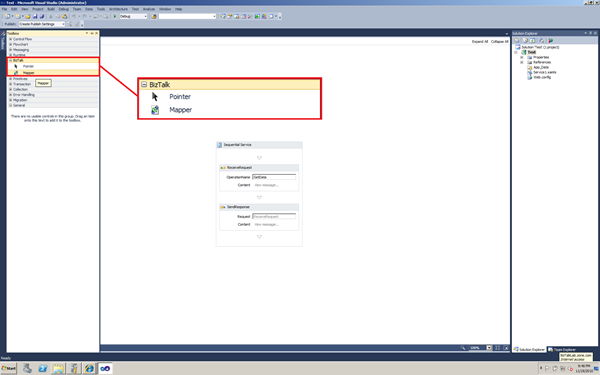
On AppFabric connect see also Thiago post: Microsoft AppFabric Connect in BizTalk 2010 – licensing and installation, what’s the deal?
Technorati: biztalk biztalk server 2010 biztalk server adapter pack 2010
by community-syndication | Nov 18, 2010 | BizTalk Community Blogs via Syndication
In addition to blogging about BizTalk, I have decided to start blogging about Windows Phone 7. Therefore, I have created a new blog to focus on WP7 and will continue to blog about BizTalk here.
I recently had my first WP7 App published in the marketplace. The app is called BizTweet and may be found in the Social category. The purpose of the application is to aggregate information related to BizTalk and AppFabric. So if you have a WP7 and are interested in BizTalk and/or AppFabric then I encourage you to check it out.
For more details, check out the BizTweet blog post.
by community-syndication | Nov 18, 2010 | BizTalk Community Blogs via Syndication
Summary for the Service Provider IT Professionals / Procurement Officers who are desperately late for a meeting and spilling coffee as they run down the hall… There are some pricing changes for Windows Server in SPLA that take effect January 1st. This does not affect the pricing in the other volume licensing programs. If you don’t know what SPLA is, stop reading and pick up the pace. If SPLA is important to you, here’s the info:
|
SKU
|
% Change
|
|
Windows Server 2008 R2 Web
|
– 21%
|
|
Windows Server 2008 R2 Standard
|
– 21%
|
|
Windows Server 2008 R2 Enterprise
|
– 21%
|
|
Windows Server 2008 R2 Datacenter
|
+30%
|
The rest of the story…
The three most important assets in a software company are people, intellectual property and price integrity. The third one might stand out as an odd item on the list but it is far more critical than most people would think. Far too many software companies take what I call a “cash-ectomy” approach to selling. Loosely defined, a “cash-ectomy” is the removal of as much cash as possible from a customer regardless of the volume of the sale. That approach rarely works for very long as customers compare notes and quickly realize that the price they paid was far more correlated to their budget than it was to their volume.
Microsoft takes a different approach. Our prices reflect what we charge. We don’t uplift by 50% so those brave enough to ask feel like they are getting a “deal”. Going a step further, we attempt to normalize the Microsoft server product portfolio prices between channels to help reduce conflict and drive consistency. On January 1st, 2011, changes in SPLA pricing will take effect which to better align SPLA prices with subscription prices. For the most part, SPLA prices drop 21%. The one exception is Windows Server 2008 R2 Datacenter which has unlimited virtualization rights. That product increases by 30% over the current price, this only applies to the SPLA program, not other volume licensing agreements.
Why is the price of Windows Server 2008 DataCenter (WS DC) for SPLA providers going up? Truth be told, it’s going down. That’s not PR spin or some hocus-pocus math factoring Moore’s Law. The current price for SPLA on WS DC is a limited promotional price. The original announced price was almost double. MSFT deferred the implementation of the full price in 2009 and again in 2010. As we have moved closer to January 1, 2011, feedback on the implementation of the full price was as consistent as it was intense. That feedback compelled us to look at the non-promotional WS DC price again.
After a lot of math, a lot of feedback, and more math, we made a decision to lower the January 1st price on DC. Specifically, instead of retiring the promotional price and doubling the price, we have landed on a much more modest increase of 30% which we think will be welcome news to our service provider partners when considering the original plan.
Here are some plain-English answers to some likely questions…
Q1 – “The new DC price point makes sense for newer hardware where I can achieve greater VM density. What about my older hardware?”
The decrease in Windows Server EE should be a welcome surprise for older hardware. For hardware that only practically supports 4 or less instances, EE may be a more economical option.
Q2 – “Why raise the DC price at all?”
As mentioned above, the current price is a promotional price (note that the price of DC in the current model is less than EE). The January 1st change is 34% less than what was planned. More importantly, since the DC sku was launched, server capacity in terms of cores has doubled, significantly increasing the performance value.
Q3 – “Is the new price a promotional price?”
No.
Q4 – “What will this translate to in terms of the price I pay my Service Provider?”
Since the introduction of this sku, cores per proc have doubled spreading the cost over twice the capacity. That said, each service provider sets their own price based on their goals for revenue and share.



