by community-syndication | Jul 9, 2008 | BizTalk Community Blogs via Syndication
Thanks to those of you that attended my web cast today. Here is the link to a book that has coverage of .NET 3.5 – http://www.amazon.com/Essential-Windows-Communication-Foundation-WCF/dp/0321440064/ref=pd_bbs_sr_3?ie=UTF8&s=books&qid=1215632437&sr=8-3
For learning about WF – here is the MSDN WF developer center – which is a good place
to start for info about WF – http://msdn.microsoft.com/en-us/netframework/aa663322.aspx
And here is the code that I used today –
WCFWFWebCast.zip
(273.37 KB)
Thanks again to the all attendees!

Check out my BizTalk
R2 Training.
by community-syndication | Jul 9, 2008 | BizTalk Community Blogs via Syndication
For those of you that still live in the wonderful world of BizTalk 2004 and use the EnlistOrch.vbs script, I noticed today that it will always use the default Host when starting, which is a bit annoying when you have set another host during binding and are scripting your deployment…..
I’ve updated the script to accept […]
by community-syndication | Jul 9, 2008 | BizTalk Community Blogs via Syndication
Interesting information in KB:
“How to use distinguished fields and promoted properties in a BizTalk Server project” http://support.microsoft.com/kb/942250
“…
-
A promoted property may not be available as a promoted property after you write a value into the message context. This situation can occur if the value that you write into the message context has the same name and namespace that was used to promote the property.
-
Properties that have a null value are not permitted in the message context. Therefore, if a null value is written into the message context, this value will be deleted.
…”
BTW What is it “a null value”?
-
Is it <shipDate xsi:nil=”true”></shipDate> ?
-
Is it absence of the value <shipDate></shipDate> ?
-
Is it “closed tag <shipDate /> ?
-
Is it absence of the whole node?
And let me add one more, not obvious:
by community-syndication | Jul 9, 2008 | BizTalk Community Blogs via Syndication
I think this has been promoted enough but, in case you haven’t seen it, this Friday I will be presenting my second WebCast as part of the .NET 3.5 influencer’s series . This time I am going to be talking about WCF extensibility. My goal is to cover as…(read more)

by community-syndication | Jul 9, 2008 | BizTalk Community Blogs via Syndication
Hello,
as you already noticed probably, I uploaded build 9.23.4
This build has an important change I think which can reduce signicantly the size of produced files (history.log,html and xml) : Indeed I keep now in this build only the name of Stored Procs found in the detailed report “Most CPU Queries (SQL 2K5 only)” instead of the entire sp text as it was before.
In this report, for each row returned, I determine so if it a Stored Procedure and in this case I keep only its name and remove the remaining part. I think knowing the sp name is enough in this report.
However, I keep the entire SQL query if SQL query is returned as statement instead of a stored proc
Let me know if you meet any problems with this change
thanks !
JP

by Richard | Jul 9, 2008 | BizTalk Community Blogs via Syndication
<br />
Gobbledygooks · Running MSBuild scripts from Visual Studio<br />
Jul 09, 2008
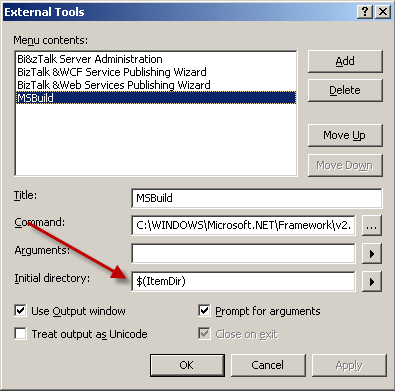
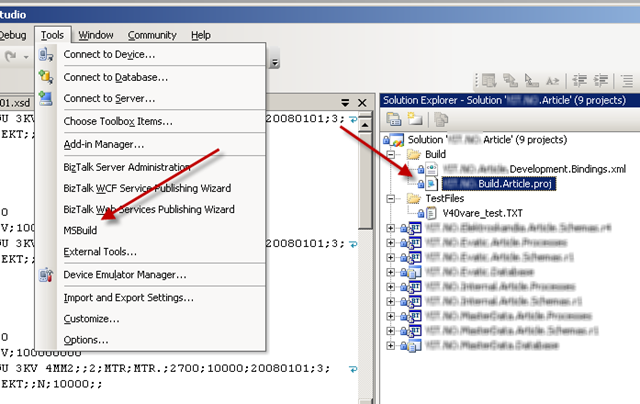
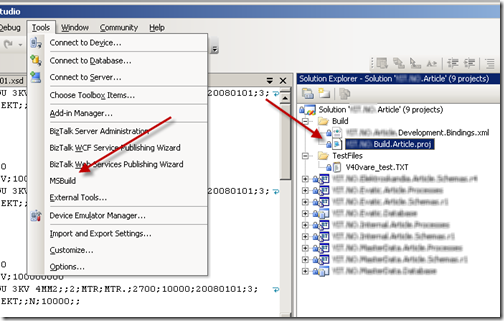
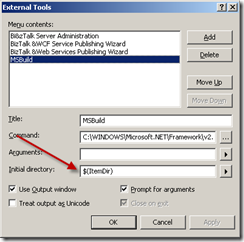 It seems like there more build script one writes, the more often one wants to run them and it’s always a bit annoying (and time consuming) having to leave Visual Studio and start MSBuild from the command line. Brennan Stehling has a cool solution to that problem here were he sets up MSBuild as an external tool and runs it.
One problem for us was the we had our solution files in one place on the file system and our build files in a totally different place. The solution was to add the build file for the current solution as a Solution Folder (as shown in the figure below) and then set MSBuild to use $(ItemDir) as its Initial Directory. That will kick of MSBuild from the directory that the current selected Solution Folder points to and in our case that’s were the XXX.Build.Article.proj file exists.
by community-syndication | Jul 9, 2008 | BizTalk Community Blogs via Syndication
It seems like there more build script one writes, the more often one wants to run them and it’s always a bit annoying (and time consuming) having to leave Visual Studio and start MSBuild from the command line. Brennan Stehling has a cool solution to that problem here were he sets up MSBuild as an […]

by Richard | Jul 9, 2008 | BizTalk Community Blogs via Syndication
 I’m really looking forward to the release of stackoverflow.com – have you heard about it? If not it’s a collaboration between Joel Spolsky and Jeff Atwood. Joel and Jeff are of course the two blogger behind the popular Joel on Software and Coding Horror blogs.
Joel is also one of the founders of the FogCreek Software company. FogCreek has a couple of different products but the most known is probably FogBugz which is a really cool project management/bug tracking/wiki/support tool for software development and management. At first it might not look like a very impressing tool but have a look at this presentation by Joel and I think you’ll start thinking different (I know we did and we’re now using it for both planing and managing big integrations projects).
Anyway, if you missed the story behind stackoverflow have a look here and don’t miss the podcasts that Joel and Jeff record, some of them are really cool. I know I’ve learnt a lot by just listening in to their conversations.
We not have quite a few online BizTalk communities such as the Microsoft forums, Google Groups, BizTalk Gurus, facebook (search for BizTalk related groups) and at LinkedIn (a couple of open BizTalk related groups) – is there room for another one at stackoverflow? Do we need one?
by community-syndication | Jul 8, 2008 | BizTalk Community Blogs via Syndication
I’m really looking forward to the release of stackoverflow.com – have you heard about it? If not it’s a collaboration between Joel Spolsky and Jeff Atwood. Joel and Jeff are of course the two blogger behind the popular Joel on Software and Coding Horror blogs.
Joel is also one of the founders of the FogCreek […]
by community-syndication | Jul 8, 2008 | BizTalk Community Blogs via Syndication
It’s been a long time since my last post. Since the last post a lot of things have happened. I took a new position as a Program Manager in the BizTalk Customer Advisory Team (CAT) in Redmond in April. I’ll be giving more details on my move and what my new team does in a later post.
The BizTalk CAT was previously known as BizTalk Rangers. The main project I’ve been working on recently has been the BizTalk Server Performance Optimizations Guide. We launched this on MSDN and Technet a few weeks ago and have had very positive feedback so far. I’ve included the launch mail below which will tell you more. I hope this is of use to you, if you have any feedback on the document please let me know!
Ewan
Launch Mail
The BizTalk Customer Advisory Team and BizTalk UE team are pleased to announce the first edition of the “Microsoft BizTalk Server Performance Optimization Guide”.
The Microsoft BizTalk Server Performance Optimization Guide is the second installment in a series of guides intended to provide easily accessible, hands-on guidance to our customer and partner community. This 228 page guide is available on MSDN, TechNet and as a separate DOCX or CHM download alongside the already available “Microsoft BizTalk Operations Guide”
The guide is based on real-world experience from BizTalk CAT (Rangers), Premier Field Engineering, MCS and other customer engagements. This guide is intended to provide regularly maintained prescriptive guidance & best practices on optimizing BizTalk Server performance for demanding production environments.
The key sections of the guide are:
Getting Started: Provides an overview of the BizTalk Server functional components that can affect performance. It also describes the phases of a BizTalk Server performance assessment.
Finding and Eliminating Bottlenecks: The Finding and Eliminating Bottlenecks section describes various types of performance bottlenecks as they relate to BizTalk Server solutions and information about how to resolve the bottlenecks.
Automating Testing: Describes how to implement an automated build process and how to automate functional and load testing using Visual Studio Team System, BizUnit and Loadgen.
Optimizing Performance: The Optimizing Performance section provides guidance for optimizing performance of specific components in a BizTalk Server environment
The target audience for this guide is Microsoft field, partner organizations, and customers who plan, deploy, and maintain mission critical BizTalk Server installations. The guide was created from the key learnings, processes and methodology that have been developed by the Rangers to effectively run Performance Labs for our customers.
The guide has been carefully reviewed and vetted by experts from the community of BizTalk Server, whom we gratefully acknowledge. We believe that the information presented here will help BizTalk Server users optimize their solutions
Full MSDN URL: http://msdn.microsoft.com/en-us/library/cc558617.aspx
Full TechNet URL: http://technet.microsoft.com/en-us/library/cc558617.aspx