by community-syndication | Apr 10, 2008 | BizTalk Community Blogs via Syndication
I have recently posted three WCF Adapter samples off the BizTalk Server Developer Center at http://msdn2.microsoft.com/en-us/biztalk/bb608378.aspx, Two samples were released today. The first one is of a WCF message intemediary where an incoming WCF message to BizTalk is dynamically channeled to the correct version of the the WCF service. The second one is shows custom message interception during BizTalk Server’s binding processing of an outgoing WCF message. The third sample was published in January and is an example of using pure WCF messaging with the WCF adapters.

by community-syndication | Apr 10, 2008 | BizTalk Community Blogs via Syndication
I’ll be teaching a one-day workshop on the SQL Server 2008 BI platform in Sydney and Brisbane in May. Check here for dates/details and to register if you’re interested.
https://www.local.microsoft.com.au/australia/events/register/home.aspx?levent=941039&linvitation


by community-syndication | Apr 10, 2008 | BizTalk Community Blogs via Syndication
I don’t usually post lists of links, but I’ve been reading all that has been coming out following the Google’s AppEngine announcement, and thought it would be a good idea to systematize these.
Bungee Labs – Next Generation Web Development Platform
an ambitious new on-demand, web-based development environment that enables developers to build and deploy web apps that utilize the large variety of APIs and web services out on the Internet
BungeeConnect
The Bungee Connect Platform-as-a-Service is a single environment for the development, testing, deployment and hosting of amazing web applications. Bungee Connect powers highly interactive user web applications built 80% faster and at a cost tied only to end user adoption
Google App Engine: Cloud Control to Major Tom
Google App Engine is similar to the Amazon Web Services stack, which rolled out at the end of 2006 and has since gone on to be utilised by many startups for their infrastructure needs. But it is not a set of standalone services like Amazon’s – which includes S3 for storage, EC2 for hosting and the SimpleDB database. Google App Engine is an end-to-end service and bundles everything into one package.
Red Dog: Microsoft’s Answer to App Engine and AWS?
Kip Kniskern over at the LiveSide blog spotted a Microsoft job advert that appears to give some insight into a cloud computing platform under development at Redmond that could compete with Google’s just released App Engine or Amazon’s suite of web services. The utility computing platform, codenamed "Red Dog" according to the job ad, is under development at Microsoft’s Cloud Infrastructure Services (CIS) team and aims to see a version one release within the "coming year." What little info is provided by the job posting is rather obscure, but there are a few juicy tidbits to be had.
Google’s App Engine: Aiming At Facebook, Not Amazon
If the Silicon Valley echo chamber wants to make up a competitor for AppEngine, its proper correlate (by a whisker) is Facebook’s F8 platform. If you must cram this new service into a pigeon hole, think of App Engine as the Facebook Platform for the grown-up web.
App Engine: Host Your Apps with Google
It’s about time that developers get access to Google’s platform! We’ve been hearing about Google’s server farms and development tools for years. After Amazon Web Services started doing so well we all knew it was just a matter of time (next will be Microsoft we can can safely assume). Though the obvious comparison is to AWS, they aren’t really the same beast. Amazon has released a set a disparate services that can be used to created a general computing platform. The services, though they work together, do not come bundled.
Linxter Internet Service Bus (ISB)
Linxter is an in-the-cloud, customizable communications infrastructure for distributed applications providing hyperconnective, secure, assured information delivery.
Google AppEngine
Google App Engine enables you to build web applications on the same scalable systems that power Google applications.
Red Dog: Yet another unannounced Microsoft cloud service
I believe Microsoft is working on a hosted app platform for developers, with BizTalk Services and SQL Server Data Services (SSDS) at its heart. In fact, I‘ve heard the codename “Zurich” attached to this Google-App-Engine competitor. But are Red Dog and Zurich one and the same? I think they are different, and all part of the big Microsoft services plan in the sky.
Google unlocks its data centers
Where’s Microsoft?
Food for thought.

by community-syndication | Apr 10, 2008 | BizTalk Community Blogs via Syndication
I’ve been teaching mostly WF and WCF lately, so I’m excited that in a couple of weeks (April 22) I’ll be getting a chance to teach our core BizTalk course again in the lovely city of Chicago. I’m excited because there is a lot of cool stuff for this particular open enrollment.
1) R2 – need I say more? I will. We will be using the latest bits to teach the core course from now on so you’ll be learning BizTalk Server fundamentals using the latest and greatest version. This is still a class for developers new to BizTalk, so if you have taken this class, you might be interested in the R2 features class that Jon is teaching in May and August.
2) Dual Monitors! Our crack sales team has negotiated dual monitors from the hardware vendor so you’ll be able to see the lab manual and Visual Studio each in full screen glory!
3) It’s in downtown Chicago right on Wacker Drive near all sorts of cool stuff for the evenings.
4) It’s BizTalk and we’ll cover all the three letter acronyms (TLA) BRE, BAM, WCF,WSE,ASMX (ok that’s four letters), CSV, HAT, PUB (actually a technical term, but maybe where we’ll be in the evenings as well), SUB, EAI, ESB, SOA. I could go on, but you get the picture.
5) As if all the above are not enough, we have some seats available and the course is in a week and half, so the sales guys are “ready to deal”. Actually, their just ready to cut you some discounts 🙂 , especially if you sign up two or three people together, but even if you are just signing up one developer. Talk to our fabulous sales team to get more information or register with a discount. Just tell them you read about it on my blog.
Hope to see you there, and once I get back from the class, I promise some more technical content. I’ve been working on some demos and samples that I’ll be posting over the next couple of months.
by community-syndication | Apr 10, 2008 | BizTalk Community Blogs via Syndication
In Truncating the BizTalkDTADb Database I discussed how to truncate the tracking database in BizTalk 2004. Over on the BizTalk Gurus forums, user nbusy wanted to do the same thing for BizTalk Server 2006 – he’s kindly allowed me to repost his instructions for the community on this blog:
0. Before start, ensure you have got […]

by community-syndication | Apr 10, 2008 | BizTalk Community Blogs via Syndication
Last night I delivered a presentation in a GASP meeting on cloud computing, social networking, impacts on architecture, development, and even society. A conceptual and high-level session, destined to dissect today’s trendy tendencies.
The information about the meeting is here (in Portuguese), and the slides are up at my skydrive.

by community-syndication | Apr 10, 2008 | BizTalk Community Blogs via Syndication
A few months ago we released an ASP.NET 3.5 Extensions Preview that contained a bunch of new features that will be shipping later this year (including ASP.NET AJAX Improvements, ASP.NET MVC, ASP.NET Silverlight Support, and ASP.NET Dynamic Data).
The ASP.NET Dynamic Data support within that preview provided a first look at a cool new feature that enables you to quickly build data driven web-sites that work against a LINQ to SQL or LINQ to Entities object model. ASP.NET Dynamic Data allows you to automatically render fully functional data entry and reporting pages that are dynamically constructed from your ORM data model meta-data. In addition to supporting a dynamic rendering mode, it also allows you to optionally override and customize any of the view templates using any HTML or code you want (given you full control of the experience).
ASP.NET Dynamic Data Preview
Today we released an updated ASP.NET Dynamic Data Preview. You can learn more about it and download it here.
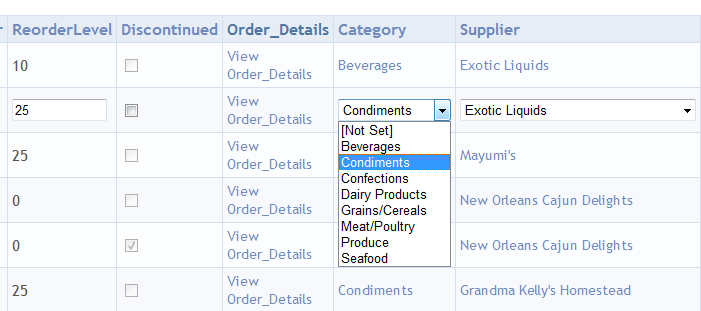
This new dynamic data preview now works with the standard built-in ASP.NET data controls (GridView, ListView, FormView, DetailsView, etc). The dynamic data support enables these controls to automatically handle foreign-key relationships. For example, on a gridview you’ll now get automatic friendly name display of foreign key column values and automatic drop-down list selection support of these values when in edit mode:
The new dynamic data support also provides automatic UI validation support (both client-side and server-side) based on the constraints you set on your data model classes. For example, if a column in the database is limited to 50 characters in size, and is marked as non-nullable, appropriate UI control validators will automatically be applied by ASP.NET dynamic data to enforce this constraint in the UI pages as well. If you change the constraints within your LINQ to SQL or LINQ to Entities data model classes, the UI will automatically pick up these changes and enforce the new constraints on the next web request.
In addition to standard data model metadata, you can also declare custom metadata to further control validation and the default display of UI of objects.
You will be able to use all of the above features with both LINQ to SQL and LINQ to Entities.
Visual Studio Dynamic Data Project Wizard
In addition to the core ASP.NET dynamic data runtime support, the VS web tools team today also shipped a first preview of a new dynamic data project wizard that enables you to quickly get a data driven web-site started. The wizard allows you to select a database, and then the tables, views and sprocs within it that you want to build a LINQ to SQL data model around:
After creating a data model, the wizard allows you to easily choose dynamic data driven template pages to build UI around it:
You can then choose what type of inserting/editing/updating UI is supported on each page:
And when you click finish it will setup a project with your data model classes and data UI pages setup to run. You can learn more about the wizard and watch it in action in a blog post and screencast here.
How to Get Started
You can learn more about this new dynamic data preview and download and run it locally here.
You can watch David Ebbo’s dynamic data presentation at MIX 08 to learn more about how it works. Also check out Scott Hunter’s screen-cast here, and Brad Millington’s screen cast here. David also has a post here that talks about the changes made between the December preview and today’s preview release.
You can ask questions and submit feedback via the www.asp.net forums here.
Hope this helps,
Scott
by community-syndication | Apr 10, 2008 | BizTalk Community Blogs via Syndication
A few months ago we released an ASP.NET 3.5 Extensions Preview that contained a bunch of new features that will be shipping later this year (including ASP.NET AJAX Improvements, ASP.NET MVC, ASP.NET Silverlight Support, and ASP.NET Dynamic Data).
The ASP.NET Dynamic Data support within that preview provided a first look at a cool new feature that enables you to quickly build data driven web-sites that work against a LINQ to SQL or LINQ to Entities object model. ASP.NET Dynamic Data allows you to automatically render fully functional data entry and reporting pages that are dynamically constructed from your ORM data model meta-data. In addition to supporting a dynamic rendering mode, it also allows you to optionally override and customize any of the view templates using any HTML or code you want (given you full control of the experience).
ASP.NET Dynamic Data Preview
Today we released an updated ASP.NET Dynamic Data Preview. You can learn more about it and download it here.
This new dynamic data preview now works with the standard built-in ASP.NET data controls (GridView, ListView, FormView, DetailsView, etc). The dynamic data support enables these controls to automatically handle foreign-key relationships. For example, on a gridview you’ll now get automatic friendly name display of foreign key column values and automatic drop-down list selection support of these values when in edit mode:
The new dynamic data support also provides automatic UI validation support (both client-side and server-side) based on the constraints you set on your data model classes. For example, if a column in the database is limited to 50 characters in size, and is marked as non-nullable, appropriate UI control validators will automatically be applied by ASP.NET dynamic data to enforce this constraint in the UI pages as well. If you change the constraints within your LINQ to SQL or LINQ to Entities data model classes, the UI will automatically pick up these changes and enforce the new constraints on the next web request.
In addition to standard data model metadata, you can also declare custom metadata to further control validation and the default display of UI of objects.
You will be able to use all of the above features with both LINQ to SQL and LINQ to Entities.
Visual Studio Dynamic Data Project Wizard
In addition to the core ASP.NET dynamic data runtime support, the VS web tools team today also shipped a first preview of a new dynamic data project wizard that enables you to quickly get a data driven web-site started. The wizard allows you to select a database, and then the tables, views and sprocs within it that you want to build a LINQ to SQL data model around:
After creating a data model, the wizard allows you to easily choose dynamic data driven template pages to build UI around it:
You can then choose what type of inserting/editing/updating UI is supported on each page:
And when you click finish it will setup a project with your data model classes and data UI pages setup to run. You can learn more about the wizard and watch it in action in a blog post and screencast here.
How to Get Started
You can learn more about this new dynamic data preview and download and run it locally here.
You can watch David Ebbo’s dynamic data presentation at MIX 08 to learn more about how it works. Also check out Scott Hunter’s screen-cast here, and Brad Millington’s screen cast here. David also has a post here that talks about the changes made between the December preview and today’s preview release.
You can ask questions and submit feedback via the www.asp.net forums here.
Hope this helps,
Scott
by community-syndication | Apr 9, 2008 | BizTalk Community Blogs via Syndication
Windows Embedded CE 6.0 R2 The April Quarterly Update for CE 6.0 R2 assists customers in implementing new features and using development tools for Windows Embedded CE. The April Quarterly Update highlights the following areas: A scenario for implementing…(read more)
by community-syndication | Apr 9, 2008 | BizTalk Community Blogs via Syndication
The evolution of Representational State Transfer (REST) as an Architecture style is having a strong influence in the way developers think about to accessing and exposing data. This influence is especially notable in Service Oriented (SOA) technologies…(read more)
